
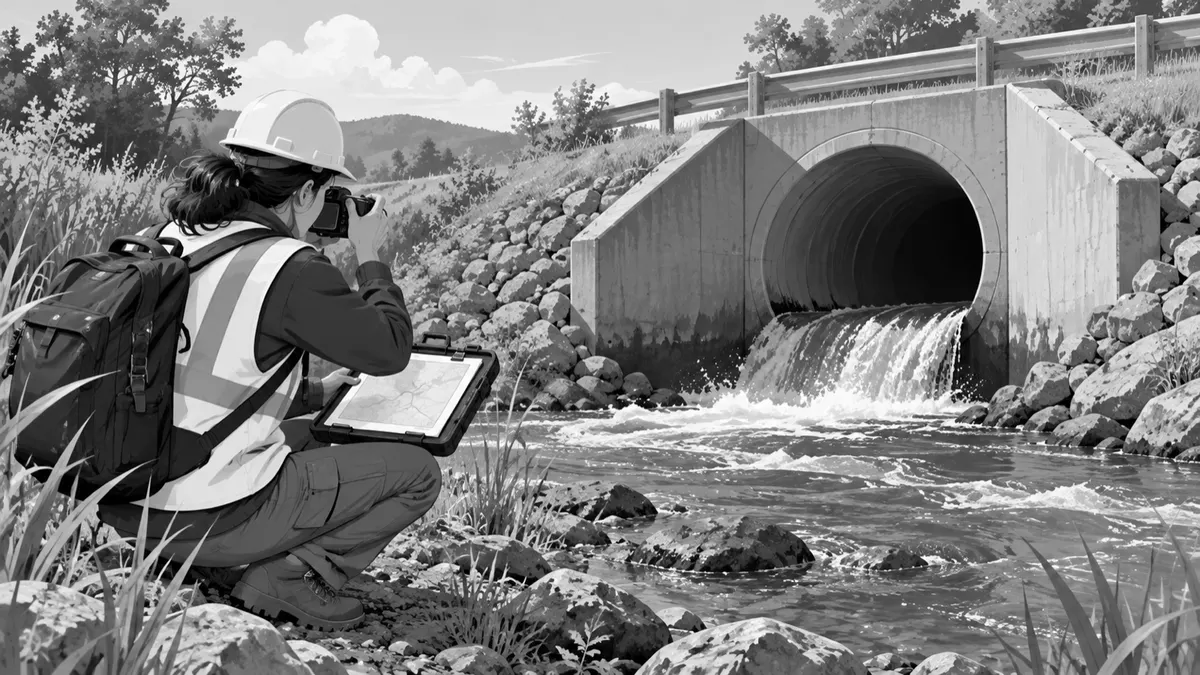
An illicit-discharge record should connect the first complaint to field evidence, follow-up, corrective action, and a documented closure decision for review.
Who This Affects
Illicit discharge investigation records affect municipal stormwater staff, public works departments, inspectors, code officials, wastewater utilities, emergency responders, contractors, and the people who receive reports from the public. A complaint may begin as a phone call about odor, color, sheen, foam, sediment, or unusual flow, but the response can involve several departments and more than one property.
For an MS4 program, the record is a practical bridge between a written procedure and day-to-day work. It helps staff see what was reported, where the concern was located, whether dry-weather flow was present, what sources were considered, and what happened after the first visit. It can also show where maps, asset data, ordinances, or response capacity need improvement.
The record does not need to prove that every report is a violation. It should capture a consistent investigation process and the evidence used to decide what happens next. Some reports may result in no observed discharge, a natural source, a permitted activity, a maintenance issue, or a referral to another authority. Clear documentation lets the program explain the decision without overstating what the field team knew.
The Stormwater Planning Issue
EPA's stormwater program describes municipal separate storm sewer systems as regulated sources that may need permits and stormwater management programs. MS4 programs commonly include procedures for illicit discharge detection and elimination, public reporting, mapping, investigation, and enforcement or corrective follow-up. Local and state requirements vary, so a municipality should use its permit, ordinance, and established response procedures as the controlling documents.
An investigation record should begin with intake. Capture the date and time, source of the report, contact information when available, location description, weather, observed symptoms, and photographs or attachments. Ask what the person saw, when it began, whether it is recurring, and whether it is entering a drain, ditch, stream, or other receiving water. Avoid rewriting a vague report into a definitive conclusion.
Location quality matters. A street address may not identify the correct outfall, inlet, drainage ditch, or private connection. Staff should record coordinates or a map reference, the nearest asset ID, direction of flow, and receiving water when known. If the location is uncertain, the record should say so and identify the step used to narrow it.
Field evidence should describe conditions rather than rely on labels. Note flow presence or absence, color, odor, sheen, turbidity, floatables, deposits, vegetation condition, staining, weather, recent rainfall, and nearby activities. Photographs should show the location and detail, with date and time captured when the system allows. If a sample is collected, document method, container, preservation, chain of custody, and laboratory handoff according to the program procedure.
The investigation should use the drainage network. Work upstream when practical, check connected inlets and outfalls, review nearby land uses, and compare the field condition to the GIS map. A single dry-weather observation may not identify an intermittent source. Revisit timing, recent rainfall, operational schedules, and staff interviews can help decide whether follow-up is appropriate.
Timing should be recorded carefully. A report received after rainfall may describe runoff that is difficult to distinguish from a dry-weather discharge. A report made during a long dry period may provide a different clue. Recording weather and the time between the report and the visit gives later reviewers context without claiming that timing alone proves a source.
The record should also support trend review. If several reports identify the same outfall, business area, or weather pattern, supervisors should be able to find those cases without reading every narrative from scratch. Consistent categories for source type, flow condition, receiving water, and disposition make that review more practical while preserving the detail of each investigation.
What to Review Before Moving Forward
Before dispatching staff, review safety conditions. Some complaints involve unknown chemicals, confined spaces, traffic, steep banks, active construction, aggressive animals, or electrical hazards. The response plan should identify when another department, technical specialist, or emergency service is needed. A stormwater investigation record is not a reason for staff to enter an unsafe area.
Review the map and asset data for gaps. Confirm whether the reported location is in the MS4, whether the system is public or private, and whether the apparent outfall connects to another drainage area. Check recent maintenance work, construction permits, spills, utility repairs, and known recurring sources. These checks can reduce duplicated site visits and help the investigator arrive with a useful hypothesis without treating it as a conclusion.
The program should define decision points. For example, staff may close a report after a documented no-flow inspection, continue upstream tracing when signs persist, refer a sanitary concern to the wastewater utility, or initiate an enforcement process when evidence and local authority support that step. The record should identify who made the decision and what information supports it. That simple decision trail helps the next reviewer understand why the case moved forward or stopped.
Public communication deserves a place in the record. If a resident reports a concern, note whether the municipality acknowledged the report, requested more information, or explained the outcome. Do not promise a permit result, cleanup deadline, or enforcement action unless the responsible authority has made that commitment. A concise, accurate response can build trust while preserving the distinction between an observation and a finding.
Corrective actions should be trackable. Record the responsible party or department, action requested, due dates when applicable, site reinspection needs, and evidence received. Where the matter is referred, record the receiving agency and reference number if available. Closure should mean that the program has documented why the investigation ended, not simply that the original email was answered.
Keep the case number visible on photographs, samples, referrals, and follow-up notes so the evidence remains connected.
Planning, Permitting, or Compliance Support That Fits
GIS support can help MS4 teams connect complaints, outfalls, inlets, catchments, parcels, receiving waters, and maintenance history. A consistent asset ID allows an investigator to compare field notes with prior events. It can also reveal clusters that deserve program-level attention, such as repeated reports near one industrial area or recurring flow from an unmapped connection.
Procedure design can help staff use the same intake, field, follow-up, and closure fields. The goal is not to make every investigation identical. The goal is to make important evidence visible so supervisors can review the work and identify missing steps. A tiered form can keep simple reports short while giving complex cases room for samples, photographs, interviews, and referrals.
Training can support inspectors and dispatch staff with scenario-based practice. A session might cover an odor complaint after dry weather, cloudy discharge during rainfall, a concrete washout concern, or a sanitary cross-connection suspicion. Participants can practice separating observations from assumptions, selecting safe next steps, documenting uncertainty, and escalating when another authority is needed.
Program audits can sample closed records and ask whether the file shows the initial report, location, field evidence, map review, response decision, communication, corrective action, and closure rationale. That review supports compliance planning and can clarify responsibilities. It does not promise a permit outcome or guarantee that a regulator will accept the program's approach.
Common Mistakes to Avoid
One common mistake is recording only the final conclusion. A line such as no illicit discharge found does not show where staff looked, when they looked, whether flow was present, or what evidence supported the decision. Another is treating a photograph without location or timing as a complete field record.
Teams should avoid confusing a stormwater symptom with a confirmed source. Odor, foam, color, or sediment may have more than one cause. Notes should distinguish what was observed, what was tested, what was ruled out, and what remains uncertain. The wording matters when a record is shared with a property owner, another agency, or a member of the public.
Another mistake is closing a case without tracking the handoff. A referral to wastewater, code enforcement, a construction inspector, or an emergency responder should include the receiving party and the next expected step. If no response is received, the program should have a follow-up method rather than letting the issue disappear between systems.
Finally, avoid building a form that staff cannot use in the field. Required fields should support the investigation, not bury essential facts under administrative detail. A short mobile-friendly intake followed by a fuller case record may be more practical than one oversized form.
Next Step
Select a sample of recent illicit-discharge reports and trace each from intake to closure. Mark whether the record contains a usable location, field observations, map context, response decision, handoff, corrective action, and closure rationale. The gaps will show whether the next improvement should be a form change, GIS update, procedure revision, training session, or supervisor review.
Consistent records help an MS4 team prepare documentation, clarify responsibilities, and identify patterns that are easy to miss in separate emails and spreadsheets. They support compliance planning without promising a permit, approval, or enforcement result.
Sources
U.S. Environmental Protection Agency, NPDES Stormwater Program - https://www.epa.gov/npdes/npdes-stormwater-program
U.S. Environmental Protection Agency, Developing an MS4 Resources - https://www.epa.gov/npdes/developing-ms4-resources
U.S. Environmental Protection Agency, Stormwater Discharges from Municipal Sources - https://www.epa.gov/npdes/stormwater-discharges-municipal-sources