
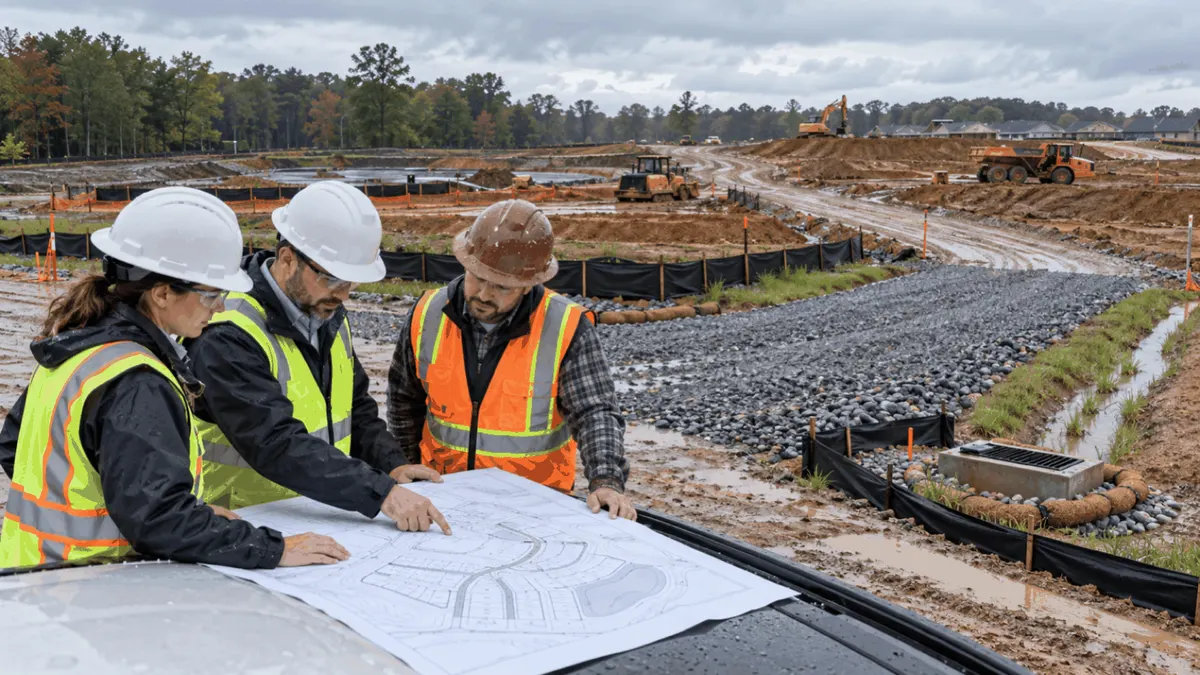
Construction runoff planning works best when developers document each disturbance phase, temporary controls, inspections, and transitions before mobilization.
Construction stormwater planning is often treated as a permit document that is finished before equipment arrives. On a real site, runoff changes every time vegetation is removed, grades are cut, roads are stabilized, utilities are installed, or a building pad is completed. A control that works during rough grading may be poorly placed during vertical construction. A stabilized entrance may protect a public road while an unprotected stockpile sheds sediment toward a downstream inlet. The plan must explain how controls will change with the sequence of work.
Developers, builders, engineers, and inspectors need a shared answer to a basic question: what is disturbed now, where will water go now, and who will verify the controls before the next phase starts? Clear phasing supports permit readiness, inspection documentation, maintenance decisions, and communication with contractors. It does not guarantee regulatory acceptance or eliminate every runoff problem, but it helps teams find gaps before a storm or a review comment exposes them.
Who This Affects
The issue affects developers, general contractors, civil engineers, grading contractors, utility installers, inspectors, owners, and environmental compliance managers. It also affects municipalities reviewing plans, neighboring property owners receiving runoff, and facility teams that inherit permanent drainage and maintenance responsibilities after construction. A project can have a sound design and still experience avoidable problems when the field sequence is not reflected in the stormwater planning documents.
Large projects may have several crews working at once. One crew may clear a new area while another installs underground utilities and a third builds a temporary access road. Their work can change drainage divides, expose soil, block an inlet, or remove a control needed by another phase. Smaller projects face the same issue at a different scale. A single builder may move from clearing to foundation excavation to utility trenching in a week, leaving little time to update the plan unless the transition points were identified in advance.
The responsible people should be named before work begins. The owner may control design changes, the contractor may control sequencing, and an assigned inspector may document conditions and corrective actions. A subcontractor may be responsible for a specific inlet protection or stockpile. If no one owns the transition decision, controls can remain on paper while the site changes around them.
The Stormwater Planning Issue
Construction stormwater requirements vary by jurisdiction and permit. In the United States, the federal NPDES framework and applicable state or local requirements may require coverage, a stormwater pollution prevention plan, erosion and sediment controls, inspections, records, and corrective actions for qualifying work. The project team should confirm the applicable permit and local process rather than assume a national summary answers every requirement. Planning supports compliance preparation; it is not legal advice or a promise of permit approval.
Phasing begins with the existing drainage pattern. Document where runoff enters the site, where it leaves, what receives it, and which areas are sensitive to sediment or flow changes. Then identify the first disturbance, the temporary drainage path, the perimeter controls, stabilized access, stockpile locations, and the place where sediment-laden water would be managed. The objective is to keep clean water separate where practical, limit exposed soil, and make the path from rainfall to receiving area understandable.
The sequence should include stabilization milestones. A site may require temporary stabilization when work pauses, when a phase is complete, or when an area will remain inactive. The plan should state what stabilization means for that project and who verifies it. Waiting until the entire site is complete can leave broad areas exposed for months. Conversely, installing permanent features too early can expose them to construction traffic or make them difficult to maintain.
Temporary controls need design context and field ownership. Silt fence, wattles, inlet protection, check dams, sediment basins, diversion swales, construction entrances, and covered stockpiles each address different conditions. No control is a universal substitute for good sequencing. A barrier may fail if concentrated flow is directed around it. An inlet filter may clog and bypass. A basin may need access for cleanout. The plan should identify inspection points and the trigger for repair, replacement, or redesign.
Rainfall forecasting is useful, but phasing should not depend on a perfect forecast. Before a storm, the contractor can review exposed areas, check outlets, secure materials, confirm equipment access, and make sure inspection coverage is understood. After a storm, the team can document whether controls functioned, where sediment accumulated, and what must change before work resumes. This creates a feedback loop between field observations and the next work phase.
What to Review Before Moving Forward
Use a phase map or schedule that links each activity to its runoff controls, inspection responsibility, and release condition.
- What land will be disturbed during the next shift, week, and major schedule milestone?
- What drainage paths will be blocked, redirected, or concentrated by that work?
- Which areas will remain exposed during a pause, weekend, or seasonal shutdown?
- Where are the site entrance, haul roads, stockpiles, concrete washout, fuel, and waste areas?
- Which inlets, outlets, swales, ditches, and receiving areas need protection or inspection?
- What must be installed before clearing, grading, utility work, or foundation excavation starts?
- Who inspects after qualifying events or at the required frequency, and who receives the record?
- What condition allows a phase to advance, and what condition requires work to pause?
Review the plan against the actual civil drawings and the contractor's schedule. A generic sequence may say clearing, grading, utilities, building, and stabilization, while the site plan shows multiple pads, off-site improvements, and separate drainage basins. Each basin may need its own transition logic. Plan-review readiness improves when the reviewer can trace the controls from the drawing to the field and from the field record back to the responsible person.
Maintenance planning belongs in the phase review. Ask how crews will reach a basin, outlet, inlet, or perimeter control without driving through an exposed area. Identify where sediment will be placed after cleanout and who is authorized to make a repair. A control that cannot be inspected safely or maintained promptly is a schedule risk. It may also create a false sense of security when the plan lists the control but no one can keep it functioning.
Documentation should be concise and usable. Photos can show conditions at a phase transition, while a written inspection can explain what was observed and what corrective action was assigned. Track the date, area, responsible party, due date, and closeout evidence. Keep the current plan and field sketch accessible to the people making daily decisions. A record that is technically complete but unavailable to the grading crew does not control runoff.
Planning, Permitting, or Compliance Support That Fits
Stormwater planning support can help a developer or contractor translate a civil schedule into a phased runoff strategy, identify gaps in a SWPPP planning package, organize inspection forms, and clarify who owns temporary and permanent controls. Municipal teams may need a review framework that compares submittals consistently. Industrial or commercial owners may need a maintenance and documentation plan that connects construction work to long-term drainage responsibilities.
The right support depends on the decision in front of the team. Early planning may focus on drainage patterns, erosion and sediment control, and construction sequencing. A permit-readiness review may focus on completeness, responsibilities, maps, inspection procedures, and recordkeeping. A field support engagement may focus on inspections, corrective actions, and communication across contractors. These services can reduce review delays and support compliance planning, but the permit authority makes its own decisions and the project team remains responsible for following applicable requirements.
Training can reinforce the plan when the people in the field understand why a control is installed, what failure looks like, and how to report a change. Short briefings can connect the day's grading limits to the inspection route. A foreman can explain the phase release condition before equipment moves. A public works or owner team can learn how to review the documentation it will inherit. Training is most useful when it is tied to the actual site plan and responsibilities.
Common Mistakes to Avoid
The first mistake is designing controls for the final site and assuming they will protect every construction phase. Final inlets, pipes, ponds, and pavement may not exist or may be vulnerable during earthwork. Temporary measures need to be selected for the current drainage pattern and then revised when the pattern changes.
Another mistake is treating inspections as a form instead of a decision process. A checklist that says a silt fence exists does not explain whether water bypassed it, whether sediment reduced capacity, or whether the control is still appropriate. Inspections should lead to assigned corrective actions, a due date, and a check that the action was completed.
Teams also lose control when a subcontractor changes the sequence without informing the plan owner. Utility work, material staging, and access changes can create new runoff paths. The contract and pre-task meeting should identify how a change is communicated and who can pause work while the controls are updated.
Finally, do not postpone long-term maintenance decisions. A detention facility, swale, outfall, or green-infrastructure feature may need access, ownership, inspection, and funding after construction. Clarifying those responsibilities early can prevent a project from reaching closeout with a drainage asset that no one is prepared to operate.
Next Step
Before land disturbance, mark the first phase on the site plan, identify the drainage path it creates, assign temporary controls and inspection duties, and define what must be true before the next phase begins. Then schedule a review whenever grading, access, utilities, or permanent drainage changes the site. A phased stormwater plan helps developers and municipalities organize documentation, reduce avoidable review delays, and make runoff responsibilities visible without promising a particular permit or compliance outcome.