
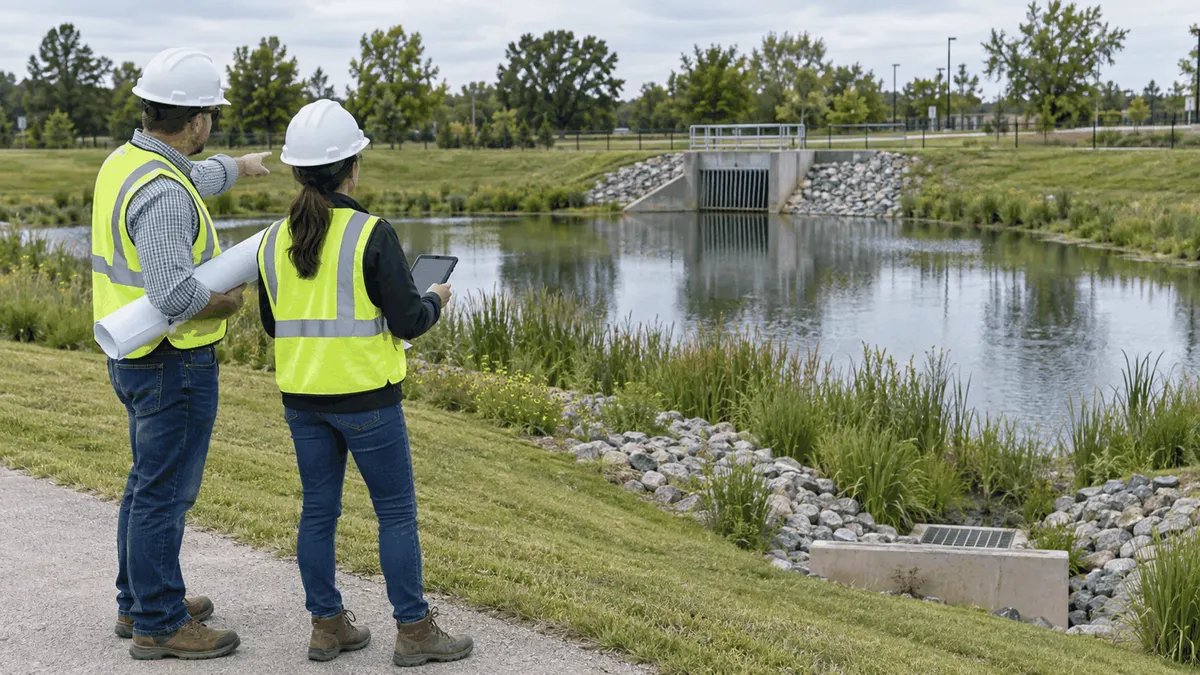
Detention pond maintenance planning should define ownership, access, inspections, outlet checks, vegetation, records, and funding before failures become urgent. These decisions keep routine observations connected to responsible action.
A detention pond is not finished when construction ends or when the basin holds water after a storm. Its performance depends on routine observation and maintenance of the inlet, forebay, embankment, outlet, emergency spillway, access route, vegetation, and downstream connection. Municipalities, developers, HOAs, facility owners, and industrial operators often know that maintenance matters but have not agreed on who inspects what, how findings are prioritized, or how repairs enter the budget. Defining those decisions during planning makes later inspections more consistent.
The exact design, permit conditions, ownership documents, and local requirements vary. This article is a planning framework, not legal advice and not a promise of permit approval or regulatory acceptance. It is intended to help a responsible party prepare questions, documentation, and a practical maintenance program that can support compliance planning and reduce review delays.
Who This Affects
Municipal public works teams may inherit ponds built by different developers, with inconsistent plans and incomplete as-builts. A city or county needs an asset record that connects the pond to parcels, inlets, outlets, easements, inspection history, and responsible departments. Without that map, a complaint can bounce between drainage, parks, streets, and private owners.
Developers and builders need to understand the maintenance obligation that will remain after turnover. Property owners and HOAs may be responsible for private facilities but lack staff who can distinguish a normal wet-weather condition from a blocked outlet or eroded embankment. Facility managers and industrial operators may need to coordinate pond access with security, traffic, landscaping, environmental, and emergency teams.
Engineers and plan reviewers benefit from a clear maintenance narrative. A design that cannot be accessed, inspected, or repaired is difficult to manage even when the hydraulics are sound. Environmental compliance teams may also need records showing inspections, corrective actions, sediment handling, and communication with contractors. The audience is broad because a pond is both a physical asset and a responsibility system.
The Stormwater Planning Issue
Maintenance begins with knowing the intended function of each feature. An inlet may need debris removal and erosion protection. A forebay may capture sediment before it reaches the main pool. An outlet structure may include a riser, trash rack, orifice, pipe, and downstream channel. An embankment may require stable slopes, controlled vegetation, and protection from burrowing or vehicle damage. A dry pond and wet pond have different inspection observations, but both require a plan for safe access and documented findings.
Sediment is not merely a cosmetic issue. It can reduce storage, block flow paths, bury vegetation, obscure an outlet, and create disposal questions. The plan should identify where sediment is likely to accumulate, what condition triggers measurement or removal, how equipment will reach the area, and how material will be characterized and managed. Removing material without considering the forebay, access, and downstream controls can simply move the maintenance problem.
Vegetation needs a defined objective. Some planted areas stabilize soil and improve infiltration or water-quality treatment. Other growth may block an outlet, conceal erosion, restrict inspection, or damage a structure. A mowing or invasive-plant schedule should be tied to function, safety, and habitat goals instead of a blanket preference for short grass. EPA guidance emphasizes that green infrastructure and stormwater controls need operation and maintenance practices that preserve their intended hydrologic and water-quality functions.
Water levels provide clues but not a complete diagnosis. A pond that drains too slowly may have a blocked outlet, compacted soil, high groundwater, or an upstream problem. A pond that empties too quickly may have erosion, a failed liner, a damaged pipe, or a design condition that needs review. Inspectors should record weather, recent rainfall, observed water level, flow, sediment, vegetation, and visible damage so trends can be distinguished from one-time conditions.
Ownership is often the hardest planning issue. The map may show an outlet on one parcel, an access easement on another, and a downstream channel in public right-of-way. A maintenance agreement may describe responsibilities without giving a reliable contact or funding mechanism. A useful program identifies the asset owner, operating party, inspection party, repair authority, access rights, cost-sharing rule, emergency contact, and record custodian.
What to Review Before Moving Forward
Build the maintenance plan around an asset record and a decision path. At minimum, collect:
- Approved plans, as-builts, calculations, specifications, easements, and maintenance agreements.
- A map of the pond, inlets, forebays, outlets, emergency spillways, access routes, utilities, and downstream connections.
- Intended functions, design elevations, normal water levels, and known limitations.
- Names and contact information for owners, operators, inspectors, contractors, and emergency decision-makers.
- Routine and event-based inspection frequencies, including inspections after unusual rainfall or reported flooding.
- Safety controls for slopes, water, unstable ground, traffic, wildlife, and equipment access.
- Trigger levels for debris removal, sediment measurement, erosion repair, vegetation work, outlet cleaning, and engineering review.
- A record format for photographs, measurements, defects, work orders, completion dates, and follow-up inspections.
During a field inspection, begin outside the basin. Confirm the access route, gate, easement, signs, and safe parking location. Look for erosion or standing water along the route and for evidence that vehicles have entered areas not designed for traffic. Inside the basin, inspect the inlet, forebay, side slopes, bottom, outlet, emergency spillway, fencing, and downstream channel. Note whether vegetation, sediment, trash, or woody growth prevents a complete view.
Inspect the embankment for settlement, cracking, slumping, animal burrows, wet spots, seepage, bare soil, and unauthorized grading. Compare the observed condition with prior photographs. Small changes may be more important than a single dramatic observation. At the outlet, check trash racks, grates, orifices, pipes, headwalls, and energy dissipation. Do not enter a confined structure or climb an unsafe slope simply to obtain a better photograph. Use a safe observation method and escalate access problems.
Connect findings to work orders. A blocked trash rack may require prompt clearing. A small erosion rill may need stabilization before it becomes a larger channel. A cracked structure or unusual seepage may need an engineer or qualified specialist. A maintenance plan is stronger when each finding has an owner, priority, due date, and verification step rather than a note that simply says monitor.
Budgeting should include recurring work and renewal. Routine mowing, debris removal, inspections, and access upkeep are different from sediment removal, outlet replacement, embankment repair, and emergency response. Use inspection history to estimate recurring costs and identify capital projects. A municipal program can rank ponds by consequence, condition, redundancy, complaint history, and downstream exposure, while a private owner can reserve funds based on the expected life of major components.
Public communication can improve the program as well. Residents may report standing water, odors, blocked inlets, or erosion before a scheduled inspection finds them. Give staff a consistent way to log the location, date, weather, photograph, and immediate response without promising a design solution. Complaint data can reveal recurring trouble spots, but it should be combined with field inspection and plan information before a project is prioritized.
Planning, Permitting, or Compliance Support That Fits
Stormwater planning support can help an owner organize plans, asset maps, inspection forms, maintenance responsibilities, and capital priorities. GIS inventory work can connect photographs and work orders to a consistent location. Drainage or hydraulic review can help clarify whether a repeated symptom is a maintenance issue, a design issue, or a condition that needs more data. SWPPP, MS4, or industrial stormwater support may be relevant when the pond is part of a larger compliance program.
The right support depends on the question. A municipality may need a systemwide asset and inspection framework. A developer may need a turnover package and maintenance agreement review. An HOA may need a plain-language schedule and contractor scope. An industrial facility may need documentation tied to outdoor operations and stormwater controls. Stormwaterplanning.us can help prepare practical planning materials and training, but no consultant or course can promise a permit decision, grant award, or regulatory outcome.
Common Mistakes to Avoid
Do not treat a pond as a landscaping area with occasional mowing. Do not wait for a flood complaint before locating the outlet or confirming access. Do not assume the recorded owner is the person who can authorize work. Do not remove sediment without planning access, disposal, downstream protection, and post-work verification. Do not accept a checklist with no photographs, measurements, or corrective-action status.
Another mistake is separating maintenance from design review. Repeated overtopping, persistent standing water, or erosion may indicate an upstream, hydraulic, soil, or outlet problem. A maintenance crew can report the pattern, but the responsible engineer or agency may need to evaluate it. Clear escalation protects both the field team and the owner.
Next Step
Choose one detention pond and create a one-page responsibility map before the next inspection. Identify the owner, access route, features, inspection triggers, corrective-action thresholds, record location, and person who approves spending. Then compare that map with the plans and agreements. The gaps you find will show whether the next need is routine maintenance, better documentation, engineering review, or broader stormwater program support.