
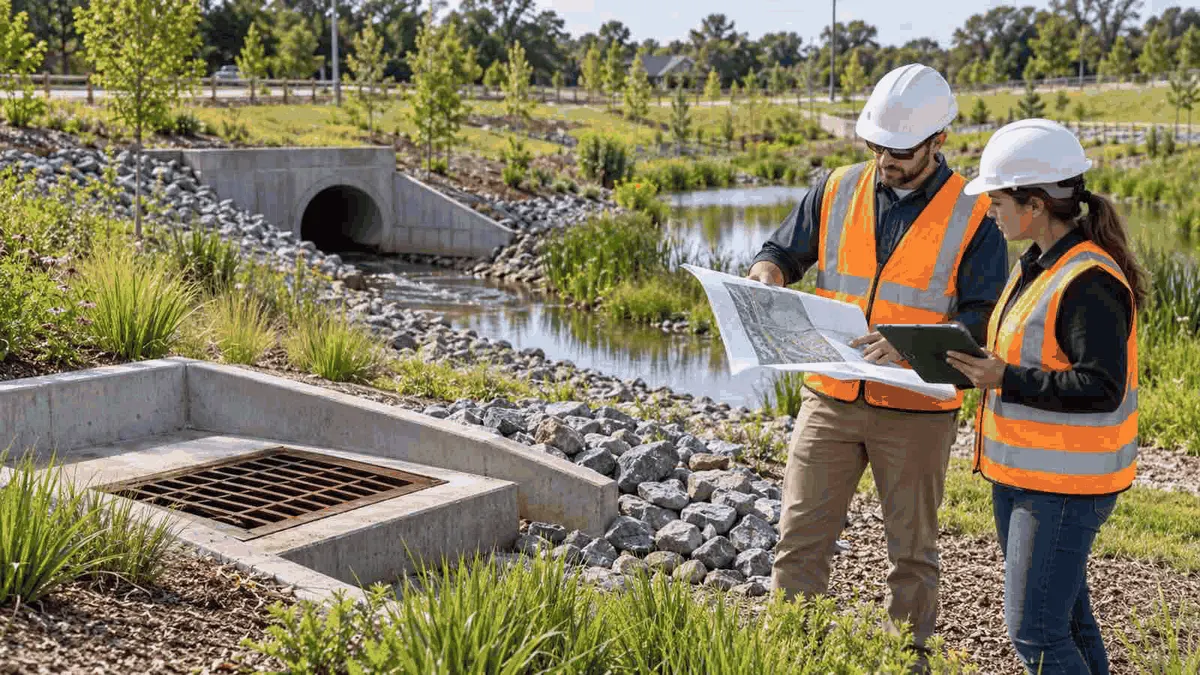
Stormwater asset condition ratings help public works teams rank repairs with consistent evidence about risk, service impact, and future capital needs. A rating does not replace engineering judgment or a drainage study, but it gives municipalities a consistent way to compare urgency, consequence, accessibility, and evidence before setting priorities.
Many communities have more stormwater assets than staff can inspect or repair in one budget cycle. A complaint may identify a flooding location, while a field crew notices a blocked inlet somewhere else, and an engineer sees a failing outfall during a project review. Without a shared condition language, the loudest complaint or most visible structure can dominate the list, even when another asset presents a greater risk to service, safety, water quality, or future cost.
Who This Affects
Condition-rating workflows affect cities, counties, townships, utilities, campus systems, transportation agencies, HOAs with private drainage, industrial site operators, and developers responsible for stormwater facilities. They are especially useful for public works directors who must explain why one repair moves ahead of another, and for engineers who need field evidence before scoping a rehabilitation or capital project.
The approach also helps inspection staff, GIS coordinators, maintenance supervisors, finance teams, emergency managers, and elected officials. Each group sees a different part of the problem. Inspectors observe physical condition. Operators know recurring maintenance. GIS staff understand network relationships. Finance teams need cost and timing. Decision makers need a clear explanation of what happens if an asset is deferred.
Construction and development teams can use condition information when a project connects to an existing system. A downstream pipe, culvert, outfall, or detention facility may be adequate on paper but constrained in the field by sediment, erosion, encroachment, access, or undocumented alterations. A condition record supports better coordination, though it does not guarantee approval or determine the applicable permit obligations.
The Stormwater Planning Issue
Stormwater systems are networks. An inlet, pipe, ditch, pond, culvert, and outfall can each be functional in isolation while the network still underperforms because one restriction controls the result. A condition rating should therefore capture both the asset and the consequence of its condition. A collapsed pipe under a low-volume access road may be urgent, while a blocked inlet near a school, emergency route, or frequently flooded intersection may deserve a different priority even if its physical defect appears smaller.
EPA’s stormwater programs place responsibilities on different operators and jurisdictions. Construction stormwater requirements may involve a SWPPP, erosion and sediment controls, inspections, stabilization, and corrective actions. Regulated MS4 owners develop, implement, and enforce stormwater management programs that can include mapping, illicit discharge detection and elimination, public education, maintenance, and reporting. The exact permit, agency, and standard depend on the location and the operator’s role, so a condition-rating system should record the regulatory or program context rather than assume one national rule applies to every asset.
Field condition is also time-sensitive. A grate may be clear on inspection day and blocked after a leaf event. A riprap outfall may look stable during dry weather but show active scour after a storm. A detention pond may meet its design intent while its access road, forebay, outlet structure, or emergency spillway requires maintenance. The record should distinguish a one-time observation from a recurring pattern and state when the next inspection should occur.
Good ratings are evidence-based. Photographs, measurements, location coordinates, observed flow, sediment depth, blockage percentage, erosion indicators, and nearby receptors help reviewers understand the score. A rating that says “poor” without an explanation is difficult to defend. A rating that says “inlet grate blocked approximately seventy percent, ponding reached curb line during 09-28 rainfall, school crossing 120 feet upstream, photo attached” can guide a work order and a budget discussion.
The goal is not to create false precision. A five-level scale may be useful, but the definitions must be clear enough that two trained inspectors usually reach similar results. If a rating depends on a structural assessment, hydraulic model, water-quality investigation, or survey, the field form should say that the condition is preliminary and needs a specialist review.
What to Review Before Moving Forward
Start by defining the asset classes and the decision the rating will support. A maintenance crew may need a fast field score for routine work. A capital program may need a more detailed score tied to consequence, rehabilitation options, and cost. The same asset can have separate physical-condition and operational-priority ratings.
A practical field framework can include:
- Asset identity, ownership, location, watershed, and GIS record.
- Physical condition, including blockage, damage, corrosion, erosion, settlement, vegetation, and structural concerns.
- Hydraulic or operational effect, such as restricted flow, ponding, surcharge, bypass, or loss of storage.
- Water-quality or environmental concern, including sediment movement, illicit discharge indicators, exposed soil, or trash accumulation.
- Safety and access, including traffic exposure, fall hazards, confined-space concerns, steep slopes, and maintenance access.
- Receptors and consequence, such as homes, roads, schools, critical facilities, receiving waters, or downstream property.
- Evidence quality, including photographs, measurements, inspection date, weather context, and reviewer confidence.
- Recommended action, responsible group, target timing, and interim control.
Use condition bands that describe action. For example, a good rating might mean routine maintenance and scheduled reinspection. A watch rating might require a work order, monitoring, or design review. A poor rating might require near-term correction, traffic control, temporary protection, or a capital scope. A critical rating should identify what must happen before the next forecasted storm or before the asset is used for a planned project. The labels are less important than the decision attached to each label.
Connect the rating to the network. A blocked inlet should be linked to its downstream pipe, outfall, and known complaint locations. A damaged culvert should be linked to road ownership and upstream drainage area. A detention outlet should be linked to the pond, emergency overflow, downstream channel, and maintenance agreement. GIS mapping can make these relationships visible, but the map should be checked against field conditions before it drives a major project.
Create a review path for uncertainty. If a crew sees a possible structural failure, the rating can be “suspected critical, engineering review required” rather than an unsupported final diagnosis. If an outfall shows unusual staining or flow during dry weather, route the observation to the IDDE process. If a private facility affects a public system, identify the owner and responsibility without assuming the municipality can perform work on private property.
Use weather and season to interpret evidence. Rainfall intensity, time since the last storm, leaf fall, freeze-thaw, drought, construction activity, and mowing can change what an inspector sees. A dry-weather inspection may miss a surcharge condition. A wet-weather inspection may reveal flow and erosion while limiting safe access. The form should record conditions so future reviewers do not mistake the observation for an all-season baseline.
Translate field ratings into a capital screen. A high-priority asset may combine poor condition, high consequence, limited redundancy, and a feasible project window. Another asset may have poor physical condition but low consequence and a low-cost routine fix. A scoring matrix can organize the conversation, but staff should preserve the underlying evidence and allow professional judgment where scores hide important context.
Planning, Permitting, or Compliance Support That Fits
Stormwater planning support is useful when a municipality needs to standardize its inspection forms, connect field data to GIS, prepare a maintenance program, or develop a capital-priority framework. Developers and owners may need a focused assessment of existing drainage assets before designing a connection, redevelopment, detention improvement, or erosion-control measure. Engineering and environmental teams may need help organizing SWPPP documentation, BMP maintenance, outfall screening, or plan-review responses.
The best support matches the decision. A mapping and inventory effort may be the right first step for a community that does not know what it owns. A condition survey may fit a system with an existing map but inconsistent inspection records. A drainage study may be needed when flooding complaints cannot be explained by visible blockage alone. A permit-readiness review may be more useful when land disturbance or construction mobilization is approaching.
Stormwaterplanning.us can help teams structure these planning questions and prepare documentation that supports compliance planning. It cannot promise permit approval, regulatory acceptance, funding, or a specific flood outcome. The municipality, owner, engineer, permittee, and agency retain their respective responsibilities, and local requirements should be confirmed before relying on a national resource or template.
Common Mistakes to Avoid
Do not rank assets from photographs alone when a defect could be structural or hydraulic. Photos are valuable evidence, but they may not show depth, capacity, hidden damage, or downstream restrictions. Do not treat a complaint count as a complete risk score. Repeated complaints are important, but quiet assets can affect critical roads, receiving waters, or emergency access.
Avoid changing rating definitions from one inspection cycle to the next. If definitions must change, preserve the old scale and document the crosswalk. Do not mix private and public responsibilities without recording ownership and access authority. A municipality may prioritize an issue without having the authority to repair a private facility.
Another mistake is separating inspection from maintenance feedback. If crews repair an inlet but the work order never updates the condition record, the next budget cycle begins with inaccurate information. Close the loop with before-and-after photographs, materials used, residual concerns, and the date for reinspection.
Finally, do not make the score more complex than the decision requires. A form that takes too long will produce gaps. Start with a small number of repeatable fields, train the inspectors, review sample records, and add detail only when it improves a real planning decision.
Next Step
Choose one asset class and pilot a condition-rating form across several neighborhoods, watersheds, or project types. Compare the ratings, review the evidence, and tie each band to a specific maintenance, monitoring, engineering, or capital action. That small pilot can show whether your stormwater program is ready for broader inventory work and where planning support will have the greatest value.