
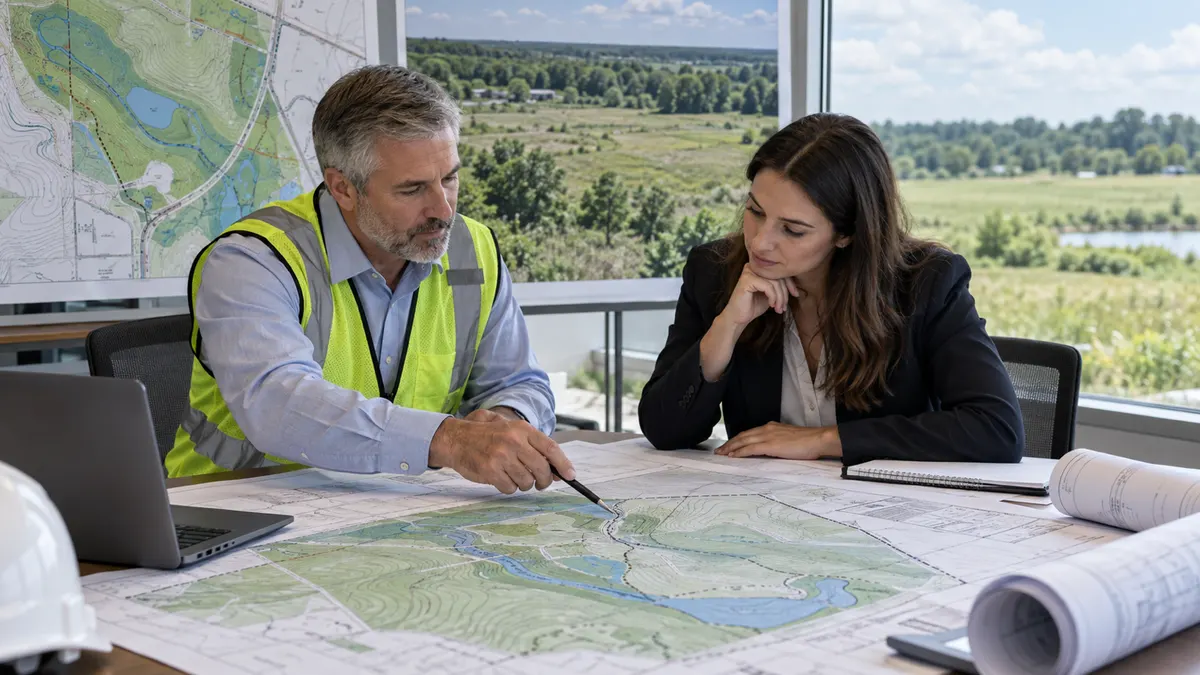
Buying land, optioning a parcel, or moving a development concept toward civil design often starts with questions about zoning, access, utilities, and market fit. Drainage can sit quietly in the background until later, when a survey, site walk, neighbor complaint, floodplain note, or plan review comment reveals that water is going to shape the project more than anyone expected. The practical question is simple: what should a buyer, developer, owner, or local review team understand about stormwater before committing to a site plan, purchase price, or construction schedule?
Drainage due diligence is not about finding a perfect parcel. Most sites have some constraint, whether it is shallow roadside ditching, a mapped floodplain, poorly defined overland flow, tight soils, downstream capacity concerns, or a legacy detention basin that no one has maintained well. The value of early review is that it helps separate manageable design issues from risks that can affect yield, cost, phasing, permitting, maintenance, and community acceptance.
For municipalities, early drainage review supports clearer conversations with applicants and elected officials. For developers, it helps prevent a land deal from being based on a layout that cannot reasonably handle runoff, water quality treatment, or floodplain limitations. For property owners and facility managers, it helps identify whether drainage complaints are tied to local grading, blocked conveyance, off-site runoff, aging infrastructure, or a larger watershed condition. For engineers and planners, it creates a better starting point for decisions that will eventually need to be documented in a stormwater management plan, SWPPP, drainage study, floodplain review, or local development submittal.
Good due diligence does not promise permit approval or remove the need for detailed engineering. It gives the project team enough information to ask better questions before money, schedule, and expectations harden around an untested assumption.
Who This Affects
Drainage due diligence affects nearly every party that has to make a land decision before final engineering is complete.
Developers and land acquisition teams need to understand whether the parcel can support the intended use without losing too much buildable area to detention, floodplain limits, stream buffers, wetlands, drainage easements, or grading transitions. A concept plan that looks efficient on a zoning exhibit may change significantly once stormwater routing, basin geometry, emergency overflow, and downstream discharge points are considered.
Municipal planners and public works staff need enough information to identify early conflicts with local ordinances, capital projects, drainage complaint history, or known system limitations. A site that technically meets zoning may still need careful review if it drains toward an undersized culvert, a neighborhood with recurring yard flooding, a roadside ditch network with limited fall, or a waterbody with water-quality requirements.
Civil engineers need early access to reliable boundary, survey, soil, topographic, floodplain, utility, and watershed information. When those items are delayed, the engineer is often asked to refine a plan using assumptions that may later prove wrong. That can lead to redesign, added field work, revised calculations, or difficult conversations about lost developable area.
Property owners, facility managers, and HOAs may need due diligence when they are expanding parking, adding buildings, reworking access drives, solving nuisance drainage, or responding to maintenance issues. Even smaller improvements can change flow paths, concentrate runoff, or trigger local requirements when they are part of a larger site change.
Lenders, real estate professionals, and buyers may also be affected. Flood maps, visible drainage patterns, easements, and maintenance obligations can influence insurance questions, construction feasibility, site value, and long-term ownership cost. These parties do not need to become drainage experts, but they benefit from knowing when to bring one into the conversation before closing or final commitment.
Construction managers and contractors are affected later if due diligence is skipped early. A site with unclear discharge points, unstable slopes, unsuitable soils, or poor staging space can become difficult to sequence. Temporary erosion and sediment controls may require more room, more inspection attention, and more maintenance than originally budgeted.
The Stormwater Planning Issue
The central stormwater planning issue is that drainage constraints are physical, regulatory, and operational at the same time. A parcel can look attractive because of location, access, acreage, or frontage, while still carrying stormwater questions that affect whether the intended development pattern is practical.
The first issue is where water comes from, where it goes, and how it leaves the site today. Existing runoff may enter from neighboring land, public streets, upstream drainage areas, roadside ditches, agricultural fields, undeveloped slopes, or roof and pavement systems on adjacent parcels. If a project team only studies water generated inside the property boundary, it may miss the off-site flow that crosses the parcel during storms. That can lead to undersized swales, misplaced buildings, poor driveway grades, and conflicts with existing drainage easements.
The second issue is whether the site has a clear and lawful discharge point. Some parcels appear to have natural drainage, but the downstream route may cross private property, depend on a shallow ditch, flow through a culvert with limited capacity, or enter a municipal system that already receives complaints. A stormwater plan usually needs to show how runoff will be collected, treated, detained where required, and released without creating avoidable downstream impacts. Early due diligence should identify whether that discharge route is obvious, questionable, or likely to require coordination.
The third issue is flood risk. FEMA flood maps are important because they show mapped flood hazard areas, floodplain boundaries, and related information used by communities, lenders, insurers, and floodplain administrators. They are not the only drainage tool, and a parcel outside a high-risk mapped zone can still have localized flooding, shallow ponding, or overland flow concerns. Still, checking flood map status, base flood elevation information where available, local floodplain rules, and any map updates underway should happen early in the decision process.
The fourth issue is earth disturbance and construction stormwater. EPA’s NPDES construction stormwater framework generally applies when construction activity disturbs one or more acres and discharges stormwater to waters of the United States, with state and local programs often administering permit coverage and related requirements. Many projects also face local erosion and sediment control rules, even when federal thresholds are not the main issue. Due diligence should identify whether the project is likely to need SWPPP preparation, inspection planning, stabilization sequencing, construction entrances, sediment basins, inlet protection, concrete washout controls, or other temporary measures before mobilization.
The fifth issue is post-construction stormwater management. A site may need detention, retention, infiltration, filtration, proprietary treatment, green infrastructure, or other best management practices depending on local criteria, soil conditions, impervious area, receiving waters, and redevelopment status. Those facilities take land, require access, need maintenance, and may affect how a site can be phased. A detention basin placed as an afterthought can interfere with truck circulation, emergency access, utilities, landscaping, or future expansion. A bioretention area may be a good fit in one corner and a poor fit in another if soils, groundwater, utilities, or sediment loads are not considered.
The sixth issue is documentation. Many drainage problems are not discovered because no one asked for the right records early. Prior plats, easements, record drawings, maintenance agreements, grading plans, watershed studies, floodplain documents, as-built surveys, complaint logs, and inspection notes can all change the story of a property. Due diligence should treat drainage as a documented condition, not only a visual impression from a sunny-day site visit.
What To Review Before Moving Forward
A practical drainage due diligence review should be scaled to the project. A small building addition does not need the same level of investigation as a mixed-use development, industrial site, subdivision, or public facility. The basic questions, however, are similar.
- Confirm the intended project footprint, disturbance area, likely impervious area, and whether the plan is part of a larger common plan of development.
- Review available topography, contours, low points, ridgelines, roadside ditches, existing channels, swales, ponds, and visible erosion.
- Identify off-site drainage entering the parcel, including sheet flow from adjacent land, concentrated flow from pipes or culverts, and public right-of-way runoff.
- Locate the downstream discharge point and trace the likely route to a public system, waterbody, ditch, drainage easement, or neighboring parcel.
- Check FEMA flood map information and ask the local floodplain administrator about local floodplain rules, studies, map changes, and elevation requirements.
- Review available soil information, groundwater indicators, infiltration limits, bedrock, steep slopes, and areas where ponding or poor drainage is visible.
- Identify wetlands, streams, buffers, riparian corridors, regulated drains, or other environmental features that may affect grading and stormwater design.
- Review recorded easements, plats, covenants, maintenance agreements, and restrictions that may control drainage routes or access.
- Ask the municipality or county about known drainage complaints, planned capital projects, road improvements, culvert replacements, or local system limitations near the site.
- Estimate whether detention, water quality treatment, volume reduction, infiltration, channel protection, or flood routing requirements may apply.
- Identify where permanent stormwater facilities could fit without blocking access, emergency routes, utilities, parking, loading areas, visibility, landscaping, or future expansion.
- Consider how construction stormwater controls would be phased, inspected, stabilized, and maintained during earth disturbance.
- Review ownership and maintenance expectations for private BMPs, detention basins, outfalls, storm drains, and easement areas.
- Compare the concept plan against drainage realities before relying on lot yield, building placement, or schedule assumptions.
The goal is not to complete final design during due diligence. The goal is to identify the issues most likely to affect feasibility and schedule. A good early review should produce a short list of items that need survey, engineering analysis, agency coordination, legal review, or owner decision-making.
For example, if a parcel drains through an apparent swale along a property line, the team should confirm whether that swale is within an easement, whether it carries off-site drainage, whether it can be graded without affecting adjacent properties, and whether it must remain open. If a detention basin is likely, the team should reserve realistic space for side slopes, maintenance access, outlet control, emergency overflow, and landscaping. If the site is in or near a mapped floodplain, the team should understand whether finished-floor elevations, compensatory storage, no-rise analysis, or local floodplain permits may affect the project.
This is also the stage to decide whether a drainage study is warranted. A formal study may be appropriate when the site has known flooding, unclear discharge routes, significant off-site drainage, downstream complaints, floodplain adjacency, major impervious-area changes, or a receiving system with limited capacity. Even when a full study is not needed yet, an early screening memo can help owners and municipalities understand what must be resolved before submittal.
Planning, Permitting, or Compliance Support That Fits
Drainage due diligence often sits between real estate strategy, civil engineering, municipal review, and stormwater compliance. That is why it helps to treat the review as a planning task first, then connect it to permitting and design as the project becomes clearer.
Stormwater Planning can support early site screening by reviewing available mapping, public records, drainage patterns, floodplain indicators, stormwater criteria, likely BMP needs, and documentation gaps. For a developer or property owner, that support can help clarify what to ask before closing, what to budget for additional study, and what assumptions should not be carried into a pro forma without confirmation. For a municipality or county, it can help staff identify the drainage questions that should be addressed before a concept plan becomes a full civil submittal.
For sites moving toward development, stormwater management plan support can help organize the path from early findings to a more complete design package. That may include identifying likely detention or treatment needs, reviewing potential outfall constraints, coordinating with survey and civil design teams, and preparing documentation that responds to local review expectations. This does not replace the jurisdiction’s review or guarantee acceptance, but it can reduce avoidable delays by making stormwater issues visible earlier.
For projects that will disturb land, SWPPP planning and construction stormwater permit readiness may also become part of the due diligence sequence. Early review can flag whether the disturbance area, common-plan status, discharge conditions, and site constraints are likely to require permit coverage or local erosion and sediment control approvals. It can also help the team think through staging, perimeter controls, temporary sediment storage, stabilized entrances, inspection access, and final stabilization before construction begins.
For existing properties, drainage due diligence can support maintenance planning and problem diagnosis. A facility manager may need to understand why an inlet backs up, why water crosses a driveway, why a basin holds water too long, or why downstream neighbors are raising concerns. A focused review can help distinguish between maintenance issues, grading issues, infrastructure limits, and larger watershed conditions that require coordination beyond the property.
The best fit is usually a phased approach: first screen the parcel, then decide what needs deeper analysis, then build the documentation required for design, permitting, construction, and long-term maintenance.
Common Mistakes to Avoid
One common mistake is treating a flood map check as the entire drainage review. Flood maps are important, but they do not always show shallow street flooding, undersized local pipes, blocked ditches, poor site grading, storm drain maintenance problems, or drainage complaints that occur outside mapped high-risk areas. A parcel can be outside a special flood hazard area and still have expensive stormwater constraints.
Another mistake is assuming that water can continue leaving the site wherever it appears to leave today. Existing drainage patterns may not be supported by recorded easements, adequate downstream capacity, or current municipal standards. If the project will concentrate flow, change grading, increase impervious area, or alter a drainage route, the team should confirm the discharge path and review expectations early.
A third mistake is drawing the concept plan before reserving realistic stormwater space. Detention, water quality treatment, infiltration practices, access drives, forebays, outlet structures, emergency spillways, and maintenance benches need room. When these elements are squeezed in late, the project may lose parking, lots, landscape area, loading space, or future expansion options.
A fourth mistake is overlooking off-site drainage. Developers sometimes focus on runoff generated by the proposed project, while an upstream basin, roadside ditch, or neighboring property sends water across the site. If off-site flow is not identified early, proposed grading can inadvertently block it, reroute it, or create conflicts with adjacent owners.
A fifth mistake is relying on old record drawings without field verification. Plans may show pipes, inlets, ditches, ponds, or easements that are missing, buried, modified, undersized, damaged, or poorly maintained. A site visit and survey can reveal whether the documents match conditions on the ground.
A sixth mistake is separating construction stormwater from site feasibility. Temporary erosion and sediment controls require access, staging room, inspection routes, stabilized outlets, and maintenance. On tight sites, steep sites, infill sites, or sites near sensitive waters, those temporary controls can influence phasing and cost long before final stabilization.
A seventh mistake is failing to assign long-term maintenance responsibility. A project can meet design intent on paper and still become a problem if no one has access, budget, authority, or schedule for inspection and maintenance. Detention basins, proprietary devices, inlets, underground storage, vegetated practices, outlet structures, and outfalls all need clear ownership and practical access.
An eighth mistake is waiting to talk with the local jurisdiction until civil plans are almost complete. Early coordination can clarify whether local staff know of drainage complaints, system bottlenecks, capital projects, floodplain concerns, or ordinance interpretations that should shape the plan. That conversation should be documented carefully and treated as guidance, not as a substitute for formal review.
Next Step
Before buying, developing, or substantially changing a parcel with possible drainage concerns, gather the basic stormwater facts early: topography, flood map status, known easements, off-site drainage, downstream discharge route, likely disturbance area, local stormwater criteria, and maintenance obligations. Then decide which questions need survey, engineering analysis, agency coordination, or owner direction before the project moves forward.
The most useful drainage due diligence does not try to solve every design detail at once. It gives decision-makers a clear view of the constraints that could affect layout, cost, schedule, permitting, construction sequencing, and long-term operation. That is the point where a stormwater concern becomes manageable planning information instead of a late-stage surprise.