
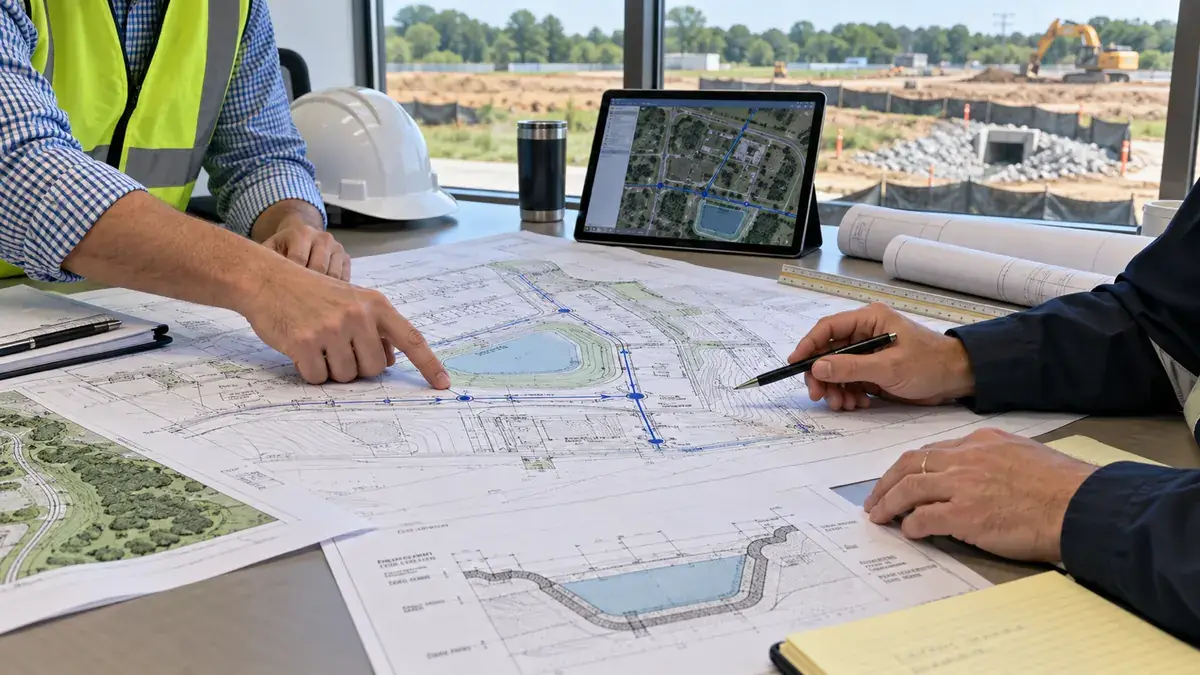
Developers, builders, owners, civil engineers, and planning teams often search for stormwater submittal guidance after a project has already entered review and the comment letters are starting to stack up. The practical question is simple: what does a stormwater reviewer need to see before a site plan can move forward with fewer avoidable delays?
That question matters because stormwater review is not only a calculation exercise. A submittal has to show how the proposed development will handle runoff during construction, how permanent drainage will function after construction, how stormwater controls will be accessed and maintained, how the project connects to public or private drainage systems, and how the plan fits local ordinances, state permit expectations, and site constraints. When those pieces are scattered, incomplete, or inconsistent, the reviewer has to ask for clarification even when the basic design concept may be workable.
For municipalities, incomplete submittals consume review time, delay public infrastructure coordination, complicate MS4 program documentation, and create pressure on staff to solve design questions that should have been resolved by the applicant team. For developers and owners, incomplete stormwater documentation can slow entitlement, grading permits, building permits, financing milestones, tenant delivery, and contractor mobilization. For civil engineering firms, the issue can become reputational: repeated stormwater comments may suggest that the plan set was not ready for the level of review requested.
This post explains what to review before submitting civil plans, drainage reports, SWPPP materials, or post-construction stormwater documentation for municipal or agency review. It is not legal advice and it does not guarantee permit approval. Requirements vary by jurisdiction, watershed, receiving system, MS4 permit, construction stormwater permit program, and project type. The goal is to help project teams organize the information reviewers commonly need so stormwater questions can be answered clearly, consistently, and early.
Who This Affects
Stormwater submittal completeness affects nearly every party involved in land development, redevelopment, public infrastructure, and site construction.
Developers and owners feel the issue when a site plan review cycle takes longer than expected because drainage narratives, calculations, easements, BMP details, construction sequencing, or maintenance commitments are missing. A project may have strong market demand and a capable design team, but if the stormwater package does not explain how runoff will be managed, the reviewer may not have enough information to recommend approval, conditional approval, or movement to the next permit step.
Civil engineering firms are directly affected because the stormwater portion of a submittal often ties together grading, utilities, erosion and sediment control, floodplain review, roadway drainage, detention or retention design, water quality treatment, landscape coordination, and maintenance access. A mismatch between plan sheets and reports can trigger comments across multiple disciplines.
Municipal engineers, public works directors, plan reviewers, and planning departments are affected because they must protect public drainage systems, local roads, neighboring properties, receiving waters, and municipal permit obligations while keeping development review predictable. Reviewers are not simply checking boxes. They are trying to understand whether the proposed site will drain safely, whether downstream connections are reasonable, whether permanent BMPs can be maintained, and whether construction controls will reduce sediment and pollutant risks.
Contractors and construction managers are affected when stormwater details are approved in theory but not field-ready. If the submittal does not clarify construction entrances, inlet protection, temporary diversions, stabilized stockpile areas, phased grading, dewatering considerations, inspection responsibilities, or limits of disturbance, the project may start with confusion that later appears as corrective action, complaints, or schedule disruption.
Property owners, facility managers, HOAs, industrial site operators, campuses, hospitals, schools, and commercial landlords are affected when long-term stormwater maintenance obligations are accepted without clear access routes, inspection schedules, responsible parties, sediment removal triggers, vegetation expectations, or budget planning. A stormwater BMP is not complete just because it is shown on the plan. It must be maintainable after the project closes.
Landscape architects, environmental consultants, surveyors, geotechnical consultants, traffic teams, utility designers, and legal or real estate teams may also be involved. Stormwater completeness often depends on information from each of them: site topography, soils, easements, utility conflicts, tree preservation, open space, public right-of-way work, floodplain limits, receiving system capacity, and ownership boundaries.
The Stormwater Planning Issue
The stormwater planning issue is that many submittals answer the design question only partially. They may show a detention pond but not the maintenance access. They may include calculations but not explain the rainfall event, release rate standard, drainage area map, or downstream connection. They may show erosion control symbols but not align them with the sequence of construction. They may reference a SWPPP but not make clear how the SWPPP will be implemented in the field. They may propose green infrastructure or proprietary treatment but not define inspection frequency, pretreatment, bypass conditions, or long-term owner responsibilities.
Reviewers often need to understand three linked stormwater conditions.
The first condition is existing drainage. What happens on the site now? Where does runoff enter, concentrate, pond, leave, or connect to a public or private system? Are there ditches, swales, culverts, inlets, outfalls, wetlands, floodplain areas, overland relief paths, off-site flows, known drainage complaints, or easements that shape the project? If the submittal does not explain existing drainage, the proposed drainage plan lacks context.
The second condition is construction-phase stormwater. During land disturbance, stormwater can carry sediment, debris, oils, concrete washout pollutants, fuels, stockpile material, and other pollutants from exposed or active work areas. EPA construction stormwater guidance recognizes the need for permit coverage for many construction activities disturbing one or more acres, or smaller sites that are part of a common plan of development or sale, and highlights the role of a Stormwater Pollution Prevention Plan in organizing controls. State and local programs may add their own procedures, forms, inspection expectations, and stabilization requirements.
The third condition is post-construction stormwater. After the project is built, the site may create more impervious area, faster runoff, changed drainage patterns, new discharge points, new BMPs, new ownership obligations, and new maintenance burdens. For regulated MS4 communities, post-construction runoff control is commonly part of the local stormwater management program. EPA’s post-construction BMP materials emphasize that programs often include structural and non-structural practices, ordinances, plan review, and long-term operation and maintenance.
Completeness problems happen when these conditions are not connected. A plan may calculate peak flow but ignore how erosion controls will protect the future basin during construction. A report may size a BMP but omit access for sediment removal. A grading plan may route off-site flow through a temporary construction area without explaining the interim condition. A maintenance agreement may name the owner but not identify the actual assets, inspection tasks, or recordkeeping approach.
The result is a review process driven by comments instead of decisions. Reviewers ask for drainage area maps, revised calculations, outlet details, pipe profiles, emergency overflow routes, soil assumptions, inspection notes, easement language, BMP maintenance sheets, or construction sequencing revisions. Some comments are unavoidable because each site has unique constraints. But many comments are preventable when the applicant team performs a completeness review before formal submission.
What To Review Before Moving Forward
Before submitting a stormwater package, review the materials as a reviewer would. The question is not whether the design team understands the project. The question is whether the submittal gives the reviewer enough evidence to follow the drainage logic without guessing.
- Confirm the review trigger: Identify whether the project needs site plan review, grading approval, construction stormwater permit coverage, local stormwater management approval, floodplain review, right-of-way drainage approval, MS4-related review, industrial stormwater coordination, or post-construction BMP documentation.
- Define the disturbance and development footprint: Show limits of disturbance, total site area, new and replaced impervious area, demolition areas, construction staging, off-site work, utility corridors, stockpile areas, laydown areas, haul routes, and any common plan of development considerations.
- Document existing drainage conditions: Include drainage area maps, topographic information, existing inlets, pipes, culverts, swales, ditches, channels, outfalls, ponds, wetlands, floodplain limits, off-site inflows, discharge points, easements, and known drainage constraints.
- Match narratives to plan sheets: The drainage report, stormwater narrative, SWPPP, erosion control sheets, grading plans, utility plans, landscape plans, and detail sheets should describe the same conditions. If the report says runoff flows north, the plans should not show a primary discharge to the south without explanation.
- Review hydrology assumptions: Confirm rainfall data, design storms, runoff coefficients, curve numbers, time of concentration assumptions, pre-development and post-development drainage areas, impervious area calculations, soil information, and any local release-rate or volume-control standards.
- Review hydraulic information: Check pipe sizing, inlet capacity, culvert assumptions, tailwater conditions, outlet protection, pond routing, emergency overflow paths, bypass flow, spread at inlets, ditch capacity, and downstream connection information where applicable.
- Confirm construction-phase controls: Make sure erosion and sediment controls match the construction sequence. Review perimeter controls, construction entrances, inlet protection, sediment basins or traps, diversion measures, stockpile protection, concrete washout, temporary stabilization, dewatering practices if relevant, and inspection access.
- Align SWPPP responsibilities: Identify who has operational control over construction plans and who has day-to-day control of site activities. The submittal should clarify responsible parties, inspection expectations, corrective action tracking, record storage, stabilization responsibilities, and communication procedures.
- Check post-construction BMP details: Confirm BMP type, location, contributing drainage area, pretreatment, elevations, media or planting notes, outlet structures, underdrains if used, overflow routes, bypass conditions, access, signage if required, and details consistent with the design calculations.
- Plan for operation and maintenance: Include ownership, maintenance responsibility, access routes, inspection frequency, sediment and debris removal triggers, vegetation care, structural repair expectations, recordkeeping, and transfer language for future owners or associations where applicable.
- Review easements and access: Verify that public and private drainage easements, maintenance access easements, off-site drainage rights, shared facilities, HOA obligations, and utility conflicts have been addressed before the reviewer has to ask.
- Coordinate with landscape and utilities: Stormwater BMPs often fail on paper when landscaping, lighting, utilities, accessible routes, retaining walls, snow storage, trash enclosures, or drive aisles crowd the required footprint. Review plans together, not separately.
- Identify downstream constraints: Confirm whether the receiving system is public, private, mapped, unmapped, capacity-limited, eroded, flood-prone, jurisdictional, or subject to separate approval. A downstream unknown should be flagged honestly rather than hidden.
- Prepare response-ready exhibits: Include clear maps, tables, details, and calculations that make the reviewer’s job easier. A concise submittal can still be complete if it shows the critical facts plainly.
This review should happen before formal submission, before resubmission after comments, and before major design changes. The earlier the team finds a missing connection, the less expensive it usually is to fix.
Planning, Permitting, or Compliance Support That Fits
StormwaterPlanning.us can support developers, owners, municipalities, engineers, and compliance teams by helping organize the stormwater information needed for a cleaner review process. The best service path depends on the project’s stage and the questions holding it back.
For early-stage development, stormwater management planning can help identify runoff constraints before the site layout becomes difficult to change. This may include reviewing existing drainage patterns, likely BMP locations, detention or retention needs, floodplain considerations, downstream discharge points, maintenance access, easements, and probable permit triggers. Early review is especially useful when a project has tight grading, redevelopment constraints, shared drainage systems, or off-site flow entering the property.
For civil submittal preparation, support may focus on plan-review readiness. That can include organizing drainage narratives, checking whether calculations align with plan sheets, identifying missing exhibits, preparing review checklists, coordinating construction-phase and post-construction stormwater documentation, and clarifying the information a municipality or agency is likely to request. This support does not replace the design engineer’s professional judgment, but it can help the project team find documentation gaps before formal review.
For construction stormwater, support may connect SWPPP planning, erosion and sediment control sequencing, inspection readiness, stabilization planning, contractor coordination, and field documentation. The purpose is to help the approved plan become usable in the field. A SWPPP that sits apart from daily construction decisions is less helpful than a plan that crews can understand, inspect, maintain, and update as site conditions change.
For municipalities, support may include reviewer-facing checklists, MS4 program support, post-construction BMP documentation templates, maintenance planning frameworks, drainage complaint screening tools, and applicant guidance materials. When local reviewers ask for the same missing items repeatedly, a clearer submittal checklist can reduce confusion for both staff and applicants.
For owners and facility managers, support may include long-term BMP maintenance planning, inspection record organization, owner responsibility summaries, facility drainage documentation, and coordination between construction closeout and ongoing property management. These materials can help clarify stormwater responsibilities and support compliance planning without promising a specific regulatory result.
The common thread is organization. Stormwater review moves more smoothly when the package tells a complete story: existing drainage, proposed changes, construction controls, permanent BMPs, maintenance responsibilities, and records that can be understood after the original project team has moved on.
Common Mistakes to Avoid
One common mistake is submitting stormwater information as scattered fragments. A drainage report, plan set, SWPPP, BMP detail sheet, and maintenance agreement may each contain useful information, but if they conflict or leave gaps, the reviewer has to reconcile the package. Consistency is part of completeness.
Another mistake is treating local stormwater review as a late-stage formality. Stormwater can shape site layout, parking counts, building pad elevations, utility corridors, landscape areas, access routes, and construction sequencing. Waiting until final engineering to resolve drainage often creates more expensive revisions than addressing it during due diligence or concept design.
A third mistake is focusing only on peak flow. Peak discharge matters, but reviewers may also need to understand runoff volume, water quality treatment, erosion protection, overland relief, downstream impacts, pollutant controls, construction sediment risk, maintenance access, and ownership. A calculation packet that ignores practical operation can still draw major comments.
Some teams underestimate off-site flow. If water enters the site from neighboring land, road ditches, upstream pipes, shared swales, or public right-of-way, the submittal should explain how that flow is handled. Pretending the site begins at the property line can create grading conflicts, ponding problems, and neighbor concerns.
Another avoidable mistake is leaving BMP maintenance vague. A reviewer may need to know who owns the BMP, who inspects it, who removes sediment, how access is preserved, what records are kept, and what happens when ownership changes. Long-term maintenance is especially important for post-construction stormwater controls in MS4 communities.
Construction sequencing is often overlooked. Erosion and sediment controls should match the actual order of clearing, demolition, grading, utility installation, paving, building work, landscaping, and stabilization. A plan that shows final controls but does not explain temporary conditions can leave the contractor guessing.
Teams also create delays by failing to coordinate with utilities and landscape design. A bioretention area may conflict with a water line. A swale may be interrupted by driveways. A detention basin access route may be blocked by a retaining wall. Tree preservation areas may conflict with grading. These issues should be resolved before submittal, not discovered during review.
Another mistake is treating reviewer comments as isolated requests. If a reviewer asks for a revised drainage area map, that map may affect calculations, pipe sizing, BMP sizing, plan callouts, and maintenance documents. A good response traces the change through the whole stormwater package.
Finally, some applicants overstate what the stormwater documents prove. A complete submittal supports review, coordination, and compliance planning. It does not guarantee approval, prevent every field issue, eliminate maintenance needs, or substitute for site-specific regulatory determinations. Careful language protects the project team and keeps the review focused on facts.
Next Step
The next step is to run a stormwater completeness review before the next formal submittal or resubmittal. Start with the reviewer’s likely questions. Can they understand existing drainage? Can they follow the proposed grading and runoff path? Can they see how construction controls will work during disturbance? Can they verify the permanent BMP concept, access, and maintenance responsibility? Can they connect the calculations to the plan sheets without hunting through unrelated documents?
If the answer is no, pause long enough to organize the package. Add the missing drainage area map. Reconcile the report with the plan set. Clarify the limits of disturbance. Confirm the downstream connection. Tighten the SWPPP responsibilities. Add the BMP maintenance details. Review easements and access. Coordinate with utilities and landscape plans. These steps can reduce avoidable comments, help reviewers focus on true design questions, and give the project team a more defensible path into permitting and construction.
Stormwater submittal completeness is not about creating a thicker binder. It is about making the stormwater story clear enough for municipalities, developers, owners, engineers, contractors, and maintenance teams to understand what is being proposed, what must be protected, and what responsibilities continue after approval.