
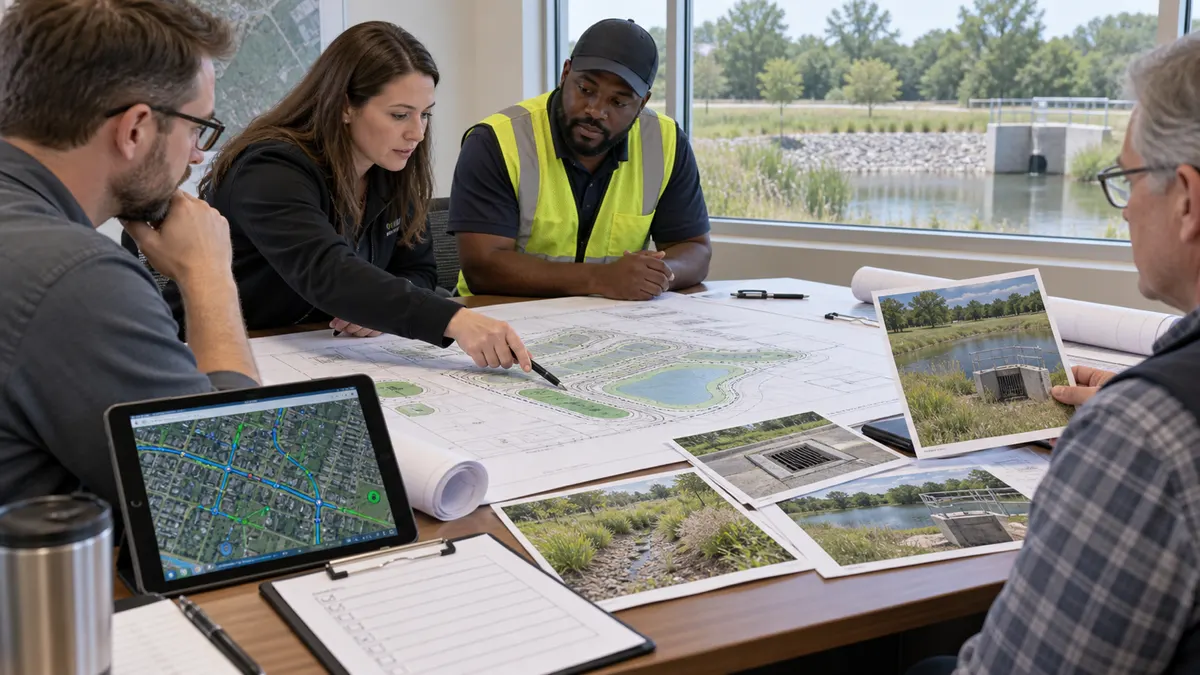
Project teams often ask which stormwater best management practice will satisfy a review comment, fit inside a tight site plan, or make a drainage report look complete. That question matters, but it is not enough. A BMP that looks appropriate on a plan sheet can become a long-term maintenance problem if the owner cannot access it, inspect it, fund it, clean it, or explain how it is supposed to function after construction.
For municipalities, BMP selection affects plan review consistency, public complaints, infrastructure budgets, and MS4 program documentation. For developers and property owners, it affects constructability, turnover, tenant expectations, HOA responsibilities, and future maintenance costs. For engineers, it affects whether the selected control matches the drainage area, soils, utilities, grades, receiving system, and ownership structure.
Good BMP selection is not only a water quality or volume-control exercise. It is a maintenance planning decision. The right practice should manage runoff in a way that supports local requirements, site constraints, and long-term stewardship. The wrong practice may still be built, but it can clog, erode, pond water unexpectedly, collect trash, become inaccessible, or shift responsibility to people who were never prepared to maintain it.
This post explains common BMP selection mistakes that create long-term maintenance problems and what to review before a project moves forward.
Who This Affects
BMP selection affects any project or program where stormwater controls must keep working after the contractor leaves the site. That includes private development, public works projects, roadway improvements, parking lot expansions, industrial yards, commercial campuses, subdivisions, multifamily sites, municipal retrofits, and redevelopment projects with limited space.
Municipal plan reviewers are affected because they often inherit the consequences of unclear maintenance assumptions. A plan may show a bioretention area, underground detention system, hydrodynamic separator, vegetated swale, filter strip, wet pond, or infiltration practice, but the reviewer still needs to know who will inspect it, where maintenance crews will access it, and how the owner will recognize when corrective action is needed.
Public works directors and stormwater managers are affected because poorly selected BMPs can become complaint generators. Standing water, blocked inlets, nuisance sediment, overgrown vegetation, mosquito concerns, failed plantings, and inaccessible outlet structures often become municipal issues even when the facility is privately owned. If the local ordinance or maintenance agreement is vague, staff may spend time sorting out responsibility after problems appear.
Developers and builders are affected because late BMP changes can trigger grading revisions, utility conflicts, easement revisions, landscaping changes, construction sequencing problems, and added review time. A BMP that is selected only to fill a plan-review gap can become expensive when the owner, lender, buyer, or municipality asks how it will be maintained.
Property owners, HOAs, facility managers, and industrial operators are affected because they usually live with the selected BMP after closeout. They need inspection frequencies, access routes, cleanout points, sediment management expectations, vegetation responsibilities, and practical budget assumptions. Without those details, the facility may be neglected until it fails, draws a complaint, or becomes a condition of sale or refinancing.
Civil engineers, landscape architects, and environmental compliance managers are affected because BMP selection connects design performance with operational reality. A technically acceptable practice can still be a poor choice if it cannot be maintained by the people responsible for it.
The Stormwater Planning Issue
Stormwater BMPs are often discussed as menu choices: detention pond, bioretention, bioswale, permeable pavement, proprietary treatment unit, underground storage, filter strip, wetland, infiltration trench, or catch basin insert. The planning issue is that each option carries a different maintenance profile. The selected practice must fit more than the hydraulic model. It must fit the people, equipment, access rights, budget, and inspection habits that will exist after construction.
EPA stormwater guidance and many local manuals emphasize that post-construction stormwater controls need long-term operation and maintenance. MS4 programs commonly address post-construction runoff through ordinances, plan review, enforceable maintenance responsibilities, and inspection or tracking procedures. Green infrastructure guidance also stresses that systems need routine inspection, sediment and debris removal, vegetation care, repair of erosion or clogs, and clear responsibility for maintenance.
Those are planning issues, not just end-of-project paperwork. If maintenance is treated as an afterthought, the project may select a BMP that is difficult to own. A landscaped bioretention cell may be placed where snow storage, sediment-laden runoff, or parking lot traffic will overwhelm it. An underground detention system may be selected without confirming inspection ports, confined-space considerations, vacuum truck access, or sediment removal costs. A wet pond may be shown without an access bench, forebay cleanout strategy, or clear responsibility for outlet structure inspection. A swale may be accepted as a simple solution even though the final grading, driveway crossings, utilities, and mowing limits make it hard to preserve the intended flow path.
The issue is not that one BMP type is always better than another. The issue is that BMP selection must match the site and the long-term owner. A public works department with established inspection routes, trained crews, and GIS-based asset tracking may be able to manage a BMP that would overwhelm a small HOA. A commercial property with a landscape contractor may be able to maintain vegetation but may not be prepared for sediment cleanout, structural repairs, or confined-space concerns. A developer may prefer an underground solution to preserve buildable area, while the future owner may face higher inspection and cleaning costs than expected.
Maintenance problems also arise when project teams separate water quality design from ordinary site operations. Trash enclosure drainage, loading areas, winter sanding, lawn care, tenant vehicle patterns, roof leaders, irrigation overspray, slope stability, and landscaping choices can all affect whether a BMP continues to function. If those operational factors are not reviewed during selection, the BMP may be technically present but practically vulnerable.
Another recurring issue is unclear ownership. A BMP may be located on a private parcel, within a common area, inside an easement, beside a public right of way, or downstream of multiple properties. If the final documents do not explain who owns it, who maintains it, who pays for it, and who can access it, the physical practice becomes an administrative problem. That problem is especially common in subdivisions, commercial outparcels, mixed-use developments, and phased projects where responsibilities change over time.
Plan reviewers and applicants can reduce these problems by evaluating maintenance at the same time they evaluate hydrology, water quality, and site layout. The goal is not to make every BMP simple. The goal is to select a practice whose inspection, maintenance, and ownership needs are understood before approval.
What To Review Before Moving Forward
Before a BMP is carried into final plans, review it as an asset that someone must operate for years. A practical review should include the following questions.
- What problem is the BMP solving?
Identify whether the practice is primarily serving water quality treatment, runoff volume reduction, peak flow control, erosion protection, flood mitigation, pretreatment, conveyance, or a combination of functions. A BMP selected for the wrong purpose can create maintenance expectations it cannot meet.
- Does the BMP match the drainage area?
Confirm the size, land use, impervious area, sediment load, pollutant exposure, slopes, and flow paths entering the practice. A BMP that receives too much sediment, trash, or concentrated flow may require more frequent maintenance than the owner expects.
- Is there enough physical access?
Show how inspectors and maintenance crews will reach inlets, outlets, forebays, cleanouts, underdrains, observation wells, pretreatment areas, valves, and embankments. Access should work after landscaping, fencing, parking, tenant improvements, and phased construction are complete.
- Can the maintenance equipment reach the facility?
A BMP that needs vacuum cleaning, sediment removal, mowing, media replacement, or structural repair should be reachable by the equipment that will perform those tasks. Turning radius, pavement strength, gate width, overhead clearance, and slope conditions may matter.
- Who will own and maintain it?
Identify the responsible party in plain language. For private BMPs, confirm whether the owner, HOA, property manager, tenant, contractor, or another party is expected to inspect and maintain the facility. For public BMPs, confirm which department will carry it in the work order system.
- Is the maintenance obligation enforceable and transferable?
Review easements, covenants, maintenance agreements, plats, permit conditions, and owner manuals. The responsibility should survive sale, lease changes, HOA turnover, and management changes.
- What routine tasks are expected?
List inspection, trash removal, sediment removal, vegetation care, mowing, inlet cleaning, outlet inspection, erosion repair, media replacement, pavement vacuuming, underdrain checks, and corrective maintenance triggers as applicable.
- Are inspection frequencies and triggers realistic?
Maintenance plans should not rely on vague language such as inspect regularly. The plan should describe when inspections occur and what observed conditions require action, such as clogged curb cuts, standing water beyond the intended drawdown period, sediment accumulation, erosion, dead vegetation, damaged outlet structures, or blocked access.
- Does the BMP conflict with normal site operations?
Review snow storage, landscaping contracts, trash pickup, loading docks, outdoor storage, vehicle circulation, pedestrian routes, irrigation, security fencing, and future tenant improvements. Many maintenance problems begin when a BMP is placed where routine operations will damage or obstruct it.
- Is pretreatment needed?
Practices that receive sediment-heavy runoff often need forebays, sumps, grass filter areas, stone diaphragms, inlet protection, or other pretreatment features. Without pretreatment, the main BMP may clog or fill faster than planned.
- Are utilities and easements clear?
Conflicts with water, sewer, gas, electric, telecom, drainage, access, and landscape easements can make maintenance difficult or prevent future repairs. The BMP layout should be checked against both existing and planned utilities.
- Does the owner understand lifecycle cost?
Selection should include a realistic discussion of inspection and maintenance cost, not only construction cost. A lower-cost BMP at construction may be a higher-cost choice over time if it needs specialized cleaning, media replacement, or frequent corrective work.
- Can the BMP be tracked?
Municipalities and large property owners benefit from assigning IDs, map locations, inspection forms, photographs, and maintenance history to each BMP. Asset tracking helps staff prioritize work and document program implementation.
This review does not replace engineering design or local permit requirements. It helps applicants, reviewers, and owners make a better selection before the project becomes difficult to change.
Planning, Permitting, or Compliance Support That Fits
Stormwaterplanning.us can support BMP selection by helping project teams connect design intent, permit expectations, maintenance responsibility, and long-term site operations. That support may fit during early site planning, civil plan review preparation, redevelopment feasibility, municipal program review, SWPPP coordination, post-construction stormwater planning, drainage studies, or stormwater asset documentation.
For developers, the value is often in finding maintenance conflicts before the civil package is submitted. A BMP that looks workable during concept design may need adjustment once utilities, grading, access drives, retaining walls, landscaping, and ownership boundaries are added. Reviewing the BMP early can help reduce redesign, clarify submittal narratives, and prepare practical maintenance information for reviewers and future owners.
For municipalities, support may include reviewing local BMP expectations, developing plan-review checklists, organizing post-construction inspection priorities, improving maintenance agreement templates, or connecting BMP inventories to GIS and asset management workflows. This can help staff ask more consistent questions and focus review time on issues that create long-term public burden.
For owners and facility managers, support may include documenting existing BMPs, identifying inspection needs, developing maintenance checklists, preparing owner-facing summaries, and clarifying what to discuss with contractors. Many sites have stormwater controls that were built years earlier but are poorly documented. A planning review can help organize what exists before a complaint, sale, audit, refinance, expansion, or repair project forces the issue.
The purpose is not to promise approval or eliminate all maintenance. Stormwater controls require care. The purpose is to make the selected BMP understandable, maintainable, and better aligned with the people who will be responsible for it.
Common Mistakes to Avoid
One common mistake is choosing the smallest visible footprint without reviewing future access. Underground systems, proprietary units, and compact treatment practices can be useful, especially on constrained sites, but they still need inspection and cleaning. If access is blocked by parking, curbs, landscaping, walls, gates, or tenant improvements, the BMP may become expensive or neglected.
Another mistake is assuming landscape maintenance equals stormwater maintenance. A rain garden or bioretention cell may look like landscaping, but it has hydraulic and water quality functions. Routine landscape crews may not recognize clogged inlets, sediment buildup, underdrain problems, erosion, improper mulch, failed check dams, or plant choices that interfere with flow.
A third mistake is placing BMPs where construction sequencing will damage them. Practices with engineered soil, infiltration surfaces, vegetation, or permeable media can be harmed by sediment, compaction, heavy equipment, or premature installation. Plans should explain how the BMP will be protected until the contributing area is stabilized.
A fourth mistake is omitting pretreatment. Sediment is one of the fastest ways to turn a good BMP into a maintenance problem. When runoff from pavement, disturbed soil, loading areas, or high-traffic areas reaches the BMP without pretreatment, clogging and cleanout needs can increase quickly.
A fifth mistake is leaving ownership vague. Statements such as owner to maintain are often not enough when multiple parties are involved. The final record should identify the responsible owner, inspection expectations, maintenance access, and any transfer obligations. This is especially important for HOAs, commercial subdivisions, mixed-use projects, shared facilities, and privately owned BMPs connected to public systems.
A sixth mistake is failing to plan for visible public expectations. Some green infrastructure is intended to look more natural than conventional landscaping. Some detention or retention systems are intended to hold water under certain conditions. If residents, tenants, elected officials, or maintenance crews do not understand the intended appearance and function, normal operation may be mistaken for failure, or actual failure may be missed.
A seventh mistake is selecting BMPs without considering staffing and equipment. A public agency may have vacuum trucks, inspection software, and trained crews. A small property owner may not. An HOA may have a landscape contract but no stormwater maintenance budget. A facility may have environmental staff for industrial compliance but no process for maintaining post-construction stormwater controls. The BMP should match real capacity.
An eighth mistake is treating the maintenance plan as a permit attachment rather than an operating document. A maintenance plan should be usable by the people who will inspect and maintain the facility. If it is buried in a technical report with unclear tasks, no map, and no practical triggers, it may not guide field work.
Finally, avoid assuming that a familiar BMP is automatically the best choice. Detention basins, swales, filters, permeable pavement, and bioretention systems can all work well in the right setting. They can also create problems when the drainage area, soils, access, ownership, or maintenance capacity do not fit.
Next Step
Before finalizing a stormwater BMP, review it as both a design feature and a long-term asset. Confirm what runoff problem it solves, who will own it, how crews will reach it, what routine maintenance is expected, what documents make responsibility clear, and whether the future owner has the capacity to keep it functioning.
For municipalities, this review can make plan comments more consistent and reduce future maintenance disputes. For developers, it can reduce late redesign and help prepare stronger submittals. For property owners and facility managers, it can turn a confusing stormwater feature into a manageable responsibility.
The best BMP is not only the one that fits the drawing. It is the one that can still be inspected, maintained, explained, and defended years after construction is complete.