
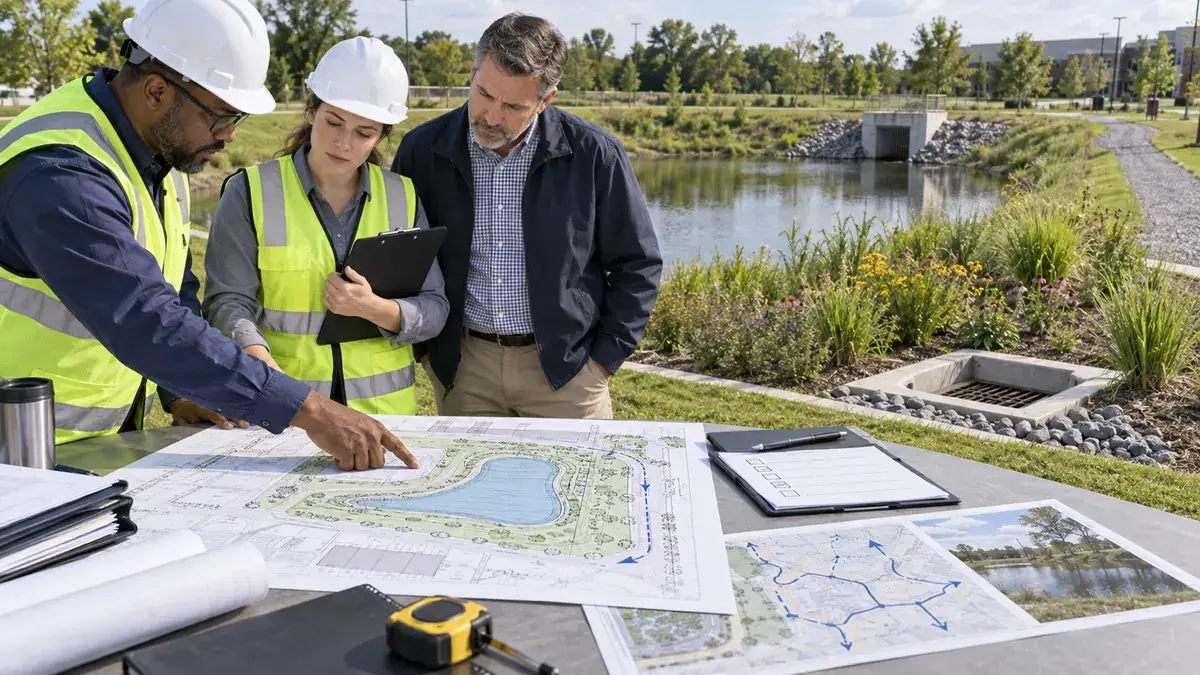
Project teams often ask about stormwater maintenance after a site is built, a certificate of occupancy is near, or the developer is preparing to turn responsibilities over to an owner, HOA, facility manager, campus maintenance group, or municipal department. The practical question is simple: what should be documented before closeout so the stormwater system can be inspected, maintained, funded, and understood after construction?
That question matters because post-construction stormwater controls do not manage runoff by themselves forever. Detention ponds, bioretention cells, underground detention, proprietary treatment structures, inlet filters, swales, permeable pavement, outlet control structures, pretreatment forebays, and green infrastructure all depend on routine attention. Sediment accumulates. Vegetation changes. Inlets clog. Access routes become blocked. Ownership changes. Contractors leave. Review staff move on to the next project.
For municipalities, a weak maintenance plan can become a long-term public works issue, even when the facility is privately owned. Staff may receive drainage complaints, ponding reports, mosquito concerns, erosion calls, or questions about who is responsible for a failing BMP. For developers, incomplete maintenance planning can delay closeout, complicate bond release, or create difficult handoff conversations with buyers and associations. For owners and facility managers, missing documentation can turn a manageable inspection program into guesswork.
A practical post-construction stormwater maintenance plan does not have to be complicated. It should identify what exists on the site, who is responsible, how access will be maintained, what inspections should look for, how records will be kept, and how funding or internal work orders will support the system over time. The goal is not to guarantee compliance outcomes or eliminate every future maintenance need. The goal is to support compliance planning, reduce confusion, and make the stormwater responsibilities visible before the project is considered finished.
Who This Affects
Post-construction stormwater maintenance planning affects any project where stormwater controls remain in place after construction. That includes commercial sites, multifamily developments, subdivisions, municipal facilities, roadway projects, schools, campuses, industrial sites, public works yards, retail centers, healthcare campuses, parks, redevelopment projects, and infill sites with small but critical BMPs.
Municipal planners, city engineers, stormwater program managers, public works directors, and plan reviewers are directly affected because they often have to decide whether the maintenance documentation is complete enough for approval, closeout, or long-term tracking. If the municipality operates under an MS4 permit, post-construction runoff control and related recordkeeping may also connect to the community's stormwater management program. The specific permit language varies by state and community, but the need for clear maintenance responsibility is a common planning issue.
Developers, builders, and construction managers are affected because maintenance planning can influence project closeout, final inspections, punch lists, as-built review, easement acceptance, bond release, and owner turnover. A stormwater control that was designed correctly can still create conflict if nobody knows who must mow, clean, inspect, repair, or pay for it after the contractor leaves.
Civil engineering firms and landscape architects are affected because their plans, details, and maintenance notes often become the first source of information for future owners. If the drawings show a BMP but the closeout package does not explain access, inspection points, sediment removal, vegetation care, or responsible parties, the design intent can be lost.
Property owners, HOAs, facility managers, industrial compliance managers, and campus operations teams are affected because they inherit the daily reality. They need to know where the facilities are, what they do, what should be checked, what records to keep, which vendors may be needed, and when a concern should be elevated to an engineer or the municipality.
Lenders, buyers, real estate managers, and due diligence teams may also care. Stormwater facilities can carry maintenance obligations, easements, covenants, and future costs that should be understood before purchase, refinance, tenant turnover, or site expansion.
The Stormwater Planning Issue
The planning issue is that stormwater maintenance is often treated as a final administrative item instead of a core part of the project. During design, attention naturally goes to drainage calculations, grading, pipe sizing, water quality volume, peak flow control, erosion control, site layout, and review comments. During construction, attention shifts to sequencing, inspections, stabilization, utilities, paving, landscaping, and punch lists. Maintenance planning sometimes waits until the end, when staff are trying to close permits and move the project off their desks.
That timing creates several problems. First, the people responsible for long-term maintenance may not have been involved in design decisions. A facility manager may learn about an underground detention system only after the keys are handed over. An HOA board may receive a maintenance agreement but not understand which pond, forebay, riser, or outlet it covers. A public works department may accept a facility without clear access expectations or record formats.
Second, the maintenance plan may not match the installed condition. Construction adjustments, utility conflicts, field changes, landscaping substitutions, sediment accumulation, and access changes can all affect how a BMP should be inspected. A plan that is copied from a generic template may miss the structures actually present on the site.
Third, the responsible party may be unclear. Ownership and maintenance responsibility are not always the same as physical location. A drainage easement may cross private land. A pond may serve multiple parcels. A commercial owner may rely on a landscape contractor that does not inspect outlet structures. A municipality may own the receiving system but not the private BMP. If these roles are not documented before closeout, confusion often appears only after a problem occurs.
EPA stormwater resources emphasize operation and maintenance planning as part of keeping stormwater controls functional. EPA's stormwater maintenance guidance notes that O&M plans can include responsible parties, maintenance schedules, inspection requirements, inspection frequency, easements or covenants, funding sources, and descriptions of maintenance activities such as sediment removal, vegetation care, and inlet or outlet cleaning. That framework is useful because it connects maintenance to assignable work, not just design intent.
For MS4 communities, post-construction stormwater controls may also be part of the broader stormwater management program. EPA describes regulated MS4 operators as developing, implementing, and enforcing stormwater management programs that address program areas including post-construction runoff control. Local requirements differ, and state permits control the specific obligations, but municipalities generally benefit from maintenance records that are organized, repeatable, and easy to explain.
For developers and owners, the issue is not only regulatory. It is operational. A pond with no access route is hard to dredge. A bioretention area without pretreatment may clog early. A proprietary device without a vendor contact or cleanout schedule may be ignored. A maintenance agreement without a budget pathway may sit in a closing binder while sediment, trash, vegetation, and erosion slowly reduce performance.
What To Review Before Moving Forward
Before a project closes out, teams should review the maintenance plan against the actual stormwater system and the people who will manage it. The following checklist can help municipalities, developers, owners, and engineers organize the discussion.
- Confirm the final inventory. List every stormwater control that requires ongoing attention, including ponds, outlet structures, forebays, underground storage, treatment units, bioretention areas, swales, infiltration practices, permeable pavement, pretreatment devices, flow splitters, level spreaders, check dams, roof drain connections, inlets, and critical conveyance features.
- Compare the plan to as-built conditions. Maintenance documents should reflect what was constructed, not only what appeared on early design drawings. Check final grading, pipe inverts, control structures, access points, easements, landscaping, utilities, and any field changes.
- Identify responsible parties by task. Avoid a vague statement that "the owner" maintains everything. Name who inspects, who performs routine landscape care, who removes sediment, who cleans inlets or proprietary devices, who responds to erosion, who maintains records, and who contacts the municipality when repairs are needed.
- Confirm access for maintenance equipment. Review whether staff or contractors can reach forebays, outlet structures, manholes, underground vaults, inlet filters, pond banks, emergency spillways, and vegetation areas. Access should account for gates, pavement strength, slopes, fences, landscaping, parked vehicles, snow storage, and locked areas.
- Define inspection frequency and triggers. The plan should explain routine inspection intervals and event-based triggers where appropriate. Examples may include inspections after major storms, during seasonal transitions, after landscaping establishment, before bond release, or after tenant changes. Frequencies should align with local requirements and practical site conditions.
- Describe what inspectors should look for. Useful inspection forms usually include sediment, trash, clogging, standing water, erosion, bank stability, vegetation condition, invasive plants, dead plantings, inlet and outlet condition, structural damage, animal burrows, access obstructions, pavement settlement, and evidence of bypass or short-circuiting.
- Clarify sediment and debris handling. Sediment removal is often easy to mention and hard to execute. The plan should identify where sediment is expected to accumulate, how it will be measured or observed, who will remove it, how access will be managed, and how disposal decisions will be documented.
- Include vegetation expectations. Vegetated BMPs need more than mowing. Plans should address establishment, watering if needed, mulch replacement, invasive species, dead plant replacement, seasonal cutbacks, tree and shrub conflicts, and the difference between intentional vegetation and neglected growth.
- Connect proprietary devices to vendor information. If the site includes manufactured treatment units, cartridges, filters, separators, or inserts, the owner should receive model information, maintenance instructions, cleanout indicators, vendor or contractor contacts, and inspection forms that match the installed unit.
- Review easements and covenants. Maintenance obligations may be embedded in recorded documents, development agreements, plats, HOA declarations, or permits. Closeout is a good time to confirm that the maintenance plan and recorded documents tell the same story.
- Establish a recordkeeping location. Decide where inspection forms, photos, work orders, maintenance invoices, sediment removal logs, contractor reports, and repair notes will be stored. A maintenance plan is more useful when records can be found during annual reporting, sale, refinance, complaint response, or municipal review.
- Tie the plan to funding or work orders. A maintenance obligation without a budget pathway is fragile. Owners should decide whether tasks are handled by site staff, landscape contractors, stormwater maintenance vendors, public works crews, asset management systems, HOA reserves, or capital repair planning.
- Prepare turnover materials. The final closeout package should include the maintenance plan, as-built drawings, contact list, easement information, inspection forms, photos of key structures, map of access routes, emergency contact process, and any local approval or permit references.
This review does not need to slow the project if it starts early. The best time to confirm maintenance access, ownership, and inspection expectations is before grading and landscaping make changes expensive. The second-best time is before closeout, while the construction team, engineer, developer, reviewer, and future owner can still compare notes.
Planning, Permitting, or Compliance Support That Fits
Stormwater Planning can support municipalities, developers, engineering teams, owners, and facility managers that need clearer post-construction stormwater maintenance documentation. The most useful support usually starts with the real site conditions, local requirements, and responsible parties, then turns those details into a maintenance package that people can actually use.
For municipalities and MS4 communities, support may include reviewing post-construction maintenance documentation, organizing inspection forms, checking whether maintenance agreements match the installed stormwater controls, building internal review checklists, and helping staff connect private BMP records to broader stormwater program tracking. This can support compliance planning and reduce ambiguity during annual reporting or program review, while recognizing that permit acceptance depends on the applicable regulatory authority.
For developers and builders, support may include preparing closeout-ready stormwater maintenance materials, identifying missing turnover information, coordinating with civil drawings and as-built records, and clarifying what the future owner or HOA should receive before acceptance. Good documentation can reduce review delays and make turnover less reactive.
For property owners, HOAs, facility managers, campuses, and industrial operators, support may include creating inspection logs, maintenance schedules, photo documentation templates, vendor scopes, drainage asset summaries, and practical checklists for staff or contractors. The focus is not to create a binder for its own sake. The focus is to make maintenance responsibilities easy to understand before small issues become expensive repairs.
For civil engineering and land development teams, support may include translating design assumptions into operational language, reviewing BMP access and maintainability, preparing maintenance narratives, and helping align plan notes with local post-construction requirements.
Common Mistakes to Avoid
One common mistake is treating the maintenance plan as a generic attachment. Templates can be useful, but a plan that does not reflect the specific site, BMP types, access routes, and owner responsibilities will not help much after closeout.
Another mistake is waiting until the final inspection to discuss maintenance responsibility. By then, grading is complete, landscaping is installed, utilities are buried, and ownership turnover may already be underway. If access is poor or the responsible party is unclear, fixing the issue can be more difficult than addressing it during design or preconstruction.
Some teams confuse landscape maintenance with stormwater maintenance. Mowing, mulch, and plant care matter, but they are not the same as inspecting inlets, measuring sediment, checking outlet structures, cleaning forebays, reviewing underdrains, or confirming that a control is draining as intended.
Another common problem is failing to document underground or less visible systems. Underground detention, proprietary treatment devices, and inlet filters can disappear from attention because they are out of sight. Owners need maps, structure IDs, access details, and cleanout guidance.
Municipalities sometimes accept maintenance agreements without confirming that the agreement matches the constructed system. If the recorded document names a pond but the site also includes bioretention, underground storage, and proprietary treatment, future enforcement or communication may become harder.
Developers sometimes turn over documents without explaining them to the future owner or HOA. A closing binder is not the same as operational readiness. Someone should know what the facilities are, where they are, how often to inspect them, and whom to call when sediment, erosion, clogging, or structural damage appears.
Owners sometimes assume the municipality will handle stormwater facilities because they connect to a public storm drain. In many cases, private BMPs remain privately maintained even when they discharge to public infrastructure. Responsibility should be confirmed in local approvals, easements, covenants, and maintenance agreements.
Another mistake is skipping photos and maps. A simple photo log of outlet structures, inlets, forebays, access routes, and vegetation areas can save time later when staff, vendors, or new owners are trying to understand the system.
Finally, many plans fail because they do not connect maintenance to money or scheduling. If there is no budget, work order pathway, vendor scope, or inspection calendar, the plan depends on memory. Stormwater systems deserve a more durable process.
Next Step
Before closeout, gather the as-built plans, maintenance agreement, BMP inventory, inspection forms, access route information, and responsible-party contacts. Then walk through the site or review recent photos with the future owner, municipal reviewer, engineer, or maintenance lead. Ask whether each stormwater control can be found, accessed, inspected, cleaned, repaired, documented, and funded.
If the answer is unclear, the maintenance plan is not finished yet. That does not mean the project is failing. It means the team still has an opportunity to make the handoff stronger before responsibilities scatter across owners, contractors, departments, and future staff.
Post-construction stormwater maintenance planning works best when it is practical, specific, and tied to real people. A clear plan can help municipalities manage program records, help developers close projects with fewer loose ends, and help owners keep stormwater controls functioning after construction is complete.