
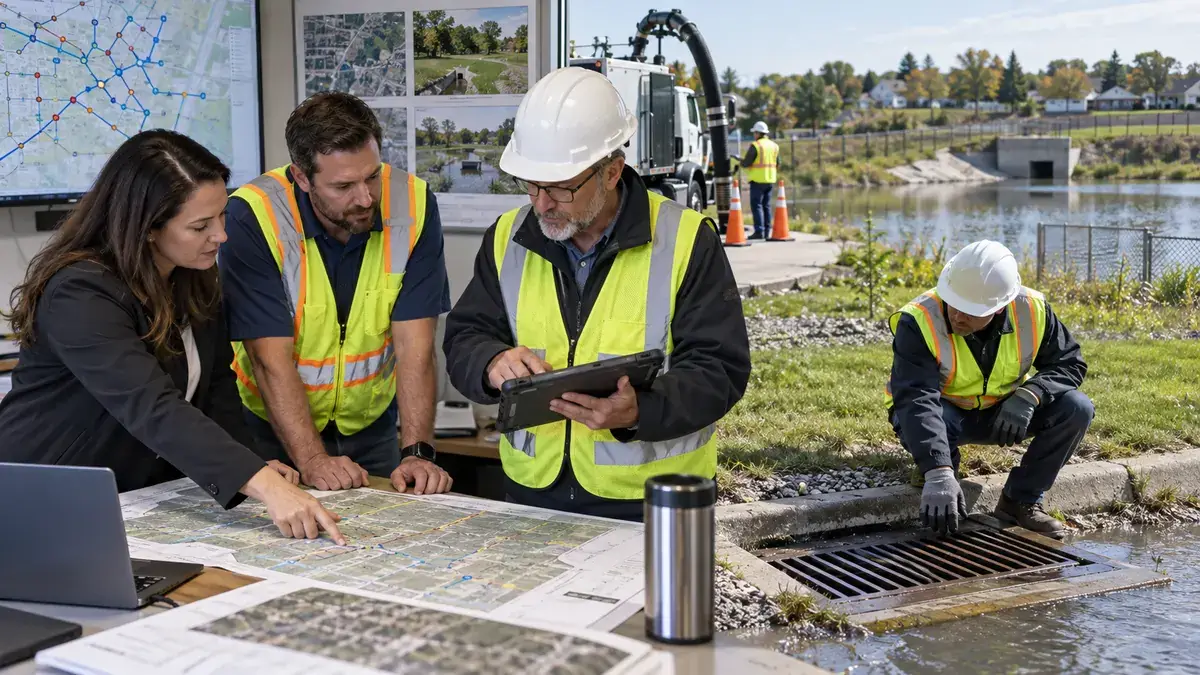
Municipal stormwater teams often receive more drainage complaints than they can investigate at once. Residents report yard flooding, street ponding, clogged inlets, ditch erosion, basement seepage, failing culverts, and runoff from nearby development. Each complaint matters to the person affected, but public works staff need a fair and defensible way to decide what to review first, what to document, and which issues belong in maintenance, capital planning, enforcement, or private property follow-up.
The practical question is how a city, county, or drainage district can prioritize complaints without relying only on who calls most often. A good stormwater planning process turns scattered reports into a usable workflow. It connects field observations, asset data, rainfall context, public safety, water quality, maintenance capacity, and long-term capital needs. It does not promise that every drainage concern has a quick fix, but it helps the agency make better decisions and explain those decisions more clearly.
Who This Affects
This issue affects public works directors, city engineers, county engineers, MS4 program managers, stormwater utility staff, maintenance supervisors, planning departments, elected officials, and customer service teams who receive drainage calls. It also affects developers and property owners because recurring complaints can reveal gaps in plan review, maintenance responsibility, easements, construction sequencing, or post-construction stormwater controls.
Small municipalities may feel the pressure most sharply because the same staff members often handle roads, drainage, utilities, inspections, and resident communication. Larger communities may have more data, but they also receive higher call volume and face more complicated handoffs between departments. In both settings, the need is the same: create a consistent screening process that helps staff separate urgent risks from routine maintenance and long-range improvement needs.
Industrial sites, HOAs, school districts, commercial property owners, and facility managers can learn from the same approach. When multiple buildings or properties report drainage problems, the owner needs a way to rank issues, document causes, and decide whether the next step is cleaning, repair, design review, erosion control, or a broader drainage study.
The Stormwater Planning Issue
Drainage complaints are difficult because they combine public expectation, infrastructure limits, private property conditions, weather variability, and regulatory context. A road may pond because an inlet is blocked by leaves. A yard may flood because a downstream ditch has filled with sediment. A culvert may be undersized for today's runoff pattern. A new development may have changed overland flow. A basement complaint may involve grading, groundwater, sump discharge, sanitary issues, or roof leaders. Treating all complaints the same wastes time and can miss the issues that pose the greatest public risk.
A planning-based approach begins with intake. Staff should record the location, date, rainfall timing if known, type of problem, observed depth or duration, affected structures or roads, photographs, prior reports, and whether public infrastructure appears involved. The intake form should avoid promising an outcome. Its purpose is to create a reliable record so the agency can triage the issue and assign the right review path.
The next step is classification. Some reports are immediate safety concerns, such as flooded travel lanes, open structures, sinkholes near storm pipes, failed culverts, or erosion threatening a road. Some are maintenance issues, such as clogged inlets, blocked ditches, sedimented pipes, or damaged grates. Some require engineering review because the complaint suggests insufficient capacity, changed flow paths, repeated structure flooding, or a conflict between public and private drainage responsibilities. Some may belong to code enforcement, development review, or private property owners rather than the stormwater utility.
MS4 communities also need to consider water quality and illicit discharge implications. A drainage complaint involving unusual color, odor, dumping, dry weather flow, or suspected contamination may need to route through outfall screening or IDDE procedures rather than ordinary maintenance. Construction-related sediment leaving a site may need inspection or permit follow-up. Industrial outdoor operations may need review under the facility's stormwater responsibilities. Prioritization should recognize these program obligations.
What To Review Before Moving Forward
- Is there an immediate public safety risk, such as road flooding, structure flooding, sinkhole formation, exposed infrastructure, or erosion threatening utilities?
- Does the complaint involve public infrastructure, private grading, an easement, a roadside ditch, a subdivision system, or an unclear ownership boundary?
- Has the same location been reported before, and do prior records show a pattern after specific storm sizes?
- Are photographs, field notes, rainfall data, and asset maps available to support the decision?
- Does the issue appear to be maintenance, capacity, erosion, water quality, development review, or private property drainage?
- Are there MS4, NPDES, construction stormwater, or IDDE implications that require a different workflow?
- Is a quick field inspection enough, or does the site need survey, modeling, CCTV, utility locating, or engineering analysis?
- Could a temporary maintenance action reduce near-term risk while a longer-term project is scoped?
- Does the agency have a clear way to communicate next steps to the resident or property owner?
Agencies should also review the condition and completeness of their storm drain asset inventory. Prioritization is much harder when inlets, pipes, outfalls, ditches, culverts, easements, and detention facilities are missing from the map. GIS mapping does not need to be perfect before it becomes useful. Even a practical inventory that improves over time can help staff see complaint clusters and plan maintenance routes.
Rainfall context matters. A location that floods during a rare, intense storm may need a different response than a location that ponds during ordinary rainfall. Staff should avoid dismissing complaints solely because the storm was large, but they should document the rainfall context so the response is proportional. This helps distinguish design capacity issues, maintenance failures, and extreme-event limitations.
Planning, Permitting, or Compliance Support That Fits
Stormwaterplanning.us can support this kind of work through drainage complaint program review, stormwater system assessment, GIS asset mapping, MS4 support, maintenance planning, drainage studies, and capital improvement scoping. The right service path depends on the pattern behind the complaints. A single clogged inlet may need maintenance. A neighborhood with repeated street flooding may need a drainage study. A citywide backlog may need a complaint triage framework and asset inventory. An MS4 community may need documentation that connects complaints to inspections, IDDE review, and maintenance records.
For municipalities, planning support can help staff create a repeatable intake and prioritization process. That process can define categories, response times, field review steps, documentation expectations, and escalation triggers. It can also help staff communicate limits: some drainage problems can be fixed by public maintenance, some require capital projects, and some remain private property responsibilities.
For developers and engineers, the same planning mindset supports civil submittals. If a proposed project is near known drainage complaints, the design team should review existing flow paths, downstream constraints, detention assumptions, and maintenance responsibilities early. Addressing those questions before submittal can reduce review delays and improve public meeting preparation.
For property owners and facility managers, documentation can clarify what is happening before calling for design help. Photos, dates, storm conditions, flow direction, inlet condition, and prior maintenance records help a consultant or public agency understand the problem faster. Better information does not guarantee approval or funding, but it supports clearer decisions.
Common Mistakes to Avoid
One mistake is treating the loudest complaint as the highest priority. Public communication matters, but prioritization should be based on risk, recurrence, infrastructure role, public safety, water quality, and available evidence. A quieter location may involve a failing culvert or road risk that deserves faster review.
Another mistake is sending every complaint directly to engineering. Some issues are routine maintenance, and engineering review can slow resolution if the inlet simply needs cleaning. The opposite mistake is also common: sending every complaint to maintenance without identifying repeated capacity problems. A strong process includes both paths and a way to move a complaint from one path to another when evidence changes.
Agencies also make trouble for themselves when they fail to document why a decision was made. If staff decide that a problem is private property drainage, the file should explain the basis for that conclusion. If a capital project is needed but not yet funded, the record should show the risk, scope, and interim steps. Documentation helps future staff understand the history and respond consistently.
A final mistake is ignoring data that already exists. Work orders, resident calls, field photos, inlet cleaning logs, pipe inspections, flood reports, and plan review comments may sit in separate systems. A stormwater planning effort can bring those records together enough to reveal patterns. The goal is not a perfect database on day one. The goal is better decisions from the data the agency already has.
Next Step
Before the next storm season, municipalities should review how drainage complaints are received, categorized, inspected, documented, and escalated. Start with a small set of practical categories: immediate safety, maintenance, engineering review, water quality or IDDE, development related, and private property. Then connect those categories to response steps and records.
Prioritizing drainage complaints is not about saying no to residents. It is about giving public works teams a fair process for deciding what needs attention first, what information is missing, and what belongs in the maintenance budget, capital plan, MS4 program, or development review workflow. A clear stormwater planning process can reduce confusion, improve response consistency, and help communities make better long-term drainage decisions.