
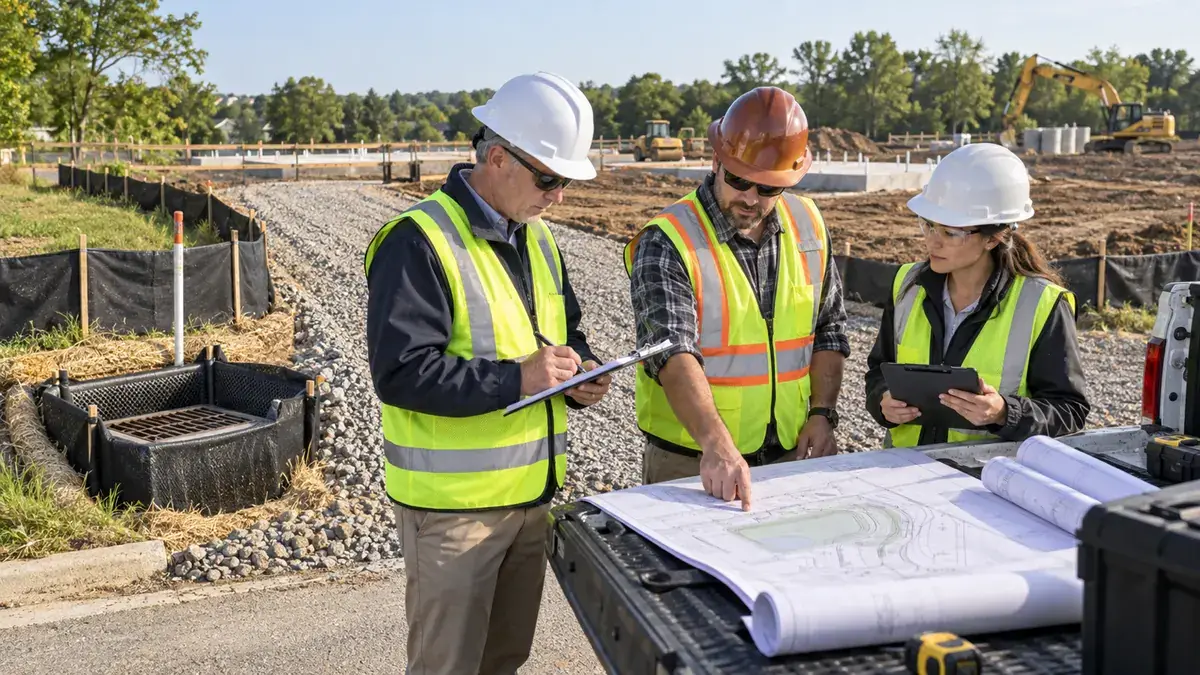
Construction teams, developers, municipal reviewers, and site owners often search for SWPPP inspection guidance when a project is about to move from approved plans into active land disturbance. The practical question is rarely whether inspections matter. Most teams already know that construction stormwater permits, local grading approvals, and owner requirements can require regular site inspections, corrective action documentation, and records that show how erosion, sediment, and pollution prevention controls are being maintained. The harder question is how to organize the inspection process before the site gets busy.
That timing matters. Once clearing, grading, utility work, hauling, and subcontractor coordination begin, the stormwater inspection process competes with schedule pressure, weather, deliveries, plan changes, and daily field decisions. If the SWPPP is treated as a binder that simply exists somewhere in the trailer, inspections can become reactive. The inspector may not have the current plan sheet, the superintendent may not know which controls were changed, and corrective action items may be discussed verbally without a clear closeout record. Those gaps can create confusion for owners, contractors, engineers, and municipal staff, even when the project team is trying to do the right thing.
Good SWPPP inspection planning is not just a compliance exercise. It is a project management habit. It helps the site team understand where stormwater flows, which controls need frequent attention, who has authority to request repairs, how inspection findings will be documented, and how changes in phasing will be reflected in the SWPPP. It also helps municipalities and public works staff review construction activity with fewer surprises because the project team can show a consistent record of site conditions, maintenance decisions, and follow-through.
This article focuses on what to organize before the first rain event, the first inspection, or the first week of active grading. It is not legal advice and does not replace the applicable permit, local ordinance, or engineer of record. It is a planning framework for teams that want inspection records to be useful, timely, and connected to real site conditions.
Who This Affects
SWPPP inspection planning affects any project team responsible for construction stormwater documentation, especially when land disturbance, exposed soil, temporary drainage changes, or construction materials could affect runoff quality.
The most common roles include:
- Developers and owners preparing to start site work after civil plan approval
- General contractors and site superintendents responsible for daily coordination
- Excavation, grading, utility, paving, and landscape contractors
- Civil engineers and environmental consultants supporting SWPPP preparation
- Qualified inspectors conducting routine inspections or rain-event inspections
- Municipal engineers, public works staff, and planning departments reviewing active construction sites
- MS4 program managers responsible for construction site runoff control programs
- Facility owners expanding yards, parking areas, industrial pads, or drainage infrastructure
- Construction managers overseeing multiple contractors across phased work areas
The issue also affects smaller projects that may not feel complicated at first. A short utility extension, a commercial pad site, a storage yard expansion, a residential subdivision phase, or a municipal facility improvement can all create inspection challenges if the team does not decide in advance how controls will be checked, repaired, and documented. The need is not limited to large projects with full-time environmental staff.
Municipalities have a related interest. Local construction site runoff programs often rely on clear owner and operator documentation, field-accessible SWPPP records, and visible maintenance of erosion and sediment controls. When the project team has a working inspection process, municipal follow-up tends to be more focused. Staff can review facts instead of reconstructing events from memory.
The Stormwater Planning Issue
The core planning problem is that SWPPP inspections are often assigned after the project is already moving. The permit coverage may be active, the erosion control plan may be approved, and controls may be installed, but the inspection workflow itself may not be ready.
That creates several practical problems.
First, the person conducting inspections may not have the current project information. They need to know the location of installed controls, areas of active disturbance, drainage patterns, stabilization status, material storage areas, concrete washout locations, dewatering activities if present, and any changes since the last inspection. If that information lives only in separate emails, plan markups, or superintendent notes, the inspection record can lag behind the site.
Second, inspection frequency can become unclear. Requirements vary by permit authority and project situation, so teams need to confirm the applicable schedule before work begins. Some programs require routine inspections at set intervals, inspections associated with qualifying rain events, or different approaches once areas are stabilized or inactive. EPA construction stormwater materials emphasize that operators should follow the applicable permit and document site-specific inspection and corrective action records. The key planning lesson is simple: do not wait until rain is in the forecast to decide how the inspection clock works.
Third, corrective action can become informal. An inspector may identify a damaged inlet protection device, sediment tracked onto pavement, an undermined silt fence, an unstable stockpile, or a washout area that needs attention. If the project team does not have a clear handoff process, the finding may be mentioned at the end of the site walk but never tracked to completion. That weakens the practical value of the inspection, and it can make later reviews harder for owners, contractors, and municipal staff.
Fourth, the SWPPP may not keep pace with phasing. Construction sites change quickly. A drainage swale may be rough graded one week and used for temporary conveyance the next. A stabilized construction entrance may move. A basin may transition from temporary sediment control to permanent stormwater function. A subcontractor may stage materials in an area that was not originally expected to be active. If inspection findings are not connected to SWPPP updates, the plan can become a historical document instead of a field guide.
Finally, teams sometimes confuse inspection documentation with proof that nothing is wrong. A useful inspection record does not have to show a perfect site. It should show that the team looked at the right areas, understood the controls, identified maintenance needs, documented corrective actions when needed, and followed up. That is a more realistic and defensible goal for active construction.
For municipalities and MS4 communities, this issue connects to construction site runoff control. EPA describes construction site runoff control as a required program area for regulated MS4s, and local programs often need enough site documentation to understand whether erosion, sediment, and pollution prevention controls are being implemented and maintained. A well-organized SWPPP inspection process supports that local oversight without suggesting that any one document guarantees permit acceptance or compliance outcomes.
What To Review Before Moving Forward
Before construction starts, the project team should hold a focused SWPPP inspection planning review. This does not need to be a long meeting, but it should produce clear answers. The goal is to make sure the field team, inspector, owner, and engineer understand the same process.
- Confirm the applicable permit and local requirements. Identify the construction stormwater permit, local grading permit, MS4 requirements, owner standards, and any special conditions that affect inspection frequency, documentation, stabilization, dewatering, or impaired waters.
- Confirm who is responsible for inspections. Name the qualified person or inspection provider, identify backup coverage, and clarify whether the inspector has authority to request immediate maintenance or must route findings through the superintendent.
- Confirm when inspections begin. Tie the inspection start point to permit coverage, actual construction activity, local notice requirements, and mobilization timing. If there is a delay after permit coverage, document how the team will explain the timing and update records.
- Confirm the inspection schedule. Document routine inspection intervals, rain-related inspection triggers if applicable, inactive period procedures, winter or seasonal considerations, and how the team will track dates.
- Confirm site access. Make sure inspectors can reach active areas, perimeter controls, discharge points, inlets, basins, stockpiles, staging areas, dewatering locations, and material storage areas safely.
- Confirm the current plan set. Inspectors should have the latest erosion and sediment control plan, grading plan, drainage plan, SWPPP narrative, phasing plan, and any field-approved revisions.
- Confirm the map of inspection areas. The inspection route should cover disturbed areas, stormwater controls, drainage paths, discharge points, material and waste areas, equipment maintenance areas, and areas where runoff leaves or enters the site.
- Confirm how findings become work orders. Decide whether corrective actions will be assigned through project management software, email, daily reports, shared logs, or a specific maintenance ticket process.
- Confirm deadlines and closeout documentation. The team should know how corrective actions will be dated, photographed, assigned, completed, and verified.
- Confirm who updates the SWPPP. If controls move, phasing changes, or drainage patterns shift, decide who updates the plan and how the inspector will receive the new version.
- Confirm photo standards. Photos should show context, location, and condition. A close-up of a failed control is useful, but a wider image that shows where it sits in the drainage path is often more useful.
- Confirm weather tracking. Decide which weather source will be used, who records rainfall when needed, and how forecasted storms will be communicated to field crews.
- Confirm stabilization tracking. The inspection process should note areas where grading is complete, where work is temporarily paused, and where stabilization measures have been installed or need attention.
- Confirm dewatering procedures if dewatering may occur. Pumping, filtration, discharge location, monitoring requirements, and records should be planned before water is encountered.
- Confirm municipal communication. If the local jurisdiction conducts inspections, requires notices, or requests records, decide who will respond and where the supporting documentation will be stored.
This review is most useful when it happens before the first inspection is due. A project team can also repeat the review at phase changes, before major grading transitions, before winter shutdown, before paving, and before final stabilization.
Planning, Permitting, or Compliance Support That Fits
Stormwaterplanning.us can support SWPPP inspection planning by helping owners, contractors, developers, and municipal teams organize the practical pieces that sit between the approved plan and the active site.
That support may include reviewing construction stormwater documentation, preparing or updating SWPPP materials, building inspection checklists, aligning inspection routes with drainage patterns, organizing corrective action logs, reviewing erosion and sediment control sequencing, and helping teams prepare for municipal or owner oversight. For projects with phased construction, support may also include keeping SWPPP materials aligned with site changes so field inspections reflect the work that is actually happening.
For municipalities and MS4 programs, support can focus on construction site runoff review procedures, documentation expectations, inspection forms, staff checklists, and ways to evaluate whether local records are consistent across projects. The objective is not to promise a specific regulatory outcome. The objective is to help the team clarify responsibilities, reduce avoidable review delays, and maintain records that are easier to understand when questions arise.
For developers and contractors, early inspection planning can also reduce friction between the office and the field. The civil plans may show where controls should go, but the inspection process helps confirm whether those controls are installed, maintained, and adjusted as conditions change. When responsibilities are clear, site teams are less likely to lose time deciding who should repair a control, who should update the plan, or where the latest inspection report is stored.
The best time to set up this support is before mobilization or immediately after permit coverage is active. The second-best time is before the next major phase change. Waiting until a failed inspection, complaint, or rain event usually makes the process more rushed.
Common Mistakes to Avoid
One common mistake is treating the SWPPP as a static document. A SWPPP should describe site-specific conditions and planned controls, but construction changes. If the plan does not reflect current phasing, inspection records become harder to interpret.
Another mistake is assigning inspections without confirming qualifications and expectations. The inspector needs to understand the site, the controls, the applicable inspection procedures, and the documentation requirements. A name on a schedule is not enough if that person does not have current information or access.
A third mistake is failing to plan inspection routes. Inspectors can miss important areas when they walk only the most active part of the site. Perimeter controls, discharge points, stabilized entrances, stockpiles, waste areas, basins, temporary swales, and downstream inlets may all need attention depending on the project.
Teams also get into trouble when corrective actions are not tracked to completion. It is not enough to write that inlet protection needs maintenance. The record should show who was responsible, when the repair was completed, and how closeout was verified.
Another common issue is weak photo documentation. Photos without location context can be difficult to use later. A good record often includes both overview photos and detail photos, with enough description that someone who was not present can understand the condition.
Some projects overlook weather documentation until after a storm. If rainfall matters to inspection timing or corrective action decisions, the team should agree on the weather source, recording method, and communication process before the first event.
Another mistake is ignoring temporary drainage changes. Field grading, utility trenches, haul roads, and temporary berms can redirect runoff. If inspections are based only on the original plan sheet, the team may miss how water is actually moving across the site.
Contractor turnover can also weaken the process. A superintendent, foreman, or subcontractor may change mid-project. If inspection procedures live only in one person’s memory, documentation quality can drop quickly. A written workflow and shared records reduce that risk.
Projects sometimes wait too long to update stabilization status. Areas that are complete, inactive, temporarily stabilized, or permanently stabilized should be tracked because stabilization affects maintenance priorities and, in some cases, inspection procedures.
Finally, teams may assume municipal inspectors and project inspectors are doing the same job. They are related but not identical. Municipal staff may review permit conditions, local ordinance requirements, public impacts, or MS4 program expectations. The project’s SWPPP inspections should still be organized and documented as the project team’s own process.
Next Step
Before the first rain, first inspection, or first full week of grading, gather the project owner, superintendent, SWPPP preparer, inspector, and civil engineer for a short inspection planning review. Confirm the inspection schedule, inspection route, current plan set, corrective action process, SWPPP update responsibility, and record storage location.
The most useful question is not simply, “Do we have a SWPPP?” A better question is, “Can the field team use the SWPPP and inspection process tomorrow morning without confusion?” If the answer is no, the project has a planning gap worth closing before the site becomes busier.
Strong inspection planning helps construction teams respond to changing site conditions, supports municipal and owner review, and gives project records a clearer connection to actual field decisions. It cannot guarantee permit acceptance or eliminate every stormwater issue, but it can make the work more organized, more transparent, and easier to manage when weather, schedule pressure, and site changes arrive at the same time.