
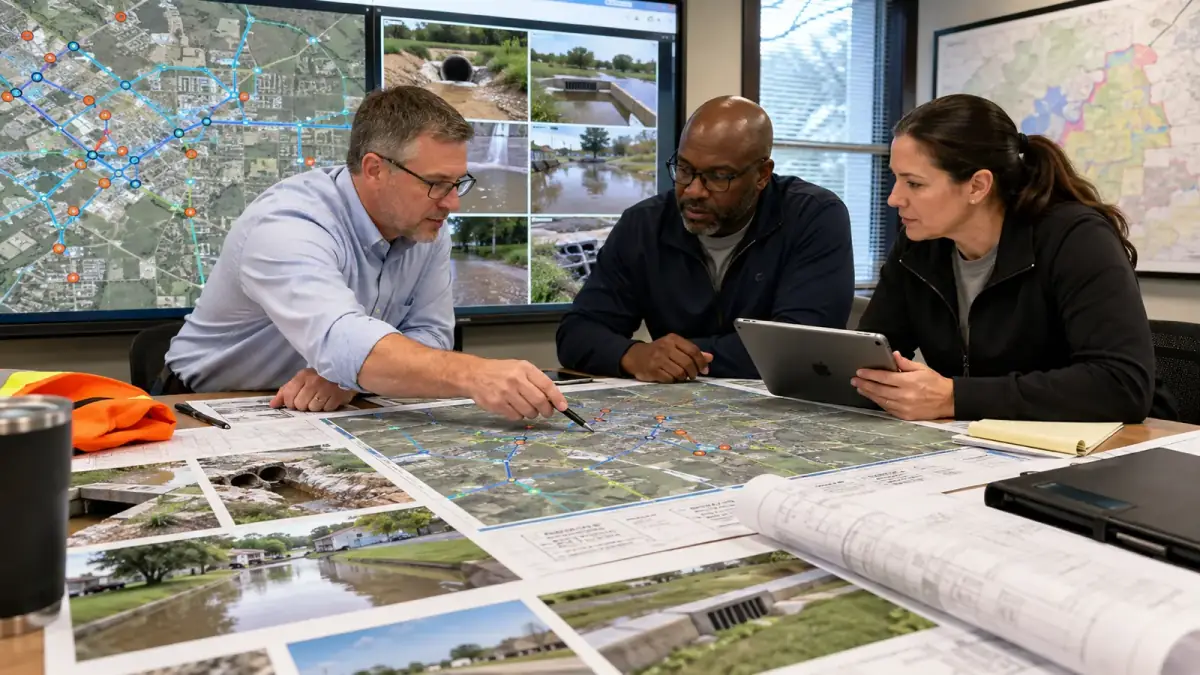
Municipal leaders often know they have more drainage needs than they can fund in a single budget cycle. The practical question is how to move from scattered complaints, aging pipes, undersized culverts, neighborhood flooding, and maintenance backlogs into a stormwater capital improvement plan that can be explained to elected officials, residents, grant reviewers, and internal departments.
This topic matters because stormwater projects compete with roads, utilities, parks, public safety, fleet needs, and general operations. A public works director may understand that a failing outfall is urgent, but a council member may be hearing louder complaints about nuisance ponding in a subdivision. A city engineer may know that a small culvert replacement will not solve a downstream capacity problem, while residents may reasonably expect action after repeated street flooding. A finance director may need a phased project list before supporting a stormwater utility fee, bond issue, or grant match. Without a clear planning method, stormwater capital decisions can appear reactive even when staff are doing careful work.
A defensible stormwater utility capital plan does not need to make every project easy or inexpensive. It should help the municipality explain why certain drainage needs rise to the top, what information supports those priorities, which projects are ready for design, and which locations still need study before construction dollars are committed. For communities that operate a stormwater utility, manage an MS4 program, or face recurring drainage complaints, this planning step can turn a long problem list into a staged, fundable path forward.
Who This Affects
Stormwater utility capital planning affects local governments that own drainage infrastructure, respond to flooding complaints, review private development, maintain streets, and manage water quality obligations. It is especially relevant for city engineers, public works directors, stormwater managers, county engineers, finance officers, planning departments, administrators, and elected officials who must decide which projects should be funded first.
The same issue also affects residents, business owners, HOAs, school districts, industrial parks, downtown property owners, and developers whose sites depend on public drainage systems. When public infrastructure is undersized, blocked, deteriorated, or poorly documented, private projects can face delays, unclear connection requirements, or unanticipated downstream constraints. When public drainage complaints are not organized consistently, residents may feel that decisions are based on who calls most often instead of the severity and public benefit of the work.
Common project types include storm sewer upsizing, culvert replacement, detention basin rehabilitation, channel stabilization, outfall repair, inlet additions, green infrastructure retrofits, neighborhood drainage studies, flood mitigation projects, pond sediment removal, storm drain asset inventory, and phased watershed improvements. Communities with older infrastructure, fast-growing subdivisions, redevelopment pressure, flat terrain, undersized roadside ditches, or repeated intense rainfall complaints often feel this need most sharply.
Stormwater capital planning also affects consulting engineers and grant support teams. Before design can proceed efficiently, someone must define the problem, collect the right existing information, screen alternatives, estimate order-of-magnitude costs, and identify whether the proposed project is solving a maintenance issue, a capacity issue, an erosion issue, a water quality issue, or a combination of several problems.
The Stormwater Planning Issue
The core issue is that drainage needs do not arrive in a neat order. They arrive as resident calls after a storm, field notes from maintenance crews, inspector observations, development review comments, closed-circuit television findings, sinkholes, washed shoulders, overtopped roads, pond failures, budget requests, and emergency repairs. Each item may be valid, but they are not all the same type of problem. Treating them as one list can lead to capital decisions that are difficult to explain and harder to fund.
A street that ponds for thirty minutes after a large storm may require a different response than a road that overtops and blocks emergency access. A rusted metal culvert with a collapsing invert may be more urgent than a nuisance yard drainage complaint on private property. A detention pond with clogged outlet controls may need maintenance before it needs a capital reconstruction project. A subdivision with repeated structure flooding may require a drainage study before anyone can responsibly define a construction project. A downstream channel with erosion near public utilities may need stabilization even if no one is calling weekly.
Stormwater utility planning becomes difficult when the municipality has incomplete asset data. If the city does not know the size, material, age, depth, condition, ownership, and discharge point of major storm sewer assets, project ranking can depend too heavily on memory. Staff knowledge is valuable, but it should be captured in a format that survives turnover and can be reviewed across departments. A capital plan built from mapped assets, complaint history, known flooding locations, inspection findings, and maintenance costs is stronger than one built from anecdotes alone.
Another challenge is the difference between visible symptoms and root causes. Standing water at an intersection may be caused by inlet spacing, pipe capacity, downstream tailwater, flat grades, sediment buildup, curb design, blocked ditches, or private grading changes. A backyard drainage complaint may involve public storm sewer, private lot grading, HOA-owned facilities, or roof drainage patterns. If a municipality jumps directly from complaint to construction project, it may spend public funds without resolving the actual drainage constraint.
Capital planning also has to account for readiness. Some needs are urgent but not ready for construction. They may require survey, hydrologic and hydraulic analysis, easement review, wetland screening, utility coordination, right-of-way evaluation, public communication, or permit documentation. Other projects may be smaller, well-defined, and ready for near-term implementation. A strong plan separates planning studies, design-ready improvements, maintenance work, and long-range capital projects so the budget reflects what can actually move forward.
For stormwater utilities, this distinction is important because ratepayers and elected officials often want to see a direct connection between collected revenue and visible improvements. The project list should show more than a set of engineering preferences. It should connect public benefit, risk reduction, service level, asset condition, regulatory support, water quality value, maintenance efficiency, and cost timing in a way that is understandable to non-engineers.
What To Review Before Moving Forward
Before advancing a stormwater utility capital improvement plan, review the information that explains both the drainage need and the decision-making basis. The goal is not to create a perfect database before any work can begin. The goal is to know what information is strong enough to support decisions now and what gaps must be filled before design or construction.
- Current drainage complaint records. Review addresses, dates, storm conditions if available, photos, caller descriptions, response notes, and whether the issue affects public infrastructure, private property, emergency access, structures, roads, or recurring maintenance.
- Known flooding history. Identify locations with repeated street flooding, structure impacts, roadway overtopping, school or hospital access concerns, business district impacts, and public safety implications.
- Storm drain asset inventory. Confirm whether major inlets, pipes, culverts, ditches, outfalls, detention basins, channels, and control structures are mapped. Note missing sizes, materials, ownership, condition, and discharge points.
- Maintenance records. Look for repeat cleaning, sediment removal, sinkhole repairs, pipe failures, ditch reshaping, inlet clearing, and emergency response costs. Repeated maintenance can indicate a candidate capital project or a need for better maintenance planning.
- Condition information. Use field inspection, photos, CCTV results where available, outfall observations, inlet condition, erosion locations, and known structural concerns to distinguish capacity problems from asset failure.
- Watershed and downstream context. Review whether fixing one location could send more flow downstream, shift erosion, affect a receiving channel, or require coordination with another jurisdiction.
- Existing studies and plans. Gather drainage studies, master plans, hazard mitigation plans, watershed reports, MS4 program documents, roadway plans, development agreements, and prior design concepts that may already contain useful project information.
- Ownership and access. Confirm whether the problem area is public right-of-way, a public easement, private land, HOA property, a state route, railroad property, utility corridor, or shared jurisdiction area.
- Project readiness. Separate needs that are ready for maintenance, needs that require study, projects ready for design, projects that need easements or permits, and projects that need public engagement before moving forward.
- Cost and funding fit. Develop planning-level cost ranges, possible phasing, likely grant or loan fit, stormwater utility revenue implications, and whether each project needs matching funds or board approval.
- Communication risk. Identify projects likely to draw public questions because of cost, neighborhood expectations, temporary construction impacts, private property boundaries, or visible flooding history.
- Level of service goals. Clarify whether the municipality is trying to reduce emergency closures, address repetitive structure flooding, improve maintenance efficiency, protect infrastructure, support redevelopment, improve water quality, or stabilize the most critical assets first.
This review should lead to a ranked project list with categories, not just a single priority score. A practical framework might group projects as immediate repair, high-priority study, design-ready capital project, maintenance program improvement, long-range watershed project, and watch-list location. This structure helps staff explain why a location may be important but not yet ready for construction funding.
Planning, Permitting, or Compliance Support That Fits
Stormwaterplanning.us support can help municipalities convert scattered drainage needs into a capital planning package that is easier to review, fund, and explain. The most useful service path depends on the community's current level of information.
For communities without a reliable inventory, GIS storm drain mapping and asset inventory support may be the best starting point. Mapping inlets, pipes, culverts, outfalls, detention basins, channels, and known problem areas gives staff a shared operating picture. It also supports future maintenance planning, plan review, MS4 documentation, and public works budgeting.
For communities with repeated complaints but unclear causes, drainage study support can help define whether the issue is related to capacity, grading, inlet spacing, downstream restrictions, detention performance, erosion, or maintenance. A focused study can prevent a municipality from spending design funds on a project that addresses the symptom but misses the controlling constraint.
For communities operating a stormwater utility, capital improvement planning support can help organize projects by public benefit, risk, readiness, cost range, phasing, and funding fit. This can be useful for annual budget cycles, rate discussions, grant readiness, public meetings, and internal coordination between engineering, public works, finance, and administration.
For MS4 communities, the capital plan can also support broader program decisions. It may identify outfall screening priorities, illicit discharge investigation needs, erosion concerns, maintenance documentation improvements, post-construction BMP tracking gaps, or areas where stormwater infrastructure data should be improved. The plan should not be framed as a guarantee of regulatory acceptance, but it can support compliance planning by showing that the community is organizing information, documenting decisions, and aligning projects with stormwater responsibilities.
For development-facing communities, a stronger public stormwater capital plan can also improve private plan review. When staff know where downstream constraints, undersized systems, or planned improvements are located, they can communicate expectations more clearly during pre-application meetings and civil plan review. Developers benefit when stormwater constraints are identified early instead of after design assumptions are already built into the site plan.
The best support is usually practical and staged. A municipality may not need a full watershed master plan before taking action on an urgent culvert failure. It may not need detailed design for every problem before presenting a capital outlook. The right planning product should match the decision in front of the community: what to repair, what to study, what to design, what to fund, and what to explain to stakeholders.
Common Mistakes to Avoid
- Ranking projects only by complaint volume. Frequent calls matter, but the loudest issue is not always the highest public risk. Consider severity, recurrence, safety, structures affected, public infrastructure, cost, and readiness.
- Mixing maintenance tasks and capital projects without labels. Cleaning an inlet, repairing a sinkhole, replacing a collapsed pipe, studying a watershed, and building a regional detention improvement are different actions. A useful plan names the correct action type.
- Treating asset mapping as a separate side project. Storm drain inventory is not just a mapping exercise. It supports capital prioritization, maintenance planning, emergency response, MS4 documentation, and development review.
- Advancing construction before confirming the root cause. Some drainage complaints need survey, hydraulic review, downstream assessment, or maintenance inspection before a construction scope can be trusted.
- Ignoring downstream impacts. Upsizing an upstream pipe or adding conveyance may increase flow to a downstream channel, culvert, or neighborhood. Capital planning should ask where the water goes next.
- Forgetting easements and access. A technically good project can stall if the municipality does not have the right to enter, construct, inspect, or maintain the facility.
- Using cost estimates without readiness context. A low-cost project that needs permits, easements, utility relocation, or public coordination may not be as quick as it appears. A higher-cost project with complete information may be more realistic for the next funding cycle.
- Leaving finance staff out until the end. Stormwater capital plans are stronger when engineering priorities are connected to revenue timing, grant match needs, debt capacity, and annual budget decisions.
- Overpromising outcomes to residents. Stormwater projects can reduce risk, improve service levels, and address defined problems, but they may not eliminate all ponding or flooding under every storm condition.
- Failing to preserve staff knowledge. Long-time crew members often know which inlets clog, which ditches back up, and which culverts are failing. Capture that knowledge in maps, photos, notes, and project records before it is lost.
- Presenting the project list without an explanation method. Elected officials and residents need to understand why projects were ranked. A defensible scoring or categorization framework is often as important as the list itself.
- Separating capital planning from maintenance planning. Some locations need recurring maintenance until a capital project is funded. Others may be handled through improved maintenance rather than construction.
Next Step
The next step is to turn the municipality's drainage needs into a structured review package before asking for design authorization or construction funding. Start with the known complaint list, mapped stormwater assets, maintenance history, flooding locations, and any existing drainage studies. Then sort each need by problem type, public risk, project readiness, ownership, downstream context, cost range, and likely funding path.
For a city, county, or stormwater utility, this process creates a clearer basis for capital improvement planning. It helps staff explain why one culvert, basin, neighborhood, or outfall should move ahead of another. It also helps identify where a drainage study, GIS inventory, inspection program, maintenance plan, or permit documentation review is needed before larger dollars are committed.
Stormwater capital planning works best when it is specific enough to support decisions but flexible enough to update as new data arrives. A defensible plan gives municipal leaders a practical way to move from scattered drainage concerns to a staged project list that can support budgets, public communication, compliance planning, and long-term infrastructure stewardship.