
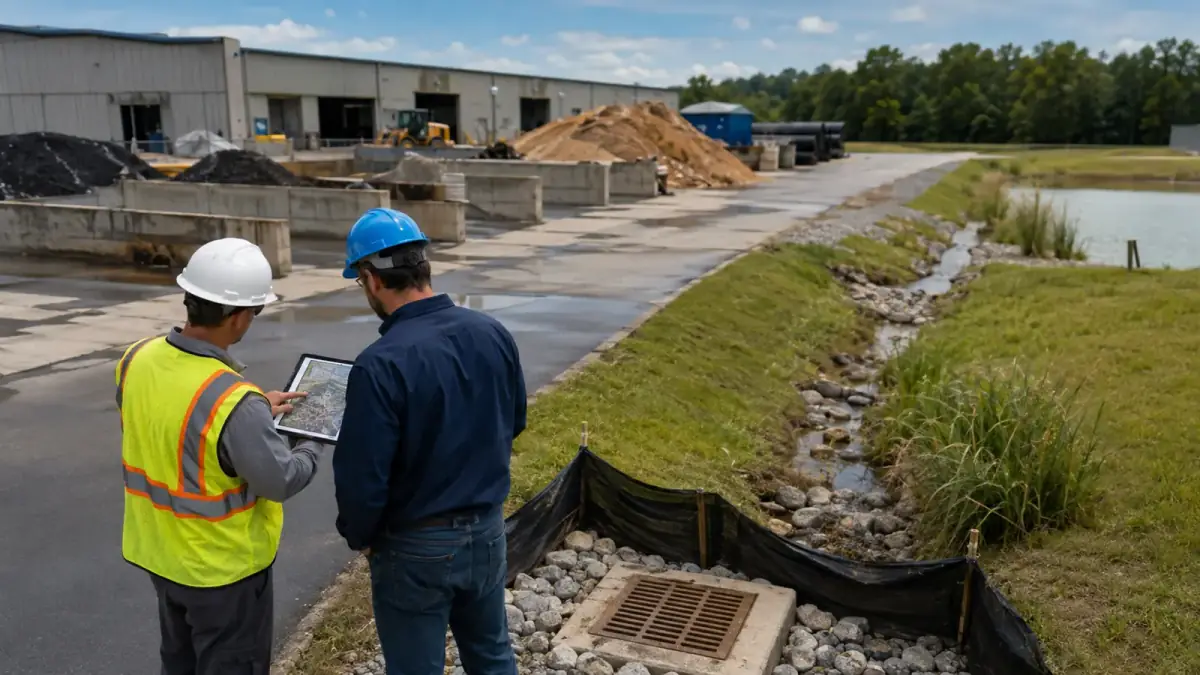
Facility managers, environmental compliance managers, industrial operators, property owners, civil engineers, and consultants often search for this topic when outdoor operations create stormwater questions that cannot be answered from a permit form alone. The practical question is straightforward: what should an industrial site document before drainage complaints, inspection findings, sampling concerns, or maintenance failures force the issue?
That question matters because industrial stormwater problems often begin as ordinary site operations. A loading area gets rearranged. Scrap, pallets, aggregate, containers, equipment, waste bins, or raw materials move outside for convenience. A roof drain discharges across a paved yard. A storm inlet collects runoff from a storage area that was never mapped clearly. A detention pond receives sediment from an internal haul route. A contractor pressure washes equipment near a flow path. None of these situations automatically mean a site is out of compliance, but each can create exposure if the facility does not understand where stormwater flows, what it contacts, who maintains the controls, and how observations are documented.
Industrial stormwater planning is valuable because it connects compliance expectations with site reality. It helps owners and operators move from general awareness to a practical record of drainage areas, pollutant sources, best management practices, inspection routines, maintenance triggers, and responsible personnel. It also helps clarify which questions need engineering review, operational changes, or permit documentation support before they become urgent.
This post explains what facilities with outdoor operations should document before problems start. It is written for decision-makers who need a useful planning framework, not legal advice. Regulatory requirements vary by location, industrial activity, permit coverage, and site condition. The goal is to help teams organize the information needed to support compliance planning, reduce avoidable review delays, and make better stormwater decisions.
Who This Affects
Industrial stormwater planning affects any property where materials, equipment, processes, traffic, waste handling, loading, fueling, maintenance, storage, or exposed surfaces may interact with rainfall or snowmelt. The need is not limited to large factories. Many smaller facilities have meaningful stormwater exposure because their operations happen partly outdoors and because drainage routes are easy to overlook during normal work.
Common affected facilities include:
- Manufacturing sites with outdoor storage, loading docks, equipment staging, scrap areas, or process-related materials.
- Warehouses and distribution centers with truck courts, trailer storage, fueling areas, vehicle maintenance, or high traffic paved yards.
- Public works yards storing aggregate, salt, vehicles, equipment, pipe, castings, signs, debris, or maintenance materials.
- Contractor yards, landscape supply sites, fleet yards, utility yards, recycling operations, and transfer stations.
- Industrial parks where shared drainage infrastructure serves multiple tenants with different operations.
- Food processing, metal fabrication, auto dismantling, concrete, lumber, petroleum, chemical handling, and similar operations where stormwater contact can be operationally significant.
- Municipalities, counties, school districts, airports, ports, and public agencies that operate maintenance yards or service campuses.
The roles involved usually extend beyond one environmental specialist. Facility managers need to know which areas require inspection and maintenance. Operations supervisors need to know how material storage and housekeeping affect runoff. Public works directors need defensible records for municipal yards and maintenance facilities. Property owners and asset managers need to understand whether a tenant’s outdoor use changes the site’s drainage risk. Civil engineers may need to evaluate grading, conveyance, outfalls, detention, or treatment practices. Environmental compliance managers need records that connect field observations to the site’s stormwater plan.
This topic also matters during property transactions, lease changes, site expansions, and operational changes. A buyer may inherit poorly documented drainage conditions. A tenant may begin outdoor storage that was not anticipated in the original site plan. A facility may add a new loading pattern, enclosure, storage rack, trash compactor, bulk container, or paved area. Each change can affect what stormwater contacts before it leaves the site.
The Stormwater Planning Issue
The central issue is that industrial stormwater is both a drainage problem and an operational documentation problem. Drainage determines where runoff goes. Operations determine what runoff may contact. Documentation determines whether the facility can explain and manage those conditions in a way that supports compliance planning, inspections, maintenance, and internal accountability.
Many facilities know where the obvious storm drains are, but do not have a complete picture of drainage areas. A paved yard may sheet flow toward a trench drain. Roof runoff may mix with yard runoff before reaching an inlet. A low point may pond during heavy rain and overtop toward a neighboring property. A ditch may carry runoff from several different operations before reaching an outfall. A detention basin may receive runoff from loading, storage, and parking areas, but maintenance staff may treat it only as a landscape feature.
The challenge is that stormwater exposure is often created by small operational details. A dumpster without a closed lid, uncovered stockpile, leaking equipment, stained pavement, loose sediment, damaged inlet protection, residue near a loading dock, or poor housekeeping around containers can change the quality of runoff. When the facility does not document where these conditions occur, inspections become reactive. Maintenance gets handled only after complaints. Compliance files may include generic language that does not match the site.
Industrial sites also face coordination problems. The person responsible for stormwater paperwork may not control daily yard operations. The maintenance team may repair inlets but not update maps. The operations manager may move material storage without notifying the environmental manager. A tenant may use a drainage area differently than the property owner expected. A civil engineer may design a BMP, but the facility may not have a realistic maintenance process for it.
This is why a practical stormwater planning process should begin with documentation. Documentation does not solve every issue by itself, but it creates a shared site picture. It shows drainage paths, material exposure areas, structural controls, inspection points, maintenance needs, outfalls, and operational responsibilities. Once that picture exists, the team can decide whether the site needs updated BMPs, revised operating procedures, better maintenance scheduling, additional sampling support, drainage study support, SWPPP updates, or permit documentation assistance.
Regulatory context should be handled carefully. Many industrial facilities may be subject to stormwater requirements under federal, state, or local programs depending on activities and discharge conditions. Some facilities operate under general permit coverage, some have sector-specific requirements, some need no exposure evaluations, and some must coordinate with local storm sewer or receiving water protections. The exact obligation should be confirmed against the applicable permit, local requirements, and site conditions. From a planning standpoint, the useful question is not only what form is required. The more useful question is whether the facility has enough site-specific information to manage runoff responsibly and explain its stormwater practices when asked.
What To Review Before Moving Forward
Before a facility updates a stormwater plan, prepares for an inspection, evaluates permit coverage, or asks for engineering support, it should review the information that explains how the site actually works. A practical review should be specific enough for field decisions, but organized enough for management, consultants, or reviewers to understand.
- Current site layout. Confirm buildings, paved yards, gravel areas, landscaped areas, loading docks, roof drains, storage areas, dumpsters, compactors, fueling areas, wash areas, maintenance areas, stockpiles, outdoor process areas, and traffic routes.
- Drainage direction. Walk the site during dry weather and, if possible, observe a rain event safely. Note where runoff begins, where it concentrates, where it ponds, which inlets receive flow, and whether runoff crosses property lines or enters public drainage infrastructure.
- Inlets, ditches, pipes, swales, basins, and outfalls. Document visible stormwater assets with photos, map locations, condition notes, and ownership or maintenance responsibility. If assets are hidden, old, or uncertain, consider whether GIS inventory or field verification is needed.
- Outdoor material exposure. Identify materials, wastes, residues, equipment, vehicles, containers, pallets, scrap, chemicals, soils, aggregates, salts, metals, oils, and other items stored or handled outside. The goal is to understand potential contact with stormwater, not to assume every exposure has the same risk.
- Housekeeping practices. Review sweeping, spill response, container management, trash handling, stockpile controls, loading dock cleanup, pavement cleaning, and routine yard organization. Weak housekeeping often creates avoidable stormwater findings.
- Existing BMPs. List structural and operational BMPs, including covers, berms, secondary containment, inlet protection, vegetated swales, detention or retention features, filters, sediment controls, good housekeeping procedures, training, and inspection routines.
- Maintenance triggers. Define what conditions require action. Examples include sediment accumulation, damaged inlet protection, clogged drains, staining, exposed stockpiles, full dumpsters, failing vegetation, eroded swales, damaged containment, or ponded water in operational areas.
- Inspection responsibilities. Confirm who inspects, how often inspections occur, what checklist is used, where records are stored, who corrects findings, and how unresolved issues are escalated.
- Operational changes. Review recent or planned changes in tenants, products, material handling, loading patterns, equipment storage, paving, grading, building additions, drainage improvements, or waste management vendors.
- Documentation gaps. Identify missing maps, unclear outfalls, outdated site plans, incomplete photo logs, old SWPPP language, unknown drainage connections, missing maintenance records, or inspection checklists that do not match the actual site.
The review should produce a usable action list, not just a file folder. A strong action list separates immediate housekeeping corrections, maintenance work, documentation updates, drainage questions, permit questions, and longer-term capital needs. This helps the facility decide whether the next step is operational cleanup, SWPPP support, stormwater mapping, BMP planning, drainage study support, inspection readiness assistance, or engineering evaluation.
Planning, Permitting, or Compliance Support That Fits
Industrial stormwater support should fit the site’s actual risk, documentation needs, and operational capacity. Some facilities need a focused field review and updated map. Others need a more complete stormwater management planning process that includes drainage evaluation, BMP selection, SWPPP updates, inspection procedures, staff training support, and maintenance planning. The right level of support depends on the site, the activity, the permit context, and the decision the facility needs to make.
Stormwater management planning can help facilities clarify how runoff moves through the property and which areas need operational attention. This is useful when the site has older drainage infrastructure, shared outfalls, unclear grading, recurring ponding, downstream complaints, or multiple outdoor exposure areas. The planning work can help separate drainage capacity issues from housekeeping issues and can identify where more detailed engineering analysis may be appropriate.
SWPPP support can help translate site conditions into a practical document that reflects real operations. A useful SWPPP should not read like a generic binder. It should describe the facility, drainage areas, potential pollutant sources, BMPs, inspection procedures, maintenance responsibilities, spill response coordination, employee awareness needs, and recordkeeping practices in a way that the site team can actually use. It should also be reviewed when operations change, outdoor storage expands, inspections show recurring findings, or stormwater controls no longer match the field.
GIS and asset inventory support can help facilities and municipal operators locate storm drains, outfalls, swales, culverts, basins, and other stormwater assets. This is especially helpful for large campuses, public works yards, industrial parks, and older facilities where drainage features have been added over time. A mapped inventory supports inspections, maintenance planning, capital decisions, and communication between operations, engineering, and compliance staff.
BMP planning can help facilities select controls that are realistic for the site. For example, covering a material storage area may be more effective than trying to maintain inlet protection downstream. Regrading a small area may reduce ponding that repeatedly carries residue toward a drain. Improving housekeeping procedures may be faster and less costly than adding a structural control, while other situations may require physical improvements. The planning process should consider exposure, flow path, maintenance burden, site access, cost, operational disruption, and long-term accountability.
Inspection readiness support can help facility teams move from informal observation to consistent records. That does not mean creating paperwork for its own sake. It means making sure inspections look at the right areas, document the right conditions, assign corrective actions clearly, and close out maintenance items. Good inspection records help a facility understand patterns over time, such as a recurring clogged inlet, damaged containment, uncovered material, or sediment movement after heavy rain.
For stormwaterplanning.us customers, the service path may include stormwater management plan support, SWPPP planning and review, industrial stormwater compliance planning, drainage study coordination, BMP planning, stormwater inspection readiness, GIS or storm drain asset inventory, maintenance planning, and permit documentation support. The most useful engagement starts with a clear question: what decision does the facility need to make, and what stormwater information is missing?
Common Mistakes to Avoid
Industrial stormwater problems often become expensive or stressful because the facility waited too long to connect operations, drainage, and documentation. The following mistakes are common and preventable.
- Treating the SWPPP or stormwater file as separate from daily operations. If the document does not reflect how materials are stored, moved, loaded, cleaned, and maintained, it will not guide good decisions.
- Relying on an old site plan without verifying drainage in the field. Industrial sites change over time, and drainage features may not match the drawing.
- Ignoring small outdoor storage changes. New bins, stockpiles, pallets, containers, parked equipment, or waste areas can change what stormwater contacts.
- Waiting for an inspection finding before updating BMPs. If a control is hard to maintain or no longer fits the operation, the facility should address it before the problem becomes documented by someone else.
- Using generic BMP language. A list of standard practices is less useful than site-specific procedures that explain what happens, where it happens, who is responsible, and when action is required.
- Overlooking roof drains and clean stormwater flow. Roof runoff may seem harmless, but it can mix with yard runoff or flow through exposure areas if routing is not understood.
- Failing to define maintenance triggers. Teams need to know what conditions require sweeping, sediment removal, inlet cleaning, repair, cover replacement, containment cleanup, or supervisor review.
- Keeping inspection records that do not lead to action. Repeated notes about the same issue without correction can signal that the planning process is not working.
- Missing tenant or contractor coordination. A site owner may be responsible for drainage infrastructure while tenants or contractors create the outdoor exposure. Responsibilities need to be clear.
- Assuming detention ponds, swales, and inlets are only engineering assets. They are also maintenance assets and compliance support features. If they fail, clog, erode, or fill with sediment, the stormwater plan loses credibility.
- Not preparing documentation before a sale, expansion, or operational change. Stormwater questions often surface during due diligence, plan review, insurance review, capital planning, or agency coordination. Waiting can limit options.
- Treating stormwater as only a rainy-day issue. Dry-weather observations, housekeeping, spill prevention, material storage, and maintenance planning all affect how the site performs when rain arrives.
Next Step
The practical next step is to build a clear stormwater documentation snapshot of the facility before problems start. Start with the site map, drainage routes, outdoor exposure areas, BMPs, inspection points, maintenance responsibilities, and current documentation gaps. Then decide which gaps can be handled through operations, which need maintenance, which require SWPPP or permit documentation support, and which call for engineering or drainage study input.
For a facility manager, that may mean walking the site with operations and maintenance staff and comparing what they see against the current stormwater plan. For an environmental compliance manager, it may mean updating inspection forms so they match actual flow paths and exposure areas. For a property owner, it may mean clarifying tenant responsibilities before outdoor use expands. For a public works director, it may mean mapping yard drainage and creating a maintenance schedule for inlets, swales, stockpile areas, and detention features.
Stormwater planning does not have to begin with a crisis. A focused review can help the facility understand where runoff goes, what it contacts, how controls are maintained, and what records support the program. That gives decision-makers a stronger basis for SWPPP updates, BMP planning, inspection readiness, drainage improvements, permit documentation, or long-term stormwater maintenance planning. The best time to create that record is before a complaint, inspection, storm event, or operational change reveals that the site’s stormwater responsibilities were not as clear as they needed to be.