
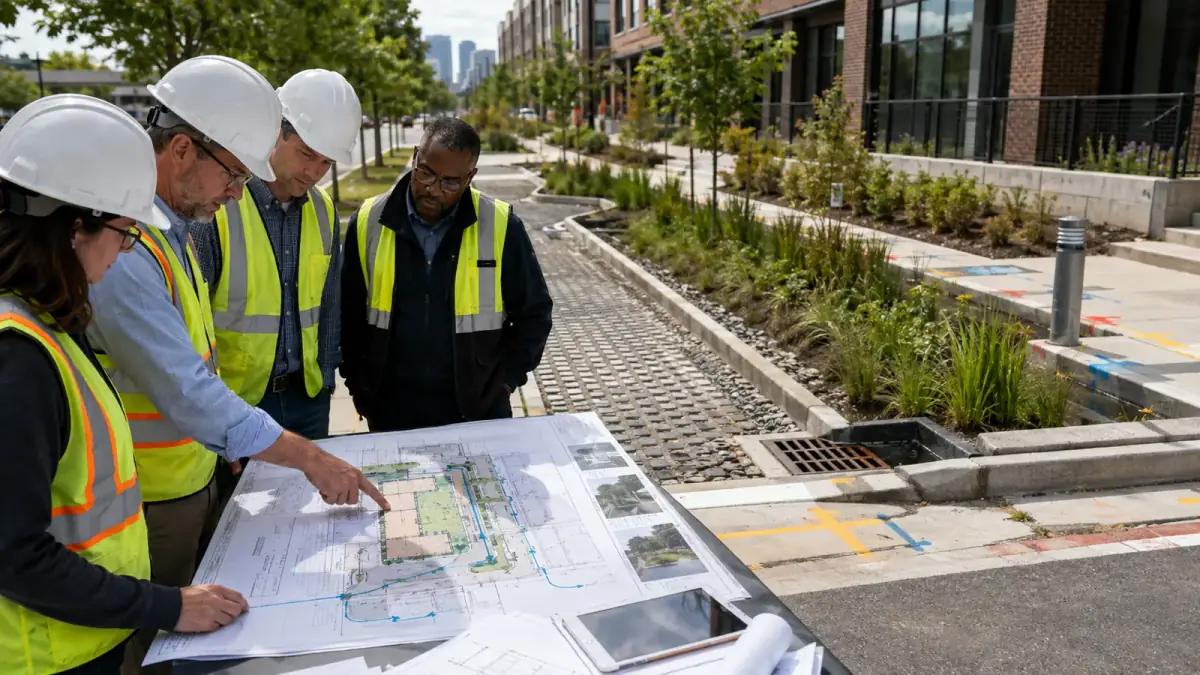
Municipal reviewers, developers, property owners, civil engineers, landscape architects, and facility managers often search for green infrastructure guidance when a site has very little room left for stormwater treatment. The practical question is not whether green infrastructure is a good idea in general. The harder question is which best management practices can actually fit the property, support permit documentation, protect downstream drainage, and remain maintainable after construction.
This topic matters because tight sites often create high expectations and limited options at the same time. A redevelopment parcel may be mostly pavement. A commercial property may need parking, loading, fire access, utilities, sidewalks, and landscaping in the same small footprint. A municipal streetscape project may have tree wells, curb extensions, catch basins, driveways, signs, lighting, and shallow utilities competing for space. A residential or mixed-use project may need to address runoff without creating maintenance burdens for an owner or homeowners association.
Green infrastructure can help manage runoff close to where rain falls, but it is not a one-size-fits-all solution. A bioswale, rain garden, permeable pavement section, underground infiltration practice, planter, tree trench, or small detention feature needs enough area, the right soil conditions, workable elevations, overflow routing, pretreatment, and a maintenance plan. If those questions are left until late plan review, the result can be redesign, unclear responsibilities, or a stormwater feature that looks acceptable on paper but performs poorly in the field.
The search intent behind this article is commercial and practical. Readers are trying to decide what to review before selecting green infrastructure BMPs for a constrained property, what information should be gathered before civil plans are submitted, and when professional stormwater planning support can reduce confusion between design goals, permit expectations, construction realities, and long-term maintenance.
Who This Affects
Green infrastructure planning for tight sites affects public and private decision-makers who must balance stormwater requirements with land use, access, cost, constructability, and maintenance. The issue is common because many high-value or high-priority projects happen on parcels where the easy stormwater options have already been removed by previous development.
Municipal planning departments and public works teams face this issue when reviewing redevelopment plans, downtown improvements, parking lot retrofits, road diets, park renovations, civic facility upgrades, and neighborhood drainage projects. A city may want green infrastructure because it supports water quality goals, reduces runoff volume where feasible, and improves public-facing projects. At the same time, public works staff must ask who will inspect it, clean it, replace media, repair underdrains, remove sediment, and respond if drainage complaints occur.
Developers and builders face this issue when a project must meet stormwater requirements without reducing the usable development program. A building footprint, drive aisle, loading area, utility easement, or parking requirement can limit available stormwater area. When stormwater planning is delayed, the project team may discover that the site layout does not leave enough room for pretreatment, overflow routing, or accessible maintenance.
Civil engineering firms and landscape architects face this issue when they are asked to make green infrastructure both attractive and technically defensible. Planting design, grading, soil media, inlet protection, curb openings, utility conflicts, pedestrian routes, and snow storage all influence whether a BMP works. The visual plan and the stormwater plan must support each other.
Property owners, facility managers, HOAs, and commercial real estate teams face this issue after construction. They may inherit bioretention areas, permeable pavers, underground systems, or landscaped stormwater features without clear maintenance responsibilities. A feature that is poorly understood can become clogged, compacted, eroded, bypassed, overgrown, or converted into ordinary landscaping.
Industrial, institutional, and campus sites can also be affected. Warehouses, schools, hospitals, municipal yards, universities, retail centers, and multifamily properties may need to retrofit existing pavement or manage runoff from expansion projects. These sites often have traffic circulation, safety, operations, and maintenance constraints that must be reviewed before a green infrastructure BMP is selected.
The Stormwater Planning Issue
The central issue is that green infrastructure has to be planned as part of the stormwater system, not added as a decorative feature after the site layout is nearly finished. On constrained sites, small choices can decide whether a BMP functions, fails, or becomes too difficult to maintain.
The first planning challenge is space. Green infrastructure usually needs more than the surface area visible on a concept plan. A bioretention area may need side slopes, freeboard, pretreatment, an overflow structure, an underdrain, mulch or stone, planting zones, and maintenance access. Permeable pavement may need storage aggregate, separation from building foundations, subgrade evaluation, traffic loading review, and a plan for vacuum sweeping. Tree trenches may need soil volume, structural support, utility coordination, drainage routing, and clear ownership. Even compact practices need enough physical room to operate.
The second challenge is elevation. Stormwater moves by gravity unless a pumped system is introduced, and constrained sites often have shallow slopes, existing curb grades, doorway thresholds, adjacent properties, accessible routes, and utility crossings that limit grading options. A BMP that looks possible in plan view may not work in profile. Inlet elevations, ponding depths, outlet elevations, emergency overflow paths, and downstream connection points should be reviewed early.
The third challenge is runoff routing. A green infrastructure practice needs to receive the right drainage area. If runoff cannot reach it, the feature becomes cosmetic. If too much runoff reaches it without pretreatment or bypass planning, the feature may clog, erode, or overflow too frequently. Designers should understand which roofs, sidewalks, parking areas, drives, landscaped areas, and off-site flows contribute to each practice.
The fourth challenge is soil and infiltration feasibility. Some sites have compacted urban fill, shallow groundwater, contaminated soils, bedrock, clay soils, nearby basements, or utility corridors that limit infiltration. That does not automatically eliminate green infrastructure, but it changes the planning path. A bioretention area may need an underdrain. A permeable pavement section may need controlled discharge rather than full infiltration. A planter may need a lined section. A stormwater plan should distinguish between infiltration, filtration, detention, conveyance, and water quality treatment rather than treating every green practice as if it works the same way.
The fifth challenge is regulatory documentation. Many communities require stormwater calculations, water quality treatment documentation, peak flow control, volume reduction analysis, erosion and sediment control measures, or post-construction BMP maintenance plans. Requirements vary by jurisdiction, permit type, redevelopment status, receiving water, and site disturbance area. A project team should not assume that a green infrastructure label is enough. Reviewers need to understand drainage areas, design criteria, assumptions, overflow pathways, maintenance obligations, and how the proposed BMPs fit the larger stormwater management plan.
The sixth challenge is maintenance responsibility. Green infrastructure often fails gradually, not dramatically. Sediment accumulates. Inlets clog. Mulch floats. Plants die. Permeable pavement pores fill. Trash collects. Curb cuts get blocked. A small grading change or landscaping decision can redirect flow away from a BMP. If maintenance access and responsibility are not planned, the owner may not know what to inspect or when to take action.
For municipalities, the issue also connects to public expectations. Residents may support greener streets, reduced nuisance flooding, and better water quality, but they also expect sidewalks to drain, parking to function, landscapes to look cared for, and public funds to be spent responsibly. A green infrastructure project needs a defensible planning record so staff can explain why certain BMPs were selected, how they will be maintained, and what performance limits should be expected.
What To Review Before Moving Forward
Before choosing BMPs for a tight site, the project team should review the physical site, regulatory pathway, runoff behavior, and long-term ownership model. A practical checklist can prevent a promising concept from turning into a late-stage redesign.
- Confirm the project trigger. Identify whether the project is new development, redevelopment, municipal retrofit, road work, utility work, site expansion, parking lot reconstruction, or maintenance-driven improvement. The trigger affects stormwater expectations and documentation.
- Map existing drainage patterns. Review where runoff currently flows, which inlets receive it, whether off-site water enters the property, where nuisance ponding occurs, and where overflow would go during larger storms.
- Separate drainage areas by surface type. Roofs, sidewalks, parking areas, drive aisles, landscaped areas, loading areas, and public right-of-way runoff may need different BMP approaches because their flow rates, pollutant loads, and routing options differ.
- Review topography and critical elevations. Check building openings, accessible routes, curb lines, utility rims, pipe inverts, retaining walls, adjacent grades, property boundaries, and downstream outlet constraints.
- Identify utility conflicts early. Shallow utilities, gas lines, water services, sanitary sewers, electric ducts, fiber, street lighting, irrigation, and public easements can reduce feasible BMP locations or require design adjustments.
- Evaluate soils and infiltration limits. Use available geotechnical information, soil borings, infiltration testing where appropriate, contamination records, groundwater information, and local knowledge of urban fill or compacted subgrades.
- Check maintenance access. A BMP needs to be reachable by the people and equipment responsible for upkeep. Access should be reviewed for sediment removal, vegetation care, inspection, paver cleaning, replacement of media, and repair of structures.
- Consider pretreatment. Small sites often receive concentrated runoff from pavement or roof leaders. Forebays, filter strips, sumps, catch basin inserts, stone diaphragms, or other pretreatment measures may be needed to reduce clogging.
- Plan for overflow. Every green infrastructure feature needs a safe route for flows that exceed its capacity or bypass its treatment function. Overflow should not threaten buildings, sidewalks, neighboring properties, or critical access routes.
- Review winter and operations conditions. Snow storage, deicing practices, plowing, trash collection, deliveries, emergency access, pedestrian movement, and landscaping routines can affect BMP performance.
- Match BMP type to ownership. A city-maintained streetscape, private commercial site, HOA common area, campus, and industrial property may require different maintenance documents, inspection schedules, and training.
- Coordinate landscape and engineering decisions. Plant selection, soil media, drainage stone, underdrains, edging, curb openings, surface storage, and grading should be reviewed together rather than separately.
- Clarify documentation needs. Determine whether the jurisdiction expects stormwater calculations, construction details, inspection forms, as-built information, operations and maintenance plans, record drawings, or owner certifications.
- Compare lifecycle costs, not only construction costs. A compact BMP that is inexpensive to build may be expensive to clean or replace. A more durable option may support better long-term operation if ownership is clear.
- Discuss performance limits honestly. Green infrastructure can support runoff management and water quality planning, but tight sites may still need conventional drainage, detention, underground storage, or off-site coordination.
This review should happen before the team commits to a final site layout. On constrained projects, stormwater planning is often most valuable when it identifies which options are realistic, which options are risky, and which questions need reviewer input before detailed design proceeds.
Planning, Permitting, or Compliance Support That Fits
Stormwaterplanning.us can support decision-makers by helping organize the information needed to select, document, and maintain green infrastructure BMPs on constrained sites. The right support depends on the project type and where the team is in the planning process.
For developers and civil design teams, support may begin with a stormwater management planning review. That can include reviewing drainage areas, available BMP locations, permitting triggers, preliminary site constraints, owner responsibilities, and the type of documentation likely to be needed for plan review. The goal is not to replace the design engineer. The goal is to clarify stormwater planning issues early so the design team has better information before submittal.
For municipalities, support may include green infrastructure screening for capital projects, public works retrofits, streetscape improvements, park projects, parking lot upgrades, or drainage complaint areas. A city may need help comparing feasible BMPs, documenting why certain locations were selected, preparing staff-facing maintenance expectations, or explaining stormwater tradeoffs to boards, councils, committees, or the public.
For property owners and facility managers, support may include documenting existing drainage conditions before requesting design help, reviewing maintenance concerns around existing BMPs, identifying signs that a green infrastructure feature is not functioning as intended, and preparing clear information for engineers, contractors, or municipal reviewers.
For projects with construction disturbance, support may connect green infrastructure planning with erosion and sediment control planning. A bioretention area, permeable pavement section, or landscaped stormwater feature should not be damaged by construction sequencing, sediment tracking, stockpiles, compaction, or temporary drainage. The construction-phase SWPPP or erosion control plan should account for how permanent BMP areas will be protected until they are ready to function.
For post-construction compliance, support may include maintenance planning, inspection readiness, BMP inventory, GIS mapping, photo documentation, and owner-facing operation and maintenance materials. These records can help clarify stormwater responsibilities and support compliance planning without implying that any specific regulatory outcome is guaranteed.
The most useful support is usually specific. Instead of asking whether green infrastructure is possible in the abstract, a project team should ask: Which drainage areas can be routed to which BMPs? What conflicts need to be resolved? What assumptions should be documented? What will the reviewer need to understand? Who will maintain the system after construction? What evidence should be collected before the project advances?
Common Mistakes to Avoid
Several common mistakes can make green infrastructure harder to approve, build, or maintain on tight sites.
- Treating green infrastructure as landscaping only. Vegetation may be visible, but the stormwater function depends on grading, inlets, storage, soil media, underdrains, overflow structures, and maintenance.
- Waiting until plan review to reserve space. If the site layout is already fixed, the stormwater team may be forced into undersized, awkward, or expensive solutions.
- Ignoring vertical constraints. Plan view can be misleading. A BMP needs workable elevations for inflow, ponding, outlet control, bypass, underdrain connection, and emergency overflow.
- Sending dirty runoff directly into a sensitive BMP. Without pretreatment, sediment and debris can quickly reduce performance, especially on parking lots, loading areas, and streets.
- Assuming infiltration is available everywhere. Soil conditions, contamination concerns, groundwater, building foundations, and utility corridors can limit or change infiltration strategies.
- Overlooking maintenance access. A feature that cannot be reached safely and efficiently is more likely to be neglected or altered after construction.
- Creating unclear ownership. If the municipality, HOA, property owner, tenant, contractor, or facility team does not know who is responsible, routine maintenance may not happen.
- Failing to protect permanent BMPs during construction. Construction sediment, compaction, and traffic can damage green infrastructure before it ever begins operating.
- Using generic BMP language in permit documents. Reviewers need site-specific drainage areas, design assumptions, details, overflow routing, and maintenance expectations.
- Forgetting the downstream system. Green infrastructure should be planned with the existing storm drain network, culverts, channels, neighboring properties, and known drainage complaints in mind.
- Choosing BMPs based only on appearance. A planter, bioswale, permeable pavement area, or tree trench should be selected because it fits the runoff, soils, grades, maintenance capacity, and documentation needs.
- Separating stormwater and landscape decisions. Plant survival, soil media, irrigation, salt tolerance, surface storage, mulch selection, and maintenance routines all affect stormwater performance.
- Overpromising outcomes. Green infrastructure can support stormwater planning, water quality goals, and compliance documentation, but it should be presented with clear assumptions and realistic performance limits.
- Skipping as-built and handoff documentation. Owners and maintenance teams need to know where the BMPs are, how they receive water, what to inspect, and when to clean or repair them.
Next Step
Before choosing green infrastructure BMPs for a constrained site, gather the information that decides feasibility: drainage areas, grades, soils, utilities, available space, overflow routes, maintenance access, ownership, and plan review expectations. A small amount of early stormwater planning can reveal whether the project needs bioretention, permeable pavement, tree trenches, planters, underground storage, conventional detention, or a combined approach.
For a municipality, the next step may be a screening review of candidate retrofit locations or a maintenance-focused review of existing green infrastructure assets. For a developer, it may be a pre-submittal stormwater planning check before civil plans are finalized. For a property owner or facility manager, it may be documentation of drainage complaints, existing BMP conditions, or maintenance gaps before asking for design or compliance support.
The strongest green infrastructure plans are practical, specific, and maintainable. They show how runoff reaches the BMP, how the BMP is sized and protected, how excess flow leaves safely, what assumptions support the documentation, and who will care for the feature after construction. When those questions are answered early, green infrastructure is more likely to support the project instead of becoming a late-stage obstacle.