
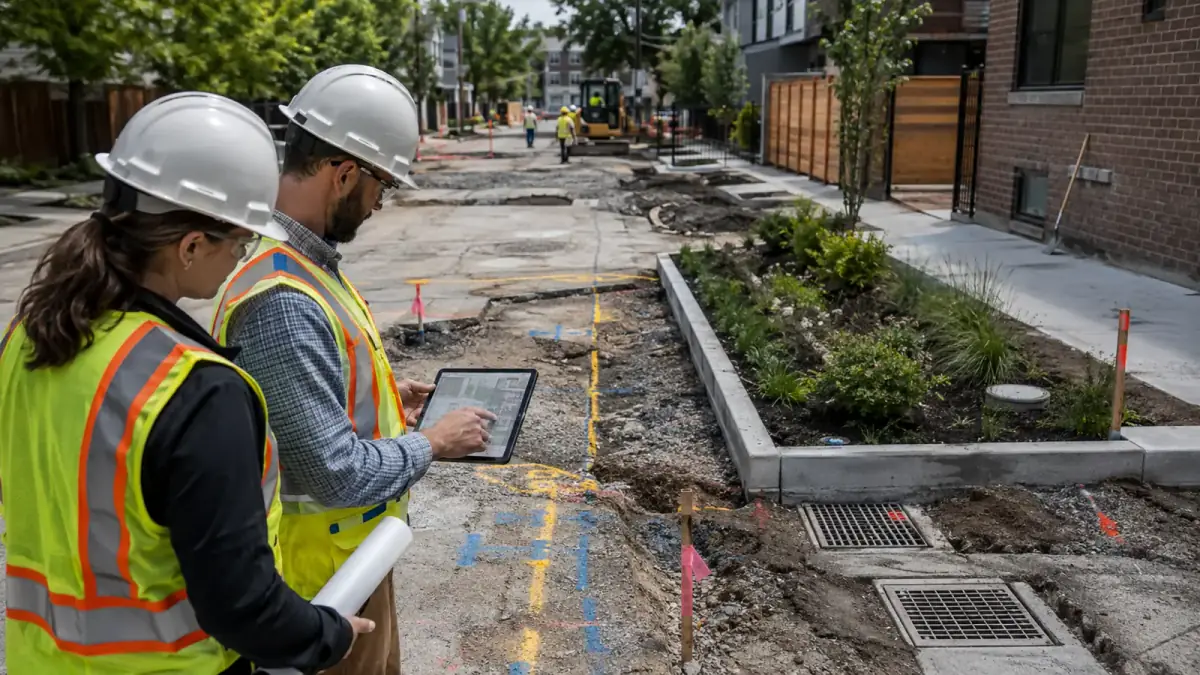
Developers, city reviewers, civil engineers, property owners, and planning staff often ask the same practical question before an infill or redevelopment project goes to civil plan review: what stormwater issues should be resolved now so the submittal does not stall later?
That question matters because infill sites rarely offer the clean slate that new greenfield projects sometimes provide. Existing pavement, old utility layouts, undersized inlets, limited right-of-way, tight property lines, prior grading decisions, downstream drainage complaints, and legacy connections can all affect whether a project can manage runoff in a way that is technically sound and review ready. A site may look small on paper, but the stormwater responsibilities can be complex.
For municipalities, the issue is not only whether a private development can be built. Reviewers need enough documentation to understand how the site will affect public drainage systems, adjacent properties, water quality controls, maintenance responsibilities, and construction-phase erosion control. For developers and owners, the issue is schedule and predictability. If stormwater questions are left vague until late review, they can trigger redesign, added survey work, utility coordination, plan revisions, or delayed permits.
This post explains how to approach stormwater plan review for infill development before civil submittal. The goal is not to replace engineering judgment or local code review. The goal is to help project teams identify the stormwater information, decisions, and coordination points that should be clarified before the package lands on a reviewer’s desk.
Who This Affects
Infill stormwater planning affects a broad group of public and private decision-makers because redevelopment sites often sit inside areas where the drainage system is already built, constrained, and sensitive to small changes.
The most common audiences include:
- City engineers reviewing site plans, drainage reports, utility layouts, and erosion control plans.
- Public works directors responsible for streets, inlets, storm sewers, culverts, open channels, detention assets, and resident drainage complaints.
- Planning departments trying to align redevelopment goals with practical infrastructure limits.
- Developers and builders preparing civil plans for small commercial, mixed-use, multifamily, industrial, institutional, or residential infill projects.
- Civil engineering firms coordinating grading, utility, stormwater, and site layout decisions under tight space constraints.
- Property owners evaluating whether a parcel can support expansion, parking changes, new buildings, or a change of use.
- Construction managers who need erosion control, phasing, dewatering, inlet protection, and temporary drainage plans that can work on a confined site.
- Environmental compliance managers and facility teams at industrial or commercial sites where outdoor operations, material storage, vehicle traffic, or loading areas affect runoff quality.
- HOAs, campus owners, and facility managers dealing with drainage complaints after paving changes, building additions, or maintenance failures.
- Landscape architects and land development teams integrating green infrastructure, site access, utilities, and long-term maintenance.
The issue is especially important for projects that add impervious area, change flow direction, disturb compact urban parcels, connect to older municipal storm sewers, redevelop previously graded land, replace surface parking, alter roof drainage, or place stormwater controls in shared spaces that will need long-term maintenance.
The Stormwater Planning Issue
Infill development creates a stormwater planning challenge because the project must fit into a drainage context that already exists. The receiving storm sewer may be old. The downstream ditch may already overtop in heavy rain. Neighboring lots may have relied for years on informal overland flow paths. Existing roof drains may connect to unknown pipes. A curb inlet may sit in the right place for the old site but not for the proposed grading. There may be little room for a detention basin, and underground detention may compete with utilities, foundations, tree requirements, parking, or access lanes.
When these issues are not reviewed early, stormwater becomes a late-stage plan review problem. The civil drawings may show proposed grades, pipe sizes, and a few notes, but the submittal may not explain why those decisions are appropriate for the site. Reviewers may ask for existing drainage area maps, time of concentration assumptions, downstream capacity information, water quality treatment calculations, maintenance access details, easement information, or construction-phase controls. Each request may be reasonable, but if the project team has not collected the information, the schedule can slow quickly.
The practical stormwater issue is usually a combination of five questions.
First, where does runoff come from today? Infill sites often receive offsite flow from alleys, roofs, pavement, yards, streets, and adjacent lots. A redevelopment plan that only maps the project parcel may miss drainage that crosses the site before construction begins.
Second, where will runoff go after development? Proposed grading, building placement, curb lines, pavement reconstruction, and utility work can change overland flow paths even when the total site area is small. A few inches of grade change can redirect water toward a neighbor, a public sidewalk, a garage entrance, a building opening, or an undersized inlet.
Third, what public or private infrastructure will receive the discharge? A connection to a storm sewer, culvert, ditch, combined system, regional pond, private drainage easement, or roadside inlet may require different documentation. Older infrastructure may not have complete record drawings, so field verification may matter.
Fourth, what stormwater controls are required or prudent? Local ordinances, MS4 program requirements, construction stormwater permits, post-construction standards, floodplain rules, and site-specific drainage conditions may affect detention, retention, infiltration, water quality treatment, erosion control, and inspection planning. Project teams should avoid treating those requirements as forms to complete after the layout is fixed.
Fifth, who will maintain the system after construction? A beautifully drawn stormwater control can still fail if maintenance access is poor, sediment forebays are omitted, inspection points are hidden, ownership is unclear, or the control is placed where future users will unknowingly damage it.
For municipalities, a strong infill review process helps protect public infrastructure and creates consistent expectations for applicants. For developers, early stormwater planning can reduce redesign risk and improve the quality of the first submittal. For property owners, it clarifies whether the site has drainage constraints that affect project scope, budget, approvals, and long-term responsibilities.
What To Review Before Moving Forward
Before submitting civil plans for an infill or redevelopment project, the team should review the stormwater context with enough detail to answer reviewer questions without guesswork. The following checklist can help organize that review.
- Existing drainage patterns: Identify roof leaders, pavement slopes, curb flow, swales, alleys, drive aisles, loading areas, low points, sump discharge, and offsite flow entering the parcel.
- Existing storm infrastructure: Locate inlets, manholes, pipes, culverts, channels, detention facilities, outfalls, cleanouts, underdrains, and any visible signs of prior drainage work.
- Record information and field conditions: Compare available record drawings, GIS data, surveys, utility maps, and observed field conditions. Note conflicts instead of assuming the record is complete.
- Downstream connection point: Confirm where the site discharge will enter the public or private drainage system and whether the receiving feature appears consistent with the proposed plan.
- Drainage area boundaries: Separate onsite and offsite contributing areas, pre-development and post-development areas, roof and pavement runoff, landscape areas, and bypass flow.
- Impervious area changes: Document existing and proposed impervious coverage, including pavement replacement, building additions, sidewalk changes, patios, compacted storage yards, and access drives.
- Rate, volume, and water quality controls: Determine whether detention, retention, infiltration, filtration, hydrodynamic separation, bioretention, permeable pavement, underground storage, or other BMPs may be needed.
- Soil and infiltration assumptions: Review soil data, seasonal groundwater, contamination concerns, compaction history, geotechnical information, and whether infiltration is suitable for the site.
- Utility conflicts: Check whether stormwater controls conflict with sanitary sewer, water, gas, electric, telecom, foundations, light poles, trees, fire lanes, or accessible routes.
- Maintenance access: Confirm that crews can inspect, clean, replace, and safely reach stormwater features without disrupting critical site functions.
- Construction-phase drainage: Plan for temporary inlet protection, perimeter controls, stabilized entrances, concrete washout, stockpile protection, dewatering, temporary swales, and sediment tracking controls.
- Phasing and sequencing: Identify how runoff will be handled during demolition, pavement removal, utility installation, grading, building construction, and final stabilization.
- Adjacent property impacts: Review whether proposed grades, retaining walls, downspouts, curb cuts, or overflow routes could affect neighboring parcels or public rights-of-way.
- Easements and ownership: Confirm whether drainage easements, access agreements, shared facilities, or private maintenance agreements are needed.
- Plan review narrative: Prepare a concise explanation of the stormwater approach so reviewers can understand the design logic, assumptions, and responsibilities.
This review does not need to become a bloated report for every small project. It should be scaled to the site. The key is to resolve the drainage questions that could affect layout, cost, permit timing, infrastructure coordination, and long-term maintenance before the project relies on a final civil submittal.
Planning, Permitting, or Compliance Support That Fits
Stormwater support for infill development works best when it is tied to the project’s actual decision points. A constrained redevelopment site may need several forms of assistance, but those services should fit the risk and stage of the project.
Stormwater management planning can help define the overall runoff approach before the layout is locked. This may include reviewing existing drainage patterns, identifying feasible BMP locations, comparing aboveground and underground options, coordinating with utility constraints, and preparing the documentation needed for plan review.
Drainage study support may be appropriate when the project changes flow paths, connects to uncertain infrastructure, sits near known complaint areas, affects downstream properties, or requires a clearer technical basis for detention, conveyance, or overflow routing decisions. A drainage study can help explain assumptions, existing conditions, proposed conditions, and potential impacts in a format reviewers can evaluate.
SWPPP support and erosion and sediment control planning are important when construction activity disturbs soil, changes drainage during construction, or requires permit documentation and inspections. Infill projects often have limited space for staging, stockpiles, stabilized entrances, and sediment controls, so the construction-phase plan needs to reflect how work will actually occur.
MS4 program support can help municipalities make their infill review expectations more consistent. Standard checklists, outfall awareness, post-construction BMP tracking, IDDE considerations, inspection documentation, and maintenance responsibility records can reduce confusion between departments and applicants.
GIS and asset inventory support may be valuable when public works staff need better information about the inlets, pipes, outfalls, and drainage assets receiving runoff from redevelopment areas. Good mapping can improve plan review, maintenance planning, complaint response, and capital improvement decisions.
Permit documentation support can help project teams organize the information needed for local review, construction stormwater permitting, post-construction stormwater requirements, board presentations, public meeting materials, or coordination with regulators. This type of support should be framed carefully. It helps prepare and clarify documentation, but it does not guarantee approval or remove the need for local engineering review.
For stormwaterplanning.us customers, the right service path depends on the project’s immediate friction point. If the team is uncertain whether the layout can support compliant stormwater controls, start with stormwater management planning. If the concern is downstream impact or capacity, start with drainage study support. If construction is near mobilization, review SWPPP and erosion control readiness. If the municipality is seeing repeat review problems across many infill projects, consider program-level checklist, GIS, or MS4 support.
Common Mistakes to Avoid
One common mistake is waiting until formal plan review to address drainage feasibility. By that point, the building footprint, parking layout, utility corridors, landscaping, and access routes may already be politically or financially difficult to change. Early stormwater review gives the team more options.
Another mistake is relying on generic BMP language. A note that says runoff will be treated by a stormwater feature is not the same as showing where the feature fits, how it receives flow, how it drains, how it will be maintained, and how it avoids utility conflicts.
Project teams also miss offsite flow. Infill parcels may receive drainage from roofs, alleys, streets, or neighboring pavement. Ignoring those flows can make proposed controls undersized or create conflicts during construction.
Some submittals focus on pipe calculations while overlooking overland relief. When an inlet clogs or a storm exceeds the design event, water still needs a safe path. Reviewers may ask how overflow avoids buildings, adjacent parcels, pedestrian areas, and public infrastructure.
Maintenance is often treated as an afterthought. Underground detention, proprietary treatment devices, bioretention areas, permeable pavement, and inlet protection systems all require inspection and cleaning. If access is tight or ownership is unclear, the long-term performance of the system is at risk.
Another mistake is separating erosion control from stormwater design. Construction phasing can temporarily change drainage patterns, expose soils, block inlets, or send sediment toward the very BMPs intended for post-construction use. The erosion control plan should reflect the actual sequence of work.
Developers sometimes assume existing storm sewer access means adequate capacity. A visible inlet or manhole does not prove that the downstream system can receive additional runoff or that the connection is acceptable. Local review may still require documentation, coordination, or design revisions.
Municipalities can also create delays by using unclear submittal expectations. If applicants do not know when drainage narratives, maintenance plans, as-built information, or post-construction BMP details are required, reviewers may spend multiple cycles asking for the same missing information. Clear checklists and consistent comments help both sides.
Finally, teams may overlook how small grading changes affect neighbors. In redevelopment, a minor curb adjustment, retaining wall, doorway threshold, or pavement slope can shift nuisance water toward another property. Addressing those details early is often less expensive than correcting them after construction.
Next Step
Before an infill or redevelopment project moves into civil plan submittal, assemble the stormwater facts that will shape review: existing drainage patterns, downstream connection points, impervious area changes, feasible BMP locations, construction-phase controls, maintenance access, and adjacent property considerations.
The next useful step is a targeted stormwater readiness review. For a developer or owner, that may mean having the drainage approach, SWPPP needs, and BMP feasibility checked before final plans are submitted. For a municipality, it may mean tightening the infill stormwater checklist so applicants understand what reviewers need on the first pass. For a public works or engineering team, it may mean pairing plan review with GIS asset information, complaint history, or maintenance records so the project’s discharge point is understood.
Infill stormwater planning is not about making every small site overly complicated. It is about identifying the few drainage, permitting, construction, and maintenance issues that can determine whether a project moves cleanly through review or returns for preventable revisions. A focused review before civil submittal can help clarify responsibilities, reduce avoidable delay, and support a stormwater approach that fits the site as it actually exists.