
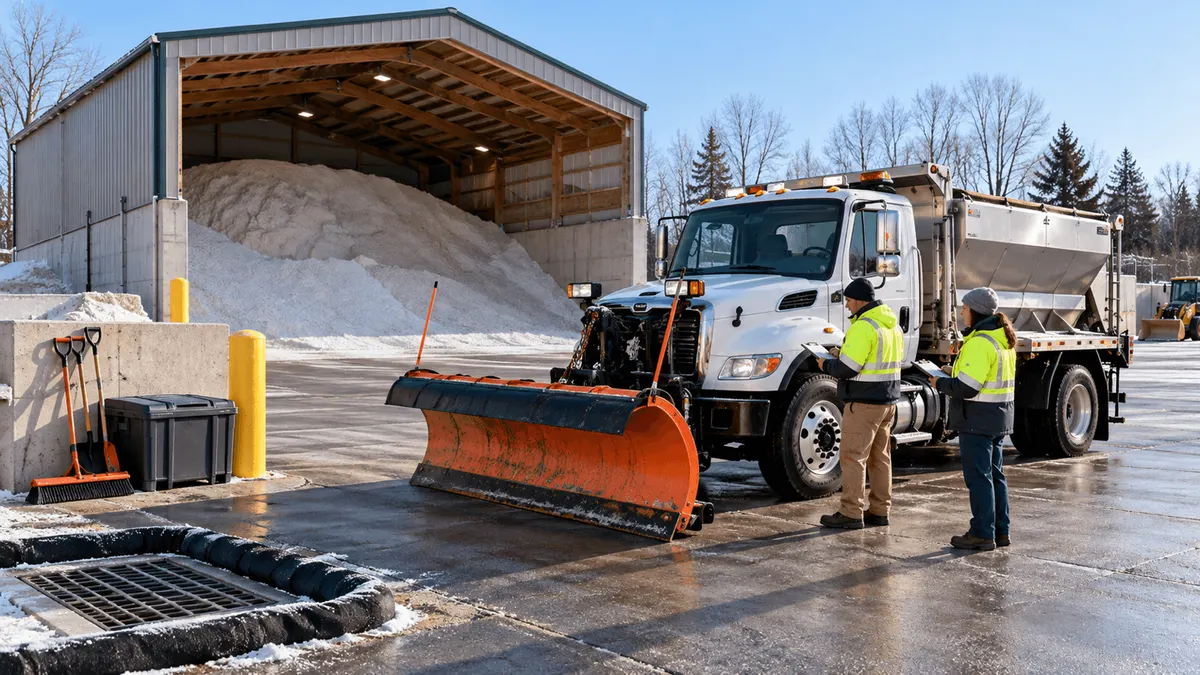
Winter road maintenance can protect travel while creating stormwater concerns when salt storage, loading, application, and cleanup are poorly coordinated.
Public works teams have to balance roadway safety, weather, staffing, equipment, material supply, budgets, and water-quality responsibilities. That balance cannot be reduced to a single application rate or universal product choice. A practical winter plan connects operational decisions to the municipality's MS4 program, applicable permits, local policies, receiving-water concerns, documentation, and training.
EPA identifies pollution prevention and good housekeeping for municipal operations as a core MS4 program area. Its resources include winter maintenance and roadway maintenance practices. The applicable state permit and local procedures determine actual requirements. The practices discussed here support compliance planning and documentation, but they do not promise permit approval or prove compliance.
Who This Affects
Street and highway departments are central because they choose routes, prepare equipment, load materials, monitor storms, apply deicers and abrasives, and clean facilities. Operators need instructions that work during changing conditions, not a binder written only for annual reporting.
Stormwater program staff need to understand winter operations well enough to connect them to the stormwater management program. They may track municipal facility controls, employee training, inspections, material storage, spill response, maintenance, and measurable goals. They should not design operational practices without public works input.
Fleet staff affect calibration, spreader condition, hydraulic systems, tanks, hoses, wash areas, and repair records. Facility managers control stockpile covers, loading areas, drainage, containment, housekeeping, and access. Procurement staff influence product specifications, delivery practices, data availability, and contractor expectations.
GIS, environmental, engineering, finance, and emergency-management staff may also contribute. Mapping can relate routes and facilities to inlets, outfalls, wells, streams, lakes, and chloride-impaired waters where relevant. Finance data can connect purchases and use. Emergency managers can clarify how winter decisions are made during extreme events.
Private contractors and neighboring jurisdictions matter when they use municipal yards, maintain shared roads, or discharge to the same system. Contracts should define training, material handling, application records, spill reporting, equipment checks, and data delivery. A municipality cannot assume that contractor practices automatically match its program.
The Stormwater Planning Issue
Salt and other winter materials can be transported by runoff, snowmelt, vehicle tracking, spills, wash water, or uncovered stockpiles. Potential pathways begin before application. Deliveries can spill at a yard, loaders can scatter material, runoff can contact a stockpile, and trucks can carry residue into drainage areas. Planning should examine the complete material path from purchase through storage, loading, use, recovery, and cleanup.
Operational effectiveness and pollution prevention often share the same need for control. Calibrated equipment, trained operators, weather information, route planning, preventive maintenance, covered storage, careful loading, and documented use can help a municipality apply its selected practice more consistently. The correct choices depend on road conditions, temperature, product, equipment, level-of-service policy, and technical guidance.
MS4 programs commonly address municipal operations through procedures and training intended to prevent or reduce pollutant runoff. Winter maintenance may intersect with facility inventories, municipal yard inspections, spill plans, employee training, catch-basin maintenance, street sweeping, outfall observations, and annual reporting. Treating salt as a stand-alone seasonal task can leave gaps between these program elements.
Receiving waters and permit conditions matter. Some communities have waterbodies impaired for chloride or permit provisions that call for specific actions. Others may have source-water protection areas, sensitive lakes, wetlands, shallow groundwater, or vegetation concerns. Teams should verify current state and local requirements rather than assume that a neighboring municipality's checklist applies.
Records should tell an operational story. Purchase totals alone cannot show where material was stored, which equipment was calibrated, what routes were treated, how conditions affected decisions, or whether a spill was corrected. At the same time, excessive data collection can burden operators without improving decisions. The plan should identify a manageable set of records tied to program needs.
What to Review Before Moving Forward
Map facilities and material pathways. Identify delivery points, covered and uncovered storage, loader travel, truck staging, mixing or brining areas, wash locations, floor drains, storm drains, ditches, outfalls, and nearby waters. Confirm where runoff and wash water actually go. Old site plans may not reflect patched pavement, added bins, relocated drains, or informal loading practices.
Inspect storage and handling controls. Review covers, doors, walls, floors, berms, drainage, product separation, loading practices, housekeeping tools, and spill supplies. Look for material outside the intended area, staining, eroded piles, damaged structures, tracked residue, and drains within the loading zone. Assign corrective actions with owners and dates.
Review equipment readiness. Inventory spreaders, sprayers, loaders, sensors, controllers, and tanks. Establish calibration and maintenance procedures that reflect equipment and manufacturer guidance. Record equipment identity, date, method, settings, results, repairs, and the person completing the work. Recheck when equipment, material, or settings change in a way that affects performance.
Connect operations to weather and routes. Define who reviews forecasts and pavement conditions, who authorizes treatment choices, and how changes are communicated. Route maps should identify operational priorities and any areas requiring special consideration under the municipality's program. Avoid creating a map so complex that operators cannot use it during a storm.
Review material data and procurement. Confirm product type, supplier information, delivery quantities, storage needs, equipment compatibility, safety information, and record format. A less familiar product should not be adopted solely because it is described as environmentally friendly. Evaluate performance, corrosivity, receiving-water concerns, equipment, cost, and applicable guidance.
Define spill and release response. Operators should know how to stop the source, protect drains when safe, recover material, report the event, obtain assistance, and document disposal or reuse. The procedure should distinguish routine housekeeping from a release requiring escalation under municipal, state, or federal requirements.
Plan post-storm and end-of-season work. Identify when and where sweeping, material recovery, yard cleanup, drainage inspection, or equipment washing occurs. Coordinate with catch-basin and inlet maintenance if accumulated material affects priorities. Never direct wash water or recovered material to a storm drain without confirming the authorized management method.
Build a concise record set. Useful records may include training, facility inspections, equipment calibration, maintenance, material purchases, route or event use, complaints, spills, corrective actions, and seasonal review. Each field should have a defined purpose. Clarify retention, quality checks, and how contractor records enter the municipal system.
Planning, Permitting, or Compliance Support That Fits
Operational planning support can bring public works, stormwater, fleet, and facility staff together around a single material-flow map. A facilitated review can identify where procedures conflict with actual practice and where a modest physical or administrative change could close a gap.
MS4 compliance support can compare current procedures, training, inspection forms, records, and annual-report descriptions with the applicable permit. This supports compliance planning, helps prepare documentation, clarifies responsibilities, and can reduce review delays caused by missing or inconsistent records. It does not guarantee a compliance outcome.
GIS support can map yards, routes, drainage features, outfalls, receiving waters, and sensitive areas at a useful scale. The map should cite its data sources and update owner. It can support decisions but should not imply that every environmental pathway is known without field verification.
Facility planning may be appropriate when storage or drainage needs physical improvement. Engineers or other qualified professionals can evaluate covers, floors, grading, containment, drainage modifications, wash systems, and structural needs. Permitting may be required for some changes. Early review helps teams prepare documentation and clarify responsibilities.
Training support should be role-based. Operators need practical instruction on equipment, product, routes, records, spills, and facility practices. Supervisors need decision and review responsibilities. Stormwater staff need enough operational context to evaluate program records. Contractors need the municipality's specific expectations.
Data and audit support can test a small sample across systems. Select a storm event and trace forecast or decision notes, vehicle or route information, material use, equipment calibration, facility conditions, incidents, cleanup, and reporting. The purpose is to find broken links, not to create a perfect reconstruction of every minute.
Common Mistakes to Avoid
Avoid treating material purchased as material applied. Inventory changes, transfers, spills, stock on hand, and contractor use can make the values different. If totals are used for program evaluation, document how they are calculated and what they exclude.
Do not use calibration as a one-time paperwork exercise. Equipment condition, controllers, material characteristics, repairs, and operator settings can affect delivery. The procedure should define when calibration or verification occurs and how a problem is corrected.
Do not focus only on the road. Storage, loading, tracking, wash water, and spills may create concentrated pathways at municipal facilities. Yard inspections should occur during the season when practices can be observed.
Avoid universal claims about one deicer or application method. Selection should account for safety, performance, temperature, equipment, infrastructure, environmental setting, cost, and current guidance. Alternatives can have their own tradeoffs.
Do not collect records that operators cannot reasonably complete during a storm. Involve users in form design, use defaults and equipment identifiers where appropriate, and separate essential event data from longer after-action notes.
Do not describe a voluntary practice as a permit requirement without checking the applicable authorization. Conversely, do not assume that general good-housekeeping language is the only relevant obligation when chloride-specific provisions or local requirements may apply.
Avoid promising that a plan will prevent every discharge or secure approval. A coordinated program can support compliance planning and better decisions, but outcomes depend on implementation, conditions, maintenance, and regulatory review.
Next Step
Before the first winter event, walk one storage yard with a public works supervisor, stormwater representative, fleet technician, and an operator. Trace salt or other material from delivery through loading and return. Photograph drainage pathways, confirm spill equipment, inspect storage, and compare written procedures with the work sequence.
Then select one spreader and one route for a record test. Verify equipment identity, calibration, operator training, material, route map, event record, maintenance history, and end-of-shift housekeeping. Correct unclear fields or ownership before scaling the process.
Finally, schedule a midseason review. Compare records, material inventory, facility observations, equipment issues, complaints, and weather experience. Update training or procedures while the season is active, and preserve the decisions for annual reporting and next year's planning.
Sources
U.S. Environmental Protection Agency, Stormwater Discharges from Municipal Sources: Developing an MS4 Program | https://www.epa.gov/npdes/stormwater-discharges-municipal-sources-developing-ms4-program
U.S. Environmental Protection Agency, Stormwater Best Management Practice: Roadway and Bridge Maintenance | https://www.epa.gov/system/files/documents/2021-11/bmp-roadway-and-bridge-maintenance.pdf
U.S. Environmental Protection Agency, NPDES Stormwater Webcasts | https://www.epa.gov/npdes/npdes-stormwater-webcasts