
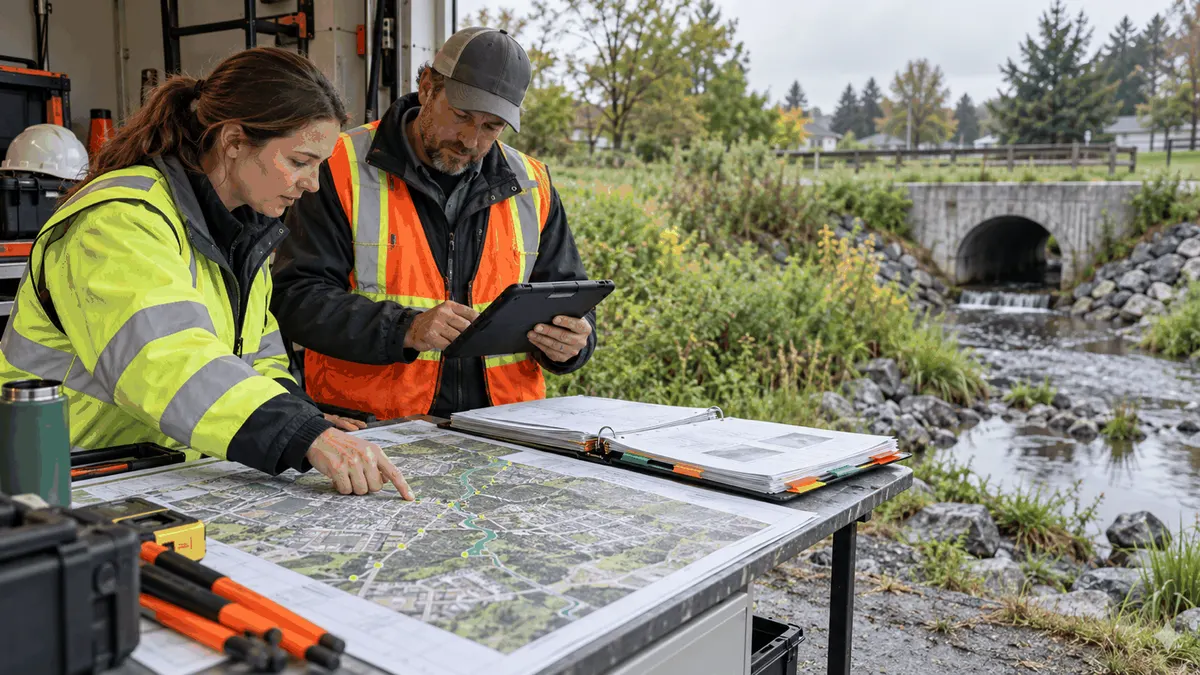
An MS4 annual report is more useful when maps, inspection logs, complaint records, BMP work, and program narratives tell one consistent, traceable story.
Municipal stormwater programs generate information throughout the year, often in different systems managed by different people. Public works may close inlet work orders in an asset platform. Inspectors may store outfall observations in a mobile application. Engineering may track plan reviews in a permitting database. Education staff may count outreach events in a spreadsheet. Consultants may maintain separate files for monitoring, illicit discharge work, or SWPPP reviews. The annual report is where these records must be assembled into a program account that matches the applicable permit and can be supported by evidence.
Data reconciliation is the work of finding and resolving differences before totals and narratives are submitted. It does not mean making every system identical. It means defining which record is authoritative for each measure, connecting related records, documenting corrections, and explaining legitimate differences. This process supports compliance planning and helps prepare documentation, but it does not guarantee agency acceptance or any compliance outcome.
Who This Affects
This issue affects MS4 program managers, public works directors, engineers, GIS staff, inspectors, permit reviewers, maintenance supervisors, finance personnel, communications staff, consultants, and officials who sign or certify reports. It also affects departments whose routine work creates stormwater evidence even when staff do not think of themselves as part of the MS4 program.
A field crew that cleans a catch basin may create a work order containing asset ID, date, material removed, and disposal information. An inspector may record a defect in another system. If the work order and inspection cannot be linked, the annual report may show an unresolved defect even though maintenance occurred, or it may count maintenance without demonstrating why the work was prioritized.
The same problem can appear in illicit discharge detection and elimination work. A complaint record, field screening form, investigation log, enforcement letter, corrective action, and closure decision may live in different places. When the annual report is prepared months later, the program needs a traceable chain rather than several unconnected counts.
Smaller municipalities are not exempt from coordination simply because they use fewer systems. A shared drive with multiple spreadsheets can create the same conflicts as a large enterprise database. The scale changes, but the underlying questions remain: what was required, what happened, who verified it, and where is the supporting record?
The Stormwater Planning Issue
MS4 reporting requirements vary by permit, permitting authority, system size, location, and reporting year. Teams should begin with their current permit, reporting instructions, and official template. A neighboring municipality's report may be a useful example, but it is not a substitute for the requirements that apply to the reporting MS4.
Annual reports often combine quantitative measures and narrative evaluation. Counts may include inspections, screenings, maintenance activities, trainings, enforcement actions, construction sites, outreach events, monitoring samples, or BMP implementation milestones. Narratives may explain progress, changes, problems, planned actions, or whether measurable goals were achieved. If the count and narrative come from different evidence, inconsistencies can appear even when both authors worked carefully.
For example, a GIS layer may contain 420 mapped outfalls, while the inspection application contains 417 active outfall records and a spreadsheet reports 401 screened locations. Those numbers may all be defensible if three structures were retired and sixteen could not be accessed, but the report should not force the reviewer to guess. Reconciliation identifies the population, the activity, the exceptions, and the reason each total differs.
Timing creates another risk. A report may cover a fiscal year, permit year, calendar year, or other period. Work orders may use completion dates while inspection systems use creation dates. A corrective action opened before the reporting period and closed during it could be counted differently depending on the measure. Defining date rules before extracting data can reduce review delays and prevent the same activity from moving between years without explanation.
Electronic reporting adds structure but does not remove judgment. Required fields, attachments, certification, and data elements still need to be matched to the permit. A successful system upload shows that the form was accepted technically; it does not prove that the underlying data are complete, accurate, or responsive to the permit.
What to Review Before Moving Forward
Build a reporting requirement crosswalk
Create a working table that lists each permit requirement, report question, data owner, source system, reporting period, calculation rule, supporting documents, reviewer, and final location. The crosswalk should use the permit's language closely enough that staff can trace a reported answer back to its requirement. It can also identify measures that depend on another department before the reporting deadline becomes urgent.
Do not start with last year's narrative alone. Reusing text can carry forward obsolete milestones, changed permit citations, retired BMPs, or promises that were not completed. Prior reports are valuable for continuity, but each statement should be checked against current requirements and evidence.
Define authoritative records and identifiers
For each dataset, decide which system provides the official total and which systems supply supporting detail. Use stable identifiers for assets, complaints, inspections, sites, BMPs, and projects. Names and locations are not always reliable keys. One outfall may be called OF-17 in GIS, North Park Pipe in a field log, and the creek outlet in a work order. A cross-reference table can connect these records without rewriting historical data.
Asset changes need effective dates and reasons. Added, retired, combined, or reclassified assets should not simply disappear from one year's denominator. Record who approved the change and how it affects inspection or maintenance schedules. This helps explain year-to-year differences and keeps the reporting population aligned with the map.
Reconcile totals to supporting records
For each reported count, preserve the query, filter, pivot, or calculation used to produce it. Check for duplicate records, blank IDs, canceled activities, reopened work, test entries, and records outside the period. Sample individual rows from the final total and trace them to source documents. Also work backward by choosing source records and confirming that they appear in the reported set.
Pay special attention to status fields. Complete, closed, inspected, corrected, and verified may describe different stages. A maintenance work order marked complete may mean the crew left the site, not that an inspector verified the BMP outcome. The annual report should use definitions that match the permit and the municipality's procedures.
Connect narrative statements to evidence
When the report says a program improved, expanded, completed, or met a goal, identify the evidence. That might be an adopted procedure, dated training roster, revised map, inspection dataset, construction record, council action, contract deliverable, or trend analysis. Avoid presenting an activity as an outcome if the data only show that the activity occurred.
If progress was delayed, explain the operational fact without making promises that the program cannot support. State what was incomplete, why it mattered, what interim controls were used if applicable, who owns the next action, and the planned schedule based on current information. Careful transparency is stronger than an unsupported claim that everything is on track.
Check finances, contracts, and shared responsibilities
Budget and expenditure figures may be maintained outside the stormwater group. Confirm which labor, equipment, consultant, capital, and shared-service costs are included. Document allocation methods when a project or crew supports both stormwater and other municipal work. Keep reported financial measures consistent with permit instructions and local accounting practices.
For co-permittees, regional programs, contracted inspections, or shared education efforts, clarify who reports each activity. A regional event should not be omitted because every participant assumes another entity will count it, and it should not be counted several times without explanation. Contracts should require data in a form and schedule that supports annual reporting.
Conduct technical and management review
Technical reviewers should verify data logic, maps, dates, calculations, and evidence. Program managers should review the complete story across minimum control measures, BMPs, schedules, and commitments. The authorized signatory needs enough time to understand what is being certified and ask questions before submission.
Keep a review log showing comments, responses, decisions, and version changes. Final files should be locked or clearly labeled so that a late edit to a spreadsheet does not silently change a total after the narrative is approved.
Planning, Permitting, or Compliance Support That Fits
A focused data-reconciliation effort fits programs that have reliable field work but fragmented records. Support may include a permit crosswalk, data inventory, asset-ID mapping, duplicate review, status-definition workshop, report calculation workbook, GIS quality checks, document index, and management review schedule. The goal is to clarify responsibilities and create a repeatable path from field activity to report entry.
Programs preparing for a new permit cycle may need broader planning. Measures, forms, asset layers, and workflows can be redesigned so required evidence is captured during the year. This can reduce review delays because staff are not reconstructing records at the deadline. It can also reveal where the current program depends on informal knowledge held by one employee or consultant.
An internal audit or readiness review may fit when reporting problems recur. A sample-based review can test whether inspection findings connect to work orders, enforcement actions connect to closure, training records identify roles, and maps match field populations. Findings should be prioritized by permit significance, data reliability, operational risk, and effort needed to correct the process.
External support can help organize the work, but municipal ownership remains essential. Consultants should document assumptions, queries, transformations, and unresolved items. The MS4 should retain accessible source files and understand how each reported value was produced. No consultant can promise that a permit authority will approve a report or determine the program compliant.
Common Mistakes to Avoid
One mistake is waiting until the reporting template opens to discover what data exist. Another is assigning each report section to a department without a common crosswalk, resulting in conflicting date ranges and definitions. A third is manually typing totals into the report without preserving the extract or calculation that produced them.
Teams also over-rely on counts. Ten inspections say little without a defined population, schedule, findings, and follow-up. Conversely, a detailed narrative without records can be difficult to verify. Good reporting connects quantity, context, exceptions, and evidence.
Another mistake is changing GIS assets only to make totals agree. Maps should reflect verified field and program information, not be edited to reconcile a report after the fact. Legitimate differences should be investigated and documented. If a correction is needed, preserve what changed, why, when, and by whom.
Finally, programs sometimes treat submission as the end of the cycle. Questions found during reconciliation should become improvements for the next year. A missing identifier, ambiguous status, or late contractor file is a workflow issue that can be corrected at the source.
Next Step
Choose three measures from the upcoming annual report and trace them from permit language to final number. For each measure, identify the population, reporting period, source system, owner, calculation, exclusions, evidence, and reviewer. Then compare one reported record with its GIS feature, inspection form, work order, and closure documentation.
Use the results to create a short reconciliation plan with due dates well before submission. Resolve definitions first, then data exceptions, then narrative alignment, and finally management review. This approach supports compliance planning, helps prepare documentation, can reduce review delays, and clarifies responsibilities without promising a permit, approval, or compliance result.
Sources
U.S. EPA, NPDES Stormwater Program | https://www.epa.gov/npdes/npdes-stormwater-program
U.S. EPA, Municipal Sources Resources | https://www.epa.gov/npdes/municipal-sources-resources
Electronic Code of Federal Regulations, 40 CFR 122.42, Additional Conditions Applicable to Specified Categories of NPDES Permits | https://www.ecfr.gov/current/title-40/chapter-I/subchapter-D/part-122/subpart-C/section-122.42
U.S. EPA, NPDES Electronic Reporting Rule | https://www.epa.gov/compliance/npdes-ereporting
U.S. EPA, Clean Water Act Compliance Monitoring | https://www.epa.gov/compliance/clean-water-act-cwa-compliance-monitoring