
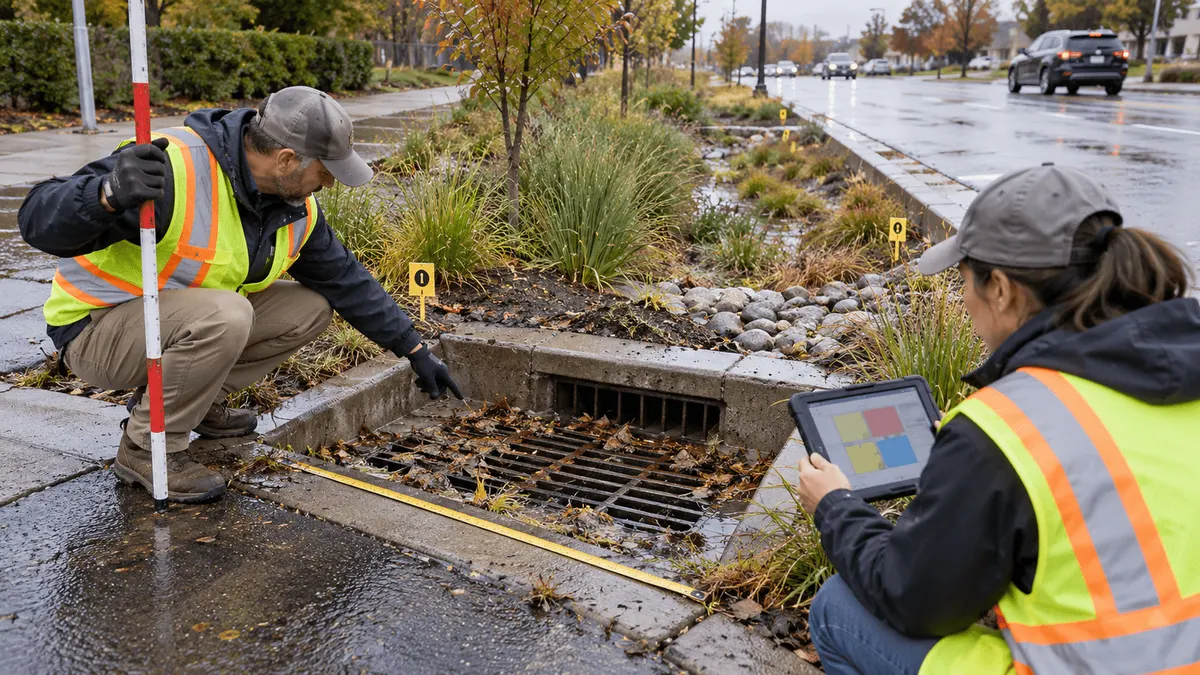
A shared defect-code library can turn scattered stormwater inspection notes into consistent maintenance priorities, clearer records, and useful trends.
Municipal teams often inspect catch basins, outfalls, swales, ponds, bioretention areas, proprietary devices, and other stormwater assets using different forms and vocabulary. One inspector records sediment, another writes needs cleaning, and a third selects poor condition. All three may be describing the same problem, but the records do not support the same decision.
Defect codes provide a controlled vocabulary for observable conditions. They can help inspectors describe what they see, connect findings to maintenance actions, and make follow-up easier to audit. Codes do not replace professional judgment, permit requirements, or site notes. Their value comes from standardizing the first layer of field information while preserving enough detail to explain the condition.
A useful library should fit the municipality's assets, maintenance program, GIS, work-order system, and reporting responsibilities. Copying a long list from another jurisdiction can create false precision. The goal is a practical set that field staff can apply consistently and supervisors can connect to decisions.
Who This Affects
This issue affects MS4 program managers, public works supervisors, stormwater inspectors, GIS teams, maintenance crews, engineers, consultants, plan reviewers, and asset-management staff. It also affects contractors who inspect or maintain privately owned BMPs when the municipality relies on their records for oversight.
Field inspectors need codes that describe observable evidence without requiring them to guess at root causes beyond their role. Maintenance crews need findings that identify the asset, location, access constraints, and likely work. Managers need a way to prioritize limited resources and show that inspection results were reviewed. GIS and database staff need stable values that can be queried without manually cleaning free text after every season.
Engineers and specialists may need a separate path for conditions that require design review, structural assessment, water-quality evaluation, or additional investigation. A defect library should make escalation visible instead of forcing every problem into a routine maintenance category.
Residents and property owners can also be affected indirectly. Clear internal codes can improve how municipalities explain that an issue was observed, assigned, investigated, or closed. That clarity supports better communication, but the code should not be presented as a guarantee that flooding, erosion, or permit issues will be resolved.
The Stormwater Planning Issue
EPA's stormwater program expects regulated MS4s to develop and implement practices that reduce pollutants from municipal operations, including inspection and maintenance procedures and schedules for stormwater BMPs. Actual obligations come from the applicable permit and state or local program. A defect-code library is an administrative tool that can support compliance planning and documentation, but it does not establish or replace those requirements.
Without standard terms, teams struggle to compare records. Free-text notes can hide whether a finding is new, recurring, urgent, already assigned, or outside the inspector's expertise. Photographs help, but a photo alone may not state what the inspector observed, where it occurred, or what follow-up was requested. A condition score can summarize severity, but it may not explain the defect.
Codes work best when they separate observable condition from action. For example, sediment accumulation is a condition; clean inlet is a proposed action. Standing water may be a condition; investigate grading, underdrain, outlet, or infiltration performance may be the next step. Keeping those fields distinct makes it easier to revise an action after review without rewriting the inspection history.
The library should also separate condition from cause unless the cause is directly verified. Erosion at an outlet is observable. The cause might involve velocity, blockage, grade change, downstream restriction, soil condition, or another factor. A field inspector can record suspected cause in notes, but the core code should not imply a conclusion that has not been evaluated.
Severity should have defined evidence. Terms such as minor, moderate, and severe are not useful if inspectors apply them differently. Thresholds may use measurable depth, percentage of storage lost, dimensions, exposed area, obstruction extent, safety impact, discharge evidence, or functional effect. Where numerical thresholds are inappropriate, the guide can provide photographs and examples.
Asset context matters. Vegetation that is expected in a bioswale may be a defect in a concrete channel. Standing water may be part of a permanent pool but unexpected in a different BMP. Sediment at a forebay may be managed differently from sediment clogging an inlet. The code library should identify which codes apply to which asset types and which require asset-specific criteria.
What to Review Before Moving Forward
Start with the regulatory and program context. Review the current MS4 permit, stormwater management program, standard operating procedures, inspection frequencies, maintenance standards, enforcement process, and reporting fields. Identify which information is explicitly required and which information the municipality needs for operational control.
Inventory the assets and forms already in use. List BMP and infrastructure types, ownership, responsible department, inspection method, work-order connection, GIS identifiers, and existing condition terms. Sample completed inspections from multiple staff and seasons. Repeated phrases and recurring ambiguities reveal where standardization will have the greatest value.
Map the lifecycle of a finding. Determine how an observation moves from the field to quality review, maintenance assignment, engineering referral, contractor notice, reinspection, and closure. A code that stops at the inspection database without creating an accountable next step may improve reporting but not operations.
Define the minimum data attached to each defect. Common fields include asset identifier, inspection date, inspector, location within the asset, condition code, severity, measured value where applicable, photo, note, recommended response, responsible group, due date or priority, work-order number, status, and closure evidence. Not every field needs to be mandatory for every code.
Review data architecture before locking the code set. Decide whether codes live in a GIS domain, mobile form, relational table, work-order system, or shared reference file. Use stable identifiers that do not change when the plain-language label is improved. Track version history so older records remain interpretable.
Plan for unknown and not applicable without making them easy escape options. Inspectors sometimes cannot observe a component because of water, vegetation, access, safety, or equipment limitations. That is different from no defect observed. The form should distinguish not inspected, inaccessible, not applicable, no observed defect, and further evaluation needed.
Test the library in the field. Give multiple inspectors the same assets and compare results. Discuss disagreements, revise definitions, and add examples. A pilot should include routine conditions, borderline cases, different asset types, and at least one situation that requires escalation. The test is whether reasonable users reach similar descriptions, not whether every record is identical.
Check how priorities are assigned. A severity rating may inform priority, but it should not be the only input. Public safety, active discharge, receiving-water sensitivity, weather forecast, access, asset criticality, repeat history, available crews, and permit timelines may affect the response. Document the decision logic so automated routing does not create misleading certainty.
Planning, Permitting, or Compliance Support That Fits
For a small municipality, support may begin with a focused workshop and a concise field guide. Staff can identify the most common assets, define a limited set of high-value defects, and connect each one to an existing maintenance or escalation process. Starting small can produce better consistency than launching hundreds of codes at once.
For a larger program, the work may involve GIS schema design, mobile inspection forms, asset hierarchy, integration with computerized maintenance management software, dashboards, and quality-control rules. Technical support can help preserve unique asset identifiers, build controlled domains, prevent duplicate records, and connect inspection observations to work orders.
Engineering support fits conditions that may involve design capacity, structural damage, hydraulic function, slope stability, repeated failure, or uncertain cause. An inspection code can trigger that review without requiring the inspector to diagnose the design problem. The supporting record should provide measurements, photos, plans, prior maintenance, and relevant storm history when available.
Permit and compliance support fits when the municipality needs to align forms, procedures, schedules, and annual reporting with its current MS4 authorization. Careful language matters. A standardized library can support compliance planning, help prepare documentation, clarify responsibilities, and reduce review delays caused by inconsistent records. It does not promise permit approval or prove compliance by itself.
Training support should address both field use and supervisory review. Inspectors need examples, measurement methods, photo expectations, and escalation rules. Supervisors need quality checks, exception handling, priority decisions, and closure standards. Maintenance crews need to understand how codes translate into work without treating the code as a complete scope.
Procurement support may be needed when consultants or contractors provide inspections. Scope language can require use of the municipality's code library, asset IDs, photo conventions, spatial accuracy, data format, and quality-control process. The municipality should retain ownership of the data dictionary and decide how revisions are communicated.
Building a Practical Code Library
Organize codes into understandable families. Common groups may include sediment and debris, vegetation, erosion and scour, structural condition, hydraulic blockage, standing water, illicit-discharge indicators, access and safety, mechanical components, outlet protection, and documentation gaps. Use only the families that fit local assets and responsibilities.
Write each definition around observable evidence. A definition for sediment accumulation might identify where the sediment is located, how depth or coverage is estimated, and what functional effect raises severity. It should avoid vague words such as excessive unless the guide explains what excess means for that asset.
Use photographs carefully. Include examples of no observed defect, borderline condition, and escalating severity. Photographs should show scale and context, not only a close-up. Update the guide when local materials, vegetation, asset designs, or maintenance practices change.
Connect codes to responses through a separate crosswalk. The crosswalk can identify routine maintenance, supervisor review, engineering evaluation, source investigation, owner notice, urgent field response, or monitoring. It should allow a reviewer to change the response when site context warrants.
Set closure evidence by response type. A completed work order may not demonstrate that the observed condition was corrected. Closure can require a follow-up inspection, dated photo, measurement, disposal record, contractor report, or engineering acceptance depending on the work. Keep the original observation intact and add the closure record rather than overwriting history.
Review the library on a schedule. Track codes that are rarely used, overused, frequently overridden, or associated with repeat findings. Invite feedback from inspectors and maintenance crews. Version updates should be documented, communicated, and tested so trend reports do not mix unlike definitions without explanation.
Common Mistakes to Avoid
Avoid creating too many codes at the start. A long menu slows field work and leads users to choose the first plausible option. Begin with meaningful distinctions that drive different decisions, then add codes when actual records show a recurring need.
Avoid combining condition, cause, action, and status into one code. A label such as clogged by leaves, clean immediately, open can become wrong as soon as the suspected cause changes or the work is assigned. Separate fields preserve the inspection evidence and make workflow updates easier.
Avoid relying on condition scores without definitions. A score of three may mean different things to different inspectors. Pair scores with observable criteria, measurements where practical, and asset-specific examples.
Avoid losing narrative and photos. Controlled codes improve consistency, but unusual conditions need explanation. Allow concise notes, require context photos where useful, and create an escalation path when the code list cannot describe the finding.
Avoid automating priority without review. Algorithms can help sort records, but public safety, receiving-water concerns, forecast conditions, access, and repeat history may change the response. Keep accountable staff in the decision loop.
Avoid closing findings when work is merely scheduled. Status should distinguish observed, reviewed, assigned, in progress, completed, verified, deferred, and closed where those states fit the program. Define who can change each status and what evidence is required.
Avoid treating the library as proof of permit compliance. The municipality must still follow the applicable permit, procedures, schedules, and documentation requirements. Codes are one way to support a defensible program, not a substitute for the program itself.
Next Step
Select three common asset types and collect a representative sample of recent inspection records. Highlight recurring observations, inconsistent words, missing measurements, unclear priorities, and findings that never reached closure. Use that evidence to draft a small pilot library with definitions, severity examples, and a response crosswalk.
Run the pilot with inspectors, maintenance staff, GIS staff, and a supervisor. Compare results on the same assets and revise the definitions before broad rollout. Document the version, train users, and monitor how codes affect work assignment and closure quality.
A well-designed defect-code library will not solve every stormwater problem, but it can give field observations a clearer route into planning, maintenance, and reporting. That shared language helps teams prepare documentation, clarify responsibilities, and make better use of limited inspection data without promising a compliance or permitting outcome.
Sources
United States Environmental Protection Agency, National Menu of Best Management Practices for Stormwater Pollution Prevention and Good Housekeeping: https://www.epa.gov/npdes/national-menu-best-management-practices-bmps-stormwater-pollution-prevention-and-good
United States Environmental Protection Agency, Transportation Stormwater Permit Compendium: https://www.epa.gov/sites/default/files/2018-11/documents/dot_ms4_compendium_10.16.18.pdf
Electronic Code of Federal Regulations, 40 CFR 122.34 Permit Requirements for Regulated Small MS4s: https://www.ecfr.gov/current/title-40/chapter-I/subchapter-D/part-122/subpart-B/section-122.34