
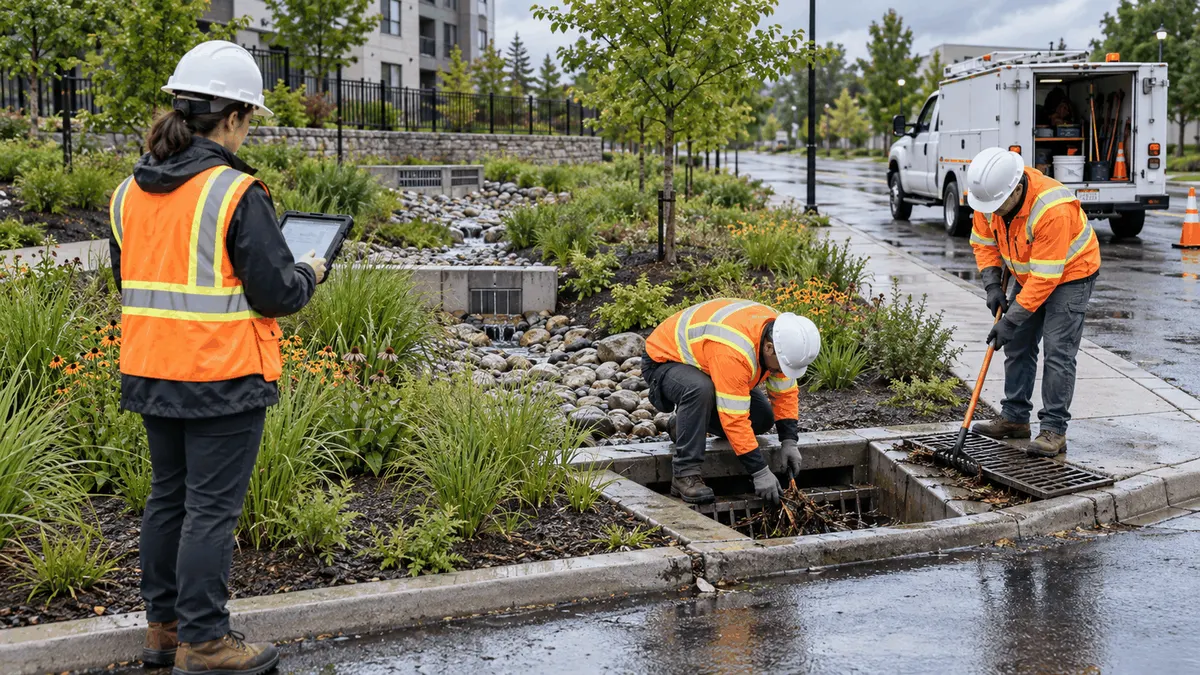
A stormwater inspection creates lasting value only when each maintenance finding reaches the right crew, receives a clear priority, and closes with evidence.
Municipal teams often have inspection forms, asset maps, service requests, and work-order systems, yet the information does not always travel cleanly between them. An inspector may identify sediment in a catch basin, erosion at an outfall, or damaged vegetation at a best management practice. The finding is recorded, but the maintenance crew receives an incomplete description, the work order lacks an asset identifier, or no one verifies what happened after dispatch.
Closing that gap is a practical stormwater planning issue. A connected workflow helps teams assign responsibility, schedule work based on risk and permit needs, document field conditions, and prepare records for program review. It does not guarantee compliance or a particular regulatory result, but it supports compliance planning and clarifies how an inspection becomes a completed, reviewable action.
Who This Affects
This issue affects MS4 program managers, public works directors, stormwater inspectors, GIS staff, customer-service teams, maintenance supervisors, field crews, engineers, and contractors. It also affects departments that own or operate facilities with drainage assets, such as streets, parks, utilities, schools, airports, and transit operations.
The workflow is especially important when several systems are involved. Inspection data may live in a mobile app, asset information in GIS, work in an enterprise maintenance platform, and supporting photographs on a shared drive. If those records do not use the same asset identifiers and status definitions, staff may spend time reconciling lists instead of resolving field needs.
Small communities face the same issue at a different scale. A spreadsheet and paper work orders can support a defensible process when fields, responsibilities, and closeout steps are clear. The objective is not purchasing a complex platform. It is creating a traceable connection from observation through decision, assignment, completion, and verification.
The Stormwater Planning Issue
Stormwater assets need inspection and maintenance to continue performing as intended. EPA's stormwater maintenance resources describe operation and maintenance planning elements such as responsible parties, maintenance schedules, inspection requirements, inspection frequency, funding, and basic maintenance activities. EPA's national menu of best management practices also identifies inspection and maintenance procedures and schedules as part of municipal pollution-prevention and good-housekeeping practices.
The local permit, stormwater management program, ordinances, design standards, and maintenance agreements determine what applies to a specific MS4. Those requirements should anchor the work-order workflow. A generic priority list copied from another jurisdiction may not reflect local reporting deadlines, impaired waters, pollutant concerns, ownership, seasonal restrictions, or response procedures.
An inspection finding is not the same as a maintenance decision. The inspector documents observed conditions. A program or maintenance lead may need to decide whether the condition requires routine work, an urgent response, engineering evaluation, enforcement, owner notification, capital planning, or continued observation. The system should preserve both the original observation and the later decision so reviewers can understand what happened.
Work orders also need geographic and asset context. A note that says clean inlet on Oak Street may be ambiguous if the block has several structures. A stable asset ID, coordinates, map link within the internal system, direction, and photograph can reduce misrouting. For assets not yet in the inventory, the process should create a temporary identifier and route the feature for mapping rather than losing the finding.
Closeout is more than changing a status to complete. Teams may need to record the date, crew, activity, material removed, disposal location, equipment, photographs, remaining deficiency, and follow-up inspection. The exact fields depend on the asset, work type, permit, and program goals. A short but consistent record is usually more useful than a long narrative that omits the key evidence.
What to Review Before Moving Forward
First, inventory the systems and handoffs. Identify where inspections begin, who reviews findings, how work orders are created, who assigns them, where crews record results, and who verifies closure. Include contractor work and owner-maintained BMPs. A simple process map often reveals manual retyping, duplicate identifiers, and statuses that mean different things to different departments.
Review asset identifiers. The same inlet, outfall, ditch, pond, swale, or proprietary treatment unit should carry one durable ID across GIS, inspection, maintenance, and reporting records. If legacy systems use different numbers, maintain a crosswalk. Avoid using only addresses because addresses change, span multiple assets, or do not exist for remote infrastructure.
Define finding categories and minimum inspection fields. Categories might include sediment, trash, erosion, structural damage, vegetation, blockage, standing water, illicit discharge indicators, access problems, and safety concerns. The categories should match the assets and decision pathways used locally. Required fields can include severity, extent, location, photograph, recommended follow-up, and whether immediate notification occurred.
Review priority rules with operations staff. Priority may reflect public safety, active discharge, flooding potential, risk to receiving water, pollutant concern, asset function, weather forecast, permit timeframe, or coordination with other work. The rules should distinguish emergency dispatch from routine scheduling and should identify who can override a priority with documented reasoning.
Check ownership and authority before dispatch. The MS4 may inspect a feature that a private owner, homeowners association, developer, state agency, or another department must maintain. The workflow should route the finding to the responsible party and track notice or follow-up without incorrectly showing municipal maintenance as assigned. Maintenance agreements, easements, and acceptance status may need review.
Evaluate environmental and field constraints. Sediment or water may require characterization or special handling. Access may require traffic control, utility coordination, property permission, confined space procedures, or specialized equipment. Work near streams or wetlands may require additional review. A work order should flag those constraints early so a crew is not dispatched without the information or authority it needs.
Finally, compare closeout fields with reporting needs. If the annual report summarizes assets inspected, maintenance completed, material removed, or response time, the source data should capture those measures consistently. Avoid promising that every field will satisfy every review. Instead, map each field to the applicable permit, program document, standard operating procedure, or management need.
Planning, Permitting, or Compliance Support That Fits
A basic workflow can use five linked states: observed, reviewed, assigned, completed, and verified. Each state should have an owner, required information, and a permitted next action. Additional states such as awaiting owner, engineering review, seasonal hold, or capital project may be useful, but too many statuses can obscure rather than clarify responsibility.
The observed record should preserve what the inspector saw without later edits erasing it. The reviewed state records the disposition and priority. The assigned work order gives the crew an actionable location, scope, constraints, and expected evidence. Completion records what the crew actually did. Verification confirms that the maintenance addressed the finding or creates a follow-up action.
GIS integration can reduce location errors and support planning. Inspectors can select an asset from the map; work orders can inherit the identifier and coordinates; supervisors can view clusters; and completed work can update condition or maintenance history. Integration does not need to mean a single software suite. Structured exports, shared IDs, and documented synchronization can be sufficient when carefully managed.
Standard operating procedures should define the workflow in plain language. Include how to handle unmapped assets, duplicate findings, urgent conditions, inaccessible locations, private ownership, contractor work, reopened issues, and failed verification. The procedure should also state what information must not be changed after an inspection and who may correct a record.
Pilot the process with a limited asset group, such as catch basins in one drainage area or municipal bioretention practices. Measure whether work orders reach the right crew, whether required fields are usable in the field, whether closeout evidence supports review, and how long each handoff takes. Adjust the workflow before expanding it across every asset class.
Program support can help prepare documentation, align fields with stated responsibilities, and reduce review delays caused by missing or inconsistent records. It can also connect recurring maintenance needs with budget and capital planning. It should not be presented as a promise of permit approval or compliance. The permitting authority and applicable requirements control those outcomes.
Common Mistakes to Avoid
One common mistake is auto-creating work orders from every inspection checkbox without review. That approach can overwhelm crews with duplicates and low-value tasks. A defined review step can consolidate findings, confirm ownership, and assign the right response while preserving the original inspection record.
Another mistake is relying on free-text locations. Crews lose time searching, and completed records may attach to the wrong feature. Stable asset IDs, coordinates, maps, and photographs make the work more precise. When no asset exists, the workflow should deliberately add one or document why the feature remains outside the inventory.
Using only open and closed statuses hides important delays. A record waiting for private-owner action is different from one assigned to a municipal crew. A capital repair is different from routine cleaning. A small set of meaningful statuses and aging reports can clarify where action is stalled.
Closing work based only on crew departure can leave unresolved conditions. Sediment may be removed while a damaged outlet remains. Vegetation may be cut without correcting erosion. Verification should match the original finding and should allow the item to reopen or split into follow-up work.
Keeping photographs outside the record weakens the history. File names and shared folders may not retain a reliable link to the asset and date. The workflow should associate before-and-after photographs or other evidence with the relevant inspection and work order while following local retention and privacy practices.
Ignoring removed material is another gap. Catch-basin sediment, debris, vegetation, and other material may need quantity estimates and disposal documentation. Local procedures should address handling and recordkeeping, especially when observations suggest contamination or an illicit discharge.
Finally, teams sometimes build a workflow around software defaults instead of program needs. A platform can automate handoffs, but it cannot decide local ownership, priority, permit interpretation, or verification standards. Those decisions should be documented first and configured second.
Next Step
Select a recent group of inspection findings and trace each one from field observation to current status. Note where an asset ID was lost, a decision was undocumented, a work order lacked useful detail, or closure could not be verified. This small audit provides a concrete list of workflow improvements.
Then convene inspection, GIS, maintenance, and program staff to agree on the minimum fields and five core states. Test the proposed process using real assets and both routine and urgent examples. Confirm that the workflow handles ownership questions, unmapped features, contractor work, and follow-up verification.
A well-connected work-order process turns scattered records into an operational history. It helps MS4 teams show what they observed, how they prioritized the issue, who acted, what was completed, and what still needs attention. That clarity supports compliance planning, maintenance budgeting, internal accountability, and better decisions about the stormwater system.
Sources
United States Environmental Protection Agency, Stormwater Maintenance: https://www.epa.gov/npdes/stormwater-maintenance
United States Environmental Protection Agency, National Menu of Best Management Practices for Stormwater Pollution Prevention and Good Housekeeping: https://www.epa.gov/npdes/national-menu-best-management-practices-bmps-stormwater-pollution-prevention-and-good
United States Environmental Protection Agency, Stormwater Discharges from Municipal Sources: https://www.epa.gov/npdes/stormwater-discharges-municipal-sources