
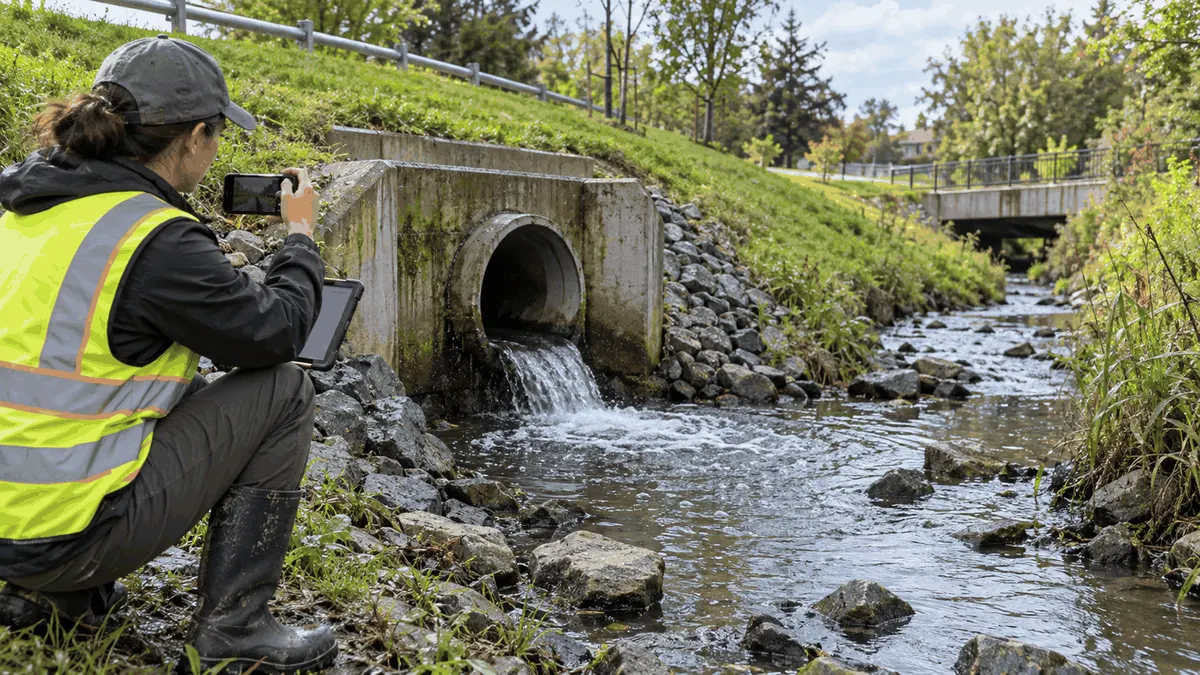
Stormwater IDDE records are most useful when a municipality can trace a complaint through screening, responsibility, correction, and documented follow-up.
Illicit discharge detection and elimination work depends on more than a map of outfalls. A complaint, odor report, discoloration, dry-weather flow, spill, or field observation may begin a chain of decisions involving public works, code staff, utilities, private owners, contractors, and environmental regulators. When the record stops at the first visit, the team may lose the reason for the next action and the evidence needed to explain what happened.
This article is a stormwater planning and documentation discussion. It does not promise a permit, grant, approval, or compliance outcome. Each program should use its applicable NPDES permit, MS4 documents, state and local requirements, safety procedures, and technical judgment.
Who This Affects
IDDE response records affect municipal stormwater programs, public works departments, drainage and utility teams, code enforcement, emergency management, wastewater staff, parks departments, and consultants supporting field investigations. They also affect private facilities, developers, industrial operators, property managers, and contractors whose activities may be connected to a reported discharge.
The first person who receives a complaint may not be the person who can investigate it. A call center may capture the report, a stormwater inspector may visit, a utility crew may correct a cross-connection, and a supervisor may decide whether follow-up is needed. The record should make those handoffs visible so the case does not disappear between systems.
GIS staff need reliable identifiers. A complaint described as behind the library, a field form using an outfall number, and a work order using a street address may all refer to the same location. Connecting those references supports trend review and helps the team distinguish a repeat concern from a new one.
Elected officials, residents, and partner agencies may ask what happened to a reported discharge. A concise, well-organized record can show what was observed, what was not verified, which responsibilities were assigned, and what remains open. It should not overstate a finding or imply that a single visit proves the absence of a source.
The Stormwater Planning Issue
EPA describes illicit discharges as discharges to a storm drain system that are not composed entirely of stormwater, subject to stated exceptions and the applicable program. Because stormwater can flow to receiving waters without treatment, MS4 programs commonly need processes for finding, investigating, documenting, and addressing potential sources. The local permit and program documents determine the exact requirements.
The planning issue is the connection between an initial signal and a defensible next step. A complaint may contain a time, smell, color, location, photograph, or suspected source. A field visit may find no flow, intermittent flow, a natural condition, a maintenance issue, or an active discharge. Each outcome should lead to a recorded disposition and, when needed, follow-up.
Start with intake quality. Capture the date, time, reporter contact when available, location, direction of flow, weather, description, photographs, and any safety concern. Do not pressure a reporter to classify the discharge. Record observations and uncertainty separately from assumptions about the source or pollutant.
Next, define screening steps. The team may review maps, upstream and downstream assets, recent maintenance, rainfall, construction activity, utility work, industrial activity, and prior complaints. A field visit may include visual observations, photographs, flow or no-flow status, odor, color, turbidity, conductivity, or other measurements selected by the program. Use trained personnel and established safety procedures, especially around channels, traffic, contaminated water, and private property.
An IDDE record should show the chain of custody for decisions, not necessarily laboratory evidence for every report. When a sample is collected, retain the required sample information. When no sample is collected, explain the screening basis and the reason for the next action. Clear limitations are stronger than unsupported certainty.
The case should also preserve the relationship between evidence and action. If a photograph shows a dry channel but the complaint described a discharge two hours earlier, the record can support a timed follow-up instead of a premature closure. If a maintenance crew finds a blocked inlet, the record can show whether the blockage explains the report or whether the upstream source remains unresolved.
That connection helps managers see whether response capacity matches the program's priorities and whether repeated reports point to a planning, maintenance, or capital question.
What to Review Before Moving Forward
Review the current outfall and drainage asset map. Confirm that identifiers, catchment boundaries, ownership notes, access points, receiving waters, and known interconnections are current enough for the response. A map that lacks a safe access note or upstream path may slow the investigation when time matters.
Compare the complaint system with public works and utility systems. Identify whether the same issue may be stored as a service request, work order, environmental case, code complaint, or emergency call. Decide which system is the primary record and how related records link back to the case number.
Review response categories. A program may need different paths for a dry-weather flow, sanitary sewage, sediment, petroleum sheen, detergent, trash, chemical odor, landscape irrigation, groundwater, fire response water, or a blocked structure. The categories should support consistent triage without pretending that a label is a confirmed source determination.
Check the safety and access process. Field staff may need traffic control, personal protective equipment, a second person, permission to enter property, weather limits, or a decision to observe from a distance. The record should allow the team to document that an investigation was delayed or limited because access was unsafe or unavailable.
Look at escalation rules. Identify when the case goes to utilities, a spill response lead, code enforcement, a state agency, a facility owner, or another authority. Include contact dates, information sent, and the expected next action. Coordination should clarify responsibility without promising that another agency will reach a particular outcome.
Review closeout criteria. A case may close after a verified correction, a documented natural condition, a referral, repeated unsuccessful attempts with an assigned next step, or a determination that more information is needed. The program should state what evidence supports each disposition and when a later inspection is appropriate.
Planning, Permitting, or Compliance Support That Fits
Support may include an IDDE case workflow, GIS catchment review, outfall and drainage inventory, field form design, complaint intake training, response-time analysis, sample documentation, or a cross-department handoff matrix. These services can help prepare documentation, organize evidence, and clarify responsibilities. They can reduce review delays caused by missing context, but they cannot promise a permit, approval, grant, or compliance result.
For public works, support may connect complaints to work orders, asset IDs, photos, and maintenance closeout. For utilities, it may connect manholes, sanitary lines, lift stations, cross-connections, and emergency response. For planning and engineering teams, it may connect a reported discharge to drainage basins, construction plans, easements, receiving waters, or capital projects.
Training should follow the role. Intake staff need to ask neutral questions and preserve location information. Field staff need to observe, photograph, measure, and record uncertainty safely. Supervisors need to assign cases and review overdue actions. GIS staff need to maintain identifiers and map edits. Contractors need to know what they must report when work affects drainage or discharge points.
A tabletop exercise can be useful. Start with a resident report of cloudy water at an outfall after dry weather. Add a second report upstream, a blocked access point, and a facility that denies responsibility. Ask each team who owns the next step, what evidence is recorded, which safety limits apply, and how the case is closed. The exercise often reveals gaps that are invisible in a flowchart.
Common Mistakes to Avoid
Do not close a case because the discharge was not present during one visit. Intermittent sources require a different follow-up plan, additional timing information, or coordination with the likely source. Record what was and was not observed.
Avoid relying on a street address when the drainage path matters. An address may identify a parcel but not the upstream inlet, outfall, private connection, or receiving water. Link the case to the drainage system and retain the map version used for the investigation.
Do not make the reporter responsible for technical classification. Ask for observations such as color, odor, time, weather, location, and direction of flow. Let trained staff decide what screening or referral is appropriate.
Avoid treating a work order as proof of environmental resolution. A crew may clean a structure while the source remains active, or the work order may address a symptom rather than a cause. Use a follow-up inspection or other evidence appropriate to the case.
Do not overpromise the effect of documentation. Better records can support planning, prepare evidence, and clarify responsibility, but they do not guarantee agency acceptance or eliminate future complaints. Keep the language proportional to the evidence.
Next Step
Select three recent IDDE or discharge complaints and trace each from intake through map review, field observation, handoff, corrective action, and closeout. Compare what the program expected to know with what the record actually preserves, then revise one form or responsibility handoff before the next report.
Sources
U.S. Environmental Protection Agency, National Menu of Best Management Practices for Stormwater IDDE https://www.epa.gov/npdes/national-menu-best-management-practices-bmps-stormwater-illicit-discharge-detection-and
U.S. Environmental Protection Agency, Developing an MS4 Program https://www.epa.gov/npdes/developing-ms4-resources
U.S. Environmental Protection Agency, NPDES Stormwater Program https://www.epa.gov/npdes/npdes-storm-water-program