
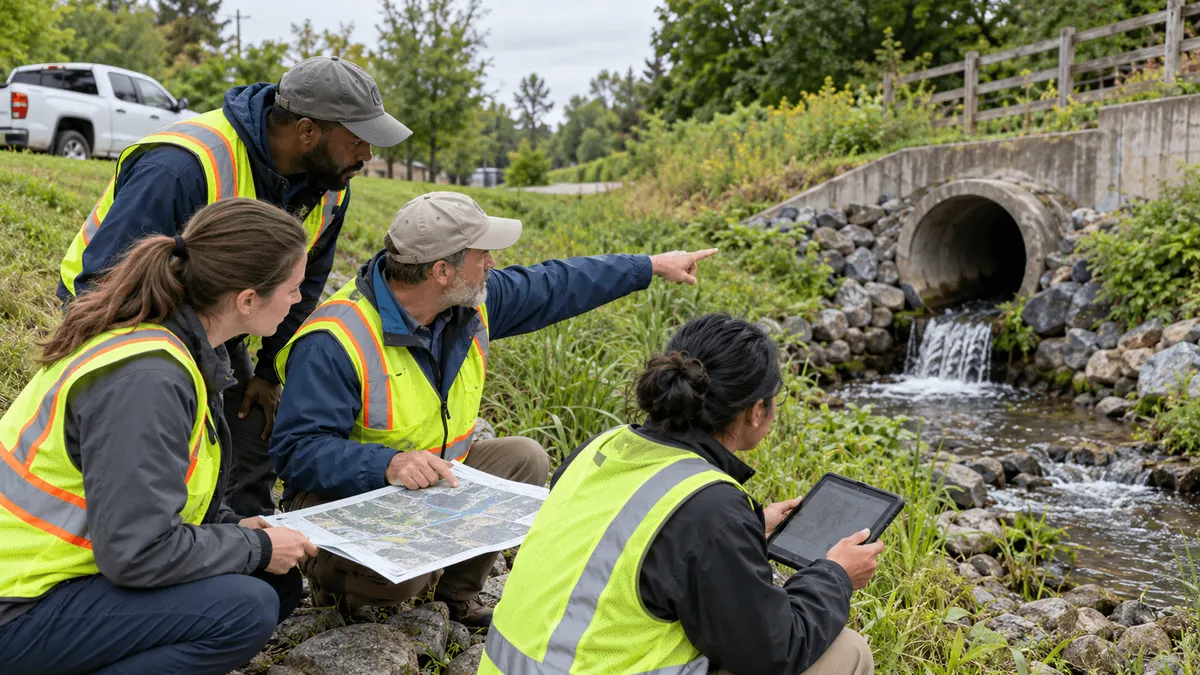
Useful MS4 training records show more than attendance by connecting each employee's learning to assigned duties, procedures, and follow-up work.
Municipal separate storm sewer system programs depend on people across departments. Inspectors review construction sites, maintenance crews clean assets, engineers review plans, code staff address enforcement, fleet workers encounter spills, and parks employees may notice illicit discharges. A single annual presentation can create a roster, but it does not necessarily show whether the right employees received instruction that fits their responsibilities.
Training records become more useful when they connect four things: the permit or program obligation, the employee's role, the procedure taught, and evidence that the role can be performed consistently. That connection supports compliance planning, helps prepare documentation, clarifies responsibilities, and can reveal coverage gaps before an annual report, audit, staff transition, or field incident.
The applicable permit remains the controlling source. Requirements vary by jurisdiction, permit, program size, and minimum control measure. EPA's MS4 Permit Improvement Guide provides example provisions and planning ideas, but it does not replace a permit issued by the responsible authority. Municipal teams should confirm their current permit language, state requirements, ordinances, and written stormwater management program before setting a training schedule.
Who This Affects
MS4 program coordinators are often responsible for assembling annual documentation, but they rarely control every relevant employee. Human resources may track course completion, public works may run tailgate sessions, engineering may hold plan-review meetings, and contractors may provide equipment instruction. Without a common record structure, evidence becomes scattered across calendars, sign-in sheets, learning systems, email, and supervisor notes.
Construction site inspectors, plan reviewers, and enforcement staff need training tied to local erosion and sediment control procedures, inspection documentation, escalation steps, and permit interfaces. Industrial and commercial facility inspectors may need different material focused on sector risks, control measures, recordkeeping, and local enforcement. IDDE staff and general field employees need a practical way to recognize and report suspected illicit discharges without confusing awareness responsibilities with investigation authority.
Operations and maintenance teams are also central. Street sweeping, catch-basin cleaning, outfall maintenance, deicing, grounds work, fleet operations, and material storage can affect stormwater. Training should reflect the written practices and asset-management tools those employees actually use. A generic stormwater definition is not enough for a crew expected to document sediment disposal, close work orders, or respond to a spill.
Managers, supervisors, consultants, and contractors may need to appear in the training matrix as well. The municipality should know which duties are retained, which are delegated, how contractor qualifications are verified, and who reviews the work. Outsourcing a task does not make coordination and documentation disappear.
The Stormwater Planning Issue
The planning issue is traceability. A reviewer should be able to move from a requirement in the permit or stormwater management program to the responsible role, then to the training activity and related field procedure. If records stop at "stormwater training, 18 attendees," the municipality may still be unable to show that construction inspectors, IDDE responders, maintenance crews, and plan reviewers received the instruction appropriate to their work.
EPA's MS4 Permit Improvement Guide includes example provisions addressing training for municipal field staff who may encounter illicit discharges, staff implementing construction stormwater programs, and personnel responsible for industrial facility inspections. The examples emphasize documenting the training provided and the staff trained. Municipalities should use their own permit language to determine required frequency, content, audience, and record retention.
Training content should align with written procedures. If the IDDE procedure tells field staff to collect detailed samples but the awareness session tells them only to call dispatch, the record exposes a mismatch rather than demonstrating readiness. If the construction inspection form has new deficiency codes but refresher training uses an older version, inspectors may create inconsistent records and repeat review delays.
Staff turnover creates another planning risk. A yearly schedule may leave a newly hired inspector without role-specific instruction for months. Temporary staff and seasonal crews may begin field work before they appear on the central roster. Promotions can also change duties without changing the person's learning plan. A role-based matrix helps supervisors trigger training when assignments change.
Training records should support learning and program management, not become a paper exercise. Attendance is one data point. A complete record may include the topic, date, duration, instructor, audience, materials or procedure version, delivery method, participants, evaluation, follow-up assignment, and approving supervisor. The municipality can choose a format that fits its systems, provided the record meets permit and program needs.
What to Review Before Moving Forward
Begin with the current MS4 permit, stormwater management program, ordinances, standard operating procedures, and annual reporting commitments. Extract training-related obligations and the operational duties that depend on trained staff. Note exact language, responsible department, frequency, deadline, retention period, and any required documentation elements. Distinguish binding permit requirements from internal goals and optional guidance.
Build a role inventory rather than a name-only list. Roles might include program coordinator, construction plan reviewer, construction inspector, enforcement official, IDDE investigator, general field observer, outfall screener, maintenance supervisor, street sweeper operator, fleet employee, parks crew, facility inspector, GIS analyst, and contractor. One person may occupy several roles and need multiple learning paths.
Map each role to tasks and decision points. A construction inspector may need to identify control failures, record site conditions, assign follow-up, and escalate unresolved deficiencies. A field observer may need only to recognize suspicious flow and report it through the correct channel. A maintenance employee may need to document material removed, disposal, asset condition, and a problem that requires engineering review.
Review training materials against current procedures and tools. Confirm screenshots, form fields, contact numbers, escalation steps, map layers, and terminology still match the field workflow. Date or version the material so the record can show what was taught. When a procedure changes, identify which roles need an update and whether prior training remains sufficient.
Check how learning is evaluated. A short knowledge check may fit awareness training, while field observation, a mock inspection, form review, or supervised task may better fit operational roles. Evaluation should be proportional to the duty. The goal is to identify where coaching or procedural clarification is needed, not to create an unsupported guarantee of performance.
Audit roster completeness across departments and employment types. Compare the training list with position rosters, supervisor assignments, contractor scopes, seasonal staffing, and system permissions. Someone who can create an inspection record or close a maintenance work order should appear in the role map. Departed employees should be marked without erasing historical evidence.
Confirm retention and access. Store records where the MS4 coordinator and responsible supervisors can retrieve them for annual reporting, permit review, audit preparation, or program evaluation. Protect personal information and limit access as appropriate, but avoid a system in which the only evidence resides in one employee's email or a contractor portal the municipality cannot access later.
Planning, Permitting, or Compliance Support That Fits
A practical training matrix can be built in a spreadsheet, learning system, asset platform, or document-control tool. At minimum, connect the role, task, permit or program reference, required content, frequency, responsible trainer, completion evidence, procedure version, evaluation method, and next due date. Include a field for exceptions or follow-up so incomplete learning is visible.
For program planning, group training by workflow. One track may cover IDDE awareness for broad field staff, with a second track for investigators and responders. Another may cover construction plan review, inspection, documentation, and enforcement. Operations tracks can address good housekeeping, spill response, facility practices, and asset maintenance. This structure helps avoid giving every employee the same broad presentation while missing the detail needed for assigned work.
For permitting support, create a crosswalk that cites the actual permit section beside each training activity. The crosswalk should use careful language and should not imply that completing the matrix guarantees compliance. It can help prepare documentation, clarify responsibilities, and make annual report preparation more efficient. It also helps reviewers distinguish a permit requirement from a municipal best practice.
For field consistency, use short refreshers tied to seasonal or procedural triggers. Before construction season, review inspection forms, deficiency categories, photo standards, and escalation. Before leaf collection or winter operations, review material handling and maintenance procedures. After a major procedure change, train affected roles promptly rather than waiting for the next annual cycle.
For supervisor oversight, add a periodic exception report. Show overdue assignments, employees without a mapped role, procedures updated since training, failed or incomplete evaluations, and contractors whose documentation is missing. Supervisors can address those exceptions without reviewing every historical record.
For audit preparation, sample backward from field records. Select recent inspections, work orders, IDDE reports, and plan reviews, then verify the responsible people were mapped to the role and received applicable instruction. This tests whether the training system connects to real work. It can also uncover confusing procedures, inconsistent forms, or responsibilities that shifted informally.
Outside support may help develop the permit crosswalk, role matrix, procedure-specific materials, GIS-supported field exercises, or documentation workflow. The municipality should retain ownership of permit interpretation, staff assignments, approvals, and records. Support should fit the local program rather than impose a generic checklist.
Common Mistakes to Avoid
Avoid using one course for every audience. Broad awareness has value, but it does not substitute for role-specific instruction on inspection, maintenance, enforcement, plan review, investigation, or documentation. The matrix should show both shared foundation topics and specialized tracks.
Avoid treating a sign-in sheet as the entire record. A roster without content, duration, version, or role context may be difficult to interpret later. Preserve enough information to explain what employees learned and why it applied to their assignments.
Avoid copying example permit language without checking the active permit. EPA guides and other programs can provide ideas, but the municipality must follow the conditions issued by its permitting authority. Draft permits and neighboring jurisdictions may have different frequencies, audiences, or documentation expectations.
Avoid separating training from procedure control. If forms, escalation steps, phone numbers, GIS layers, or ordinances change, determine whether affected employees need updated instruction. A version field can prevent an old slide deck from quietly remaining in use.
Avoid ignoring contractors and temporary staff. Define what training the municipality provides, what qualifications the contractor supplies, how records are reviewed, and who controls field decisions. Contract language and kickoff records should match the role matrix.
Avoid promising outcomes. Training and documentation support compliance planning, but they do not guarantee permit compliance, approval, enforcement results, grants, or the absence of discharges. Program effectiveness depends on implementation, supervision, resources, field conditions, and timely corrective action.
Avoid collecting records that no one reviews. Set a periodic check for gaps, overdue learning, role changes, and procedure updates. A smaller reviewed system is usually more useful than a large archive that cannot answer basic responsibility questions.
Next Step
Choose one high-activity workflow, such as construction site inspection or IDDE response, and trace it from permit language through roles, procedures, training, and a recent field record. List every person who currently performs a decision or documentation step. Confirm that each person appears in the training matrix and that the recorded instruction matches the current procedure.
Use the findings to standardize the record template before expanding to other program areas. Assign an owner for the matrix, define how supervisors report staffing changes, and schedule a recurring review before annual reporting. Document assumptions and unresolved permit questions for confirmation with the appropriate permitting authority or qualified adviser.
A connected training record does not merely show that a class occurred. It shows how the municipality prepared specific people to carry out defined stormwater responsibilities using current procedures. That clarity helps teams manage transitions, prepare documentation, target refreshers, and improve the consistency of field work.
Sources
- United States Environmental Protection Agency, MS4 Permit Improvement Guide
- United States Environmental Protection Agency, National Pollutant Discharge Elimination System, Stormwater Discharges from Municipal Sources
- United States Environmental Protection Agency, MS4 Program Evaluation Guidance
- Electronic Code of Federal Regulations, 40 CFR 122.34