
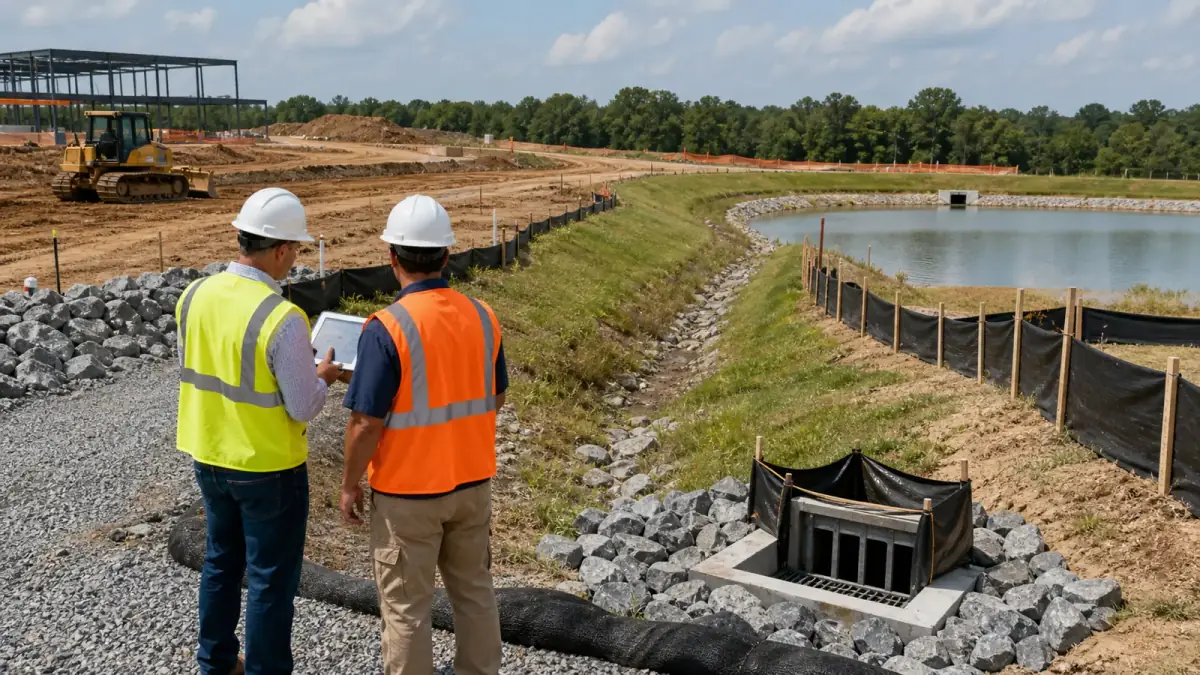
Developers, builders, construction managers, civil engineers, property owners, and municipal reviewers often ask a practical question right before field work begins: is the project actually ready to meet construction stormwater requirements once equipment mobilizes?
That question matters because construction stormwater readiness is not just a paperwork milestone. A project can have approved civil plans and still struggle in the field if erosion controls are not sequenced, inspection responsibilities are unclear, disturbed areas are larger than expected, inlet protection is missing, or runoff from the first rain event leaves the site before controls are fully installed. Those problems can lead to stop-work pressure, corrective actions, neighbor complaints, damaged public infrastructure, sediment cleanup costs, and strained relationships with reviewers or owners.
For municipalities and public works teams, construction stormwater readiness helps protect storm drains, roadside ditches, receiving waters, and public rights-of-way during active disturbance. For developers and contractors, it supports a smoother start by making sure the stormwater plan can be installed, inspected, maintained, and documented under real site conditions. For owners and facility managers, it helps clarify who is responsible for keeping sediment, exposed soil, dewatering discharge, material storage, and temporary drainage under control during construction.
This post explains what to review before mobilization so the construction stormwater plan is not treated as a binder that sits in the trailer. The goal is to help project teams connect permit documentation, SWPPP planning, erosion and sediment control details, inspection routines, site phasing, and contractor responsibilities before disturbance begins. This is not legal advice, and local requirements vary. It is a practical planning framework for teams that want the first days of construction to match the stormwater commitments shown in the documents.
Who This Affects
Construction stormwater permit readiness affects any project where land disturbance, exposed soil, grading, excavation, demolition, utility work, stockpiling, paving, building construction, or material staging can affect runoff. The details vary by jurisdiction and project size, but the planning need is common across public and private work.
The most common audiences include:
- Developers preparing to start commercial, multifamily, industrial, institutional, subdivision, roadway, utility, or mixed-use projects.
- General contractors and construction managers responsible for mobilization, subcontractor coordination, erosion control installation, and field documentation.
- Civil engineering firms that prepared drainage, grading, utility, stormwater, and erosion control plans and may need to support preconstruction clarification.
- Municipal engineers and public works staff reviewing construction entrances, inlet protection, sediment controls, traffic impacts, and connections to public storm infrastructure.
- Planning departments and permit coordinators trying to make sure approved site plans translate into field-ready conditions.
- Environmental compliance managers responsible for SWPPP implementation, inspection records, corrective action tracking, and communication with site crews.
- Property owners and facility managers expanding buildings, resurfacing yards, relocating loading areas, modifying drainage patterns, or managing construction on active sites.
- HOAs, campuses, schools, hospitals, industrial parks, and institutional owners that must keep access, safety, drainage, and water quality controls working while construction is underway.
- Landscape architects and land development teams coordinating temporary stabilization, permanent landscaping, green infrastructure, and final stormwater BMP acceptance.
The issue becomes especially important when a site has tight boundaries, nearby streams or wetlands, steep slopes, existing drainage complaints, older storm sewer connections, shared access drives, phased occupancy, contaminated soils, high groundwater, offsite runoff entering the work area, or public inlets immediately downstream of the disturbed area.
The Stormwater Planning Issue
Construction stormwater problems often start when the project team treats permit readiness as the same thing as permit possession. Having an approved plan, a notice of coverage, or a SWPPP document is important, but those items do not automatically install controls, train crews, protect inlets, stabilize entrances, or create reliable inspection evidence.
The real planning issue is that construction sites change quickly. A grading plan may show final slopes, but the first two weeks may involve demolition, clearing, utility trenching, haul routes, staging areas, and temporary drainage patterns that look very different from the final condition. A detention basin may be designed for the completed site, but it may not be ready to receive muddy runoff during early grading. A permanent outlet structure may be shown on the plans, but temporary sediment control may need different sequencing. A stockpile may be placed where runoff concentrates after a storm. A subcontractor may remove silt fence to access a work area and forget to reinstall it before the next rain.
These are not unusual failures of intent. They are coordination failures. The stormwater plan may be technically adequate, but the construction sequence may not explain how the site will be protected at each phase. The SWPPP may identify controls, but the people responsible for maintaining them may not know how inspections are triggered, what photos to take, where records are stored, or who can authorize corrective action. The erosion control sheet may show inlet protection, but field crews may not know which inlets are public, which are private, which are active, and which will be installed later.
Construction stormwater readiness should answer six practical questions before mobilization.
First, what permit coverage, local approvals, and site notices must be in place before disturbance begins? Project teams should confirm which construction stormwater permits, local grading permits, right-of-way permits, utility permits, and owner approvals apply. They should also know what records must be available onsite or electronically accessible.
Second, what controls must be installed before clearing, grading, demolition, or excavation starts? Perimeter controls, stabilized construction entrances, inlet protection, sediment traps, temporary diversions, concrete washout areas, stockpile protection, and designated staging areas may need to be in place before the first major disturbance.
Third, how will runoff move across the site during each construction phase? Temporary drainage can differ from final drainage. Teams should understand low points, bypass flows, offsite run-on, dewatering routes, haul road drainage, and whether temporary controls can handle the field condition they will actually see.
Fourth, who is responsible for inspections, maintenance, corrective actions, and documentation? A plan that says controls will be inspected is not enough if no one knows who performs inspections, who receives findings, who repairs damaged controls, and how quickly issues must be corrected.
Fifth, how will stormwater controls be protected from construction activity? Silt fence, inlet protection, check dams, compost socks, diversions, stabilized entrances, and temporary seeding can fail when they conflict with access, deliveries, concrete placement, utility work, or material storage.
Sixth, how will the project transition from temporary controls to permanent stabilization and post-construction BMPs? Construction readiness should include an endgame: final grades, permanent vegetation, pavement, basin conversion, as-built documentation, maintenance access, owner turnover, and closeout records.
When those questions are not resolved, stormwater becomes reactive. The team fixes controls after muddy runoff leaves the site, updates the SWPPP after an inspection deficiency, or revises sequencing after a regulator, city inspector, owner, or neighbor raises concerns. A better approach is to review readiness before mobilization so the construction start is aligned with the plan.
What To Review Before Moving Forward
Before mobilization, the project team should hold a focused stormwater readiness review. This does not need to be a long meeting, but it should be specific enough to assign responsibility, confirm field conditions, and identify gaps before equipment arrives.
- Confirm permit status: Verify required construction stormwater permit coverage, local grading approvals, right-of-way permits, utility permits, dewatering approvals if relevant, and any owner-specific environmental conditions.
- Review the SWPPP or erosion control plan against the current construction schedule: Confirm that the planned first phase of work matches the controls shown in the documents. If demolition, tree clearing, temporary access, or utility work will happen first, make sure the stormwater controls support that sequence.
- Walk the site before disturbance: Identify existing inlets, ditches, culverts, roof drains, offsite run-on, low spots, erosion-prone slopes, ponding areas, existing sediment, pavement breaks, and downstream discharge points.
- Mark controls before installation: Field-mark silt fence, inlet protection, stabilized entrances, stockpile areas, washout areas, temporary diversions, sediment traps, and protected areas so crews can install them in the right locations.
- Confirm access and staging: Make sure erosion controls will not be immediately damaged by equipment access, deliveries, crane locations, laydown areas, dumpsters, fuel storage, or concrete trucks.
- Assign inspection responsibility: Identify the person or firm responsible for routine inspections, rain-event inspections if applicable, inspection reports, photo records, deficiency notices, and follow-up verification.
- Define corrective action workflow: Decide who receives inspection findings, who authorizes repairs, who performs the work, what timeframe applies, and how completion will be documented.
- Prepare documentation storage: Establish where permits, SWPPP materials, plan revisions, inspection reports, maintenance logs, rainfall records, training notes, and photos will be kept.
- Coordinate with subcontractors: Explain stormwater responsibilities to earthwork, demolition, utility, paving, landscaping, concrete, and sitework subcontractors before they affect drainage patterns or controls.
- Review dewatering needs: If excavations, basements, utility trenches, pond conversions, or groundwater conditions may require pumping, plan where water will go and how sediment or pollutants will be controlled.
- Check inlet and outfall protection: Identify public and private inlets that can receive runoff from the site. Confirm that active inlets are protected before disturbance and that outfalls are inspected when appropriate.
- Clarify stabilization triggers: Decide when temporary seed, mulch, matting, stone, pavement, or other stabilization methods will be used on inactive areas, stockpiles, slopes, and completed grades.
- Coordinate temporary and permanent BMPs: Determine whether detention basins, bioretention areas, swales, underground systems, or infiltration features will be protected during construction or converted after sediment-producing work is complete.
- Review weather readiness: Check whether the first week of work includes forecasted rain and whether controls can be installed before exposed soil is created.
- Confirm communication with the municipality or owner: Know when inspections must be requested, when plan changes must be shared, and who should be contacted if field conditions require a stormwater adjustment.
A useful readiness review produces decisions, not just notes. The output should be a short list of installation tasks, responsible parties, due dates, inspection expectations, documentation locations, and unresolved items that must be corrected before land disturbance begins.
Planning, Permitting, or Compliance Support That Fits
Construction stormwater permit readiness sits at the intersection of planning, field implementation, and documentation. The right support depends on where the project is uncertain.
For developers and construction managers, stormwaterplanning.us can support SWPPP planning, construction stormwater permit readiness, erosion and sediment control planning, and pre-mobilization document review. That support can help compare the approved drawings to the actual construction sequence, identify missing controls, clarify inspection routines, and prepare the information teams need before work begins.
For municipalities, public works departments, and city engineers, support may involve reviewing submitted erosion control plans, preparing consistent preconstruction checklists, organizing construction inspection expectations, or helping staff evaluate whether applicants have addressed stormwater responsibilities before disturbance. This can be especially useful when a community receives repeated complaints about muddy streets, clogged inlets, sediment in roadside ditches, or projects that begin before controls are properly installed.
For property owners, facility managers, HOAs, campuses, and industrial operators, support may focus on active-site drainage risks, contractor coordination, documentation expectations, and maintenance responsibilities. Owners often assume the contractor is handling everything, while contractors assume the owner or engineer has addressed the permit details. A readiness review helps clarify that division before there is a field problem.
For civil engineering and land development teams, stormwater support can help prepare a more complete submittal and reduce field confusion after approval. That may include reviewing erosion control sheets for constructability, coordinating temporary controls with permanent BMPs, helping prepare inspection-ready documentation, or identifying areas where field conditions should be verified before mobilization.
Good support should not promise permit approval, regulatory acceptance, or a problem-free project. It should help the team prepare documentation, align plans with field conditions, reduce avoidable review and inspection delays, and clarify stormwater responsibilities. That practical alignment is often what separates a smooth construction start from a reactive one.
Common Mistakes to Avoid
- Waiting until mobilization week to review stormwater requirements. If controls, permits, inspections, and responsibilities are not ready before crews arrive, the site can begin with preventable risk.
- Treating the SWPPP as a static file. A SWPPP or erosion control plan must reflect site conditions, phasing, and changes that occur during construction. It should be usable by the people responsible for implementation.
- Installing perimeter controls after disturbance starts. Sediment controls often need to be in place before clearing, grading, demolition, or excavation creates exposed soil.
- Ignoring offsite run-on. Water entering the site from nearby pavement, roofs, ditches, alleys, or neighboring land can overwhelm controls if it is not considered during planning.
- Forgetting public inlets and downstream infrastructure. A small site can still discharge sediment to a municipal inlet, ditch, culvert, or storm sewer if temporary controls are missing or poorly maintained.
- Using generic BMP notes that do not match the site. Standard details help, but they do not replace decisions about where controls go, when they are installed, who maintains them, and how they work with construction access.
- Allowing access needs to destroy controls. Construction entrances, haul routes, laydown areas, and delivery paths should be coordinated with erosion controls so crews are not forced to remove or drive through them.
- Missing dewatering planning. Pumping from excavations or trenches can create compliance and water quality concerns if discharge locations and sediment controls are not planned in advance.
- Overlooking stabilization timing. Disturbed areas that sit inactive can become recurring sources of sediment. Temporary stabilization should be planned as part of the schedule, not treated as an afterthought.
- Failing to document inspections and repairs. If a control is damaged and fixed, the inspection finding, repair action, date, responsible party, and verification should be recorded.
- Letting subcontractors operate without stormwater expectations. Sitework, utility, concrete, paving, demolition, and landscaping crews can all affect stormwater controls. They need practical instructions before work begins.
- Converting permanent BMP areas into sediment traps without a plan. Bioretention, infiltration, and detention areas can be damaged by construction sediment if they are not protected, sequenced, or restored properly.
- Waiting for the first inspection to identify obvious gaps. A pre-mobilization readiness review should catch missing inlet protection, unclear entrances, weak stockpile controls, and documentation gaps before an inspector does.
Next Step
Before construction begins, review the project as it will exist during the first phase of disturbance, not only as it will look when complete. Confirm permit coverage, walk the site, identify active drainage paths, install required initial controls, assign inspection responsibility, and make sure the SWPPP or erosion control plan matches the actual sequence of work.
If the project involves public drainage infrastructure, tight urban conditions, nearby receiving waters, significant grading, industrial activity, or a history of drainage complaints, a focused construction stormwater readiness review can be a practical next step. It can help municipalities, developers, owners, and contractors clarify what must be in place before mobilization, what should be documented during construction, and what support is needed to keep stormwater planning connected to field reality.