
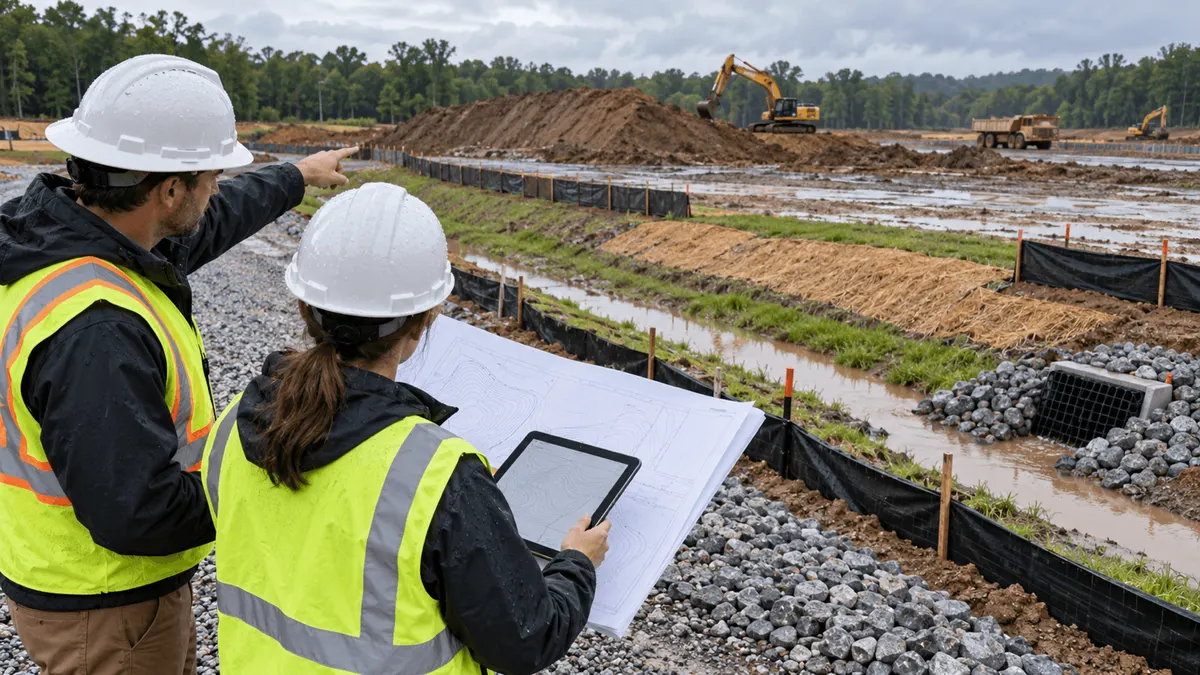
A SWPPP stops reflecting field risk when grading, operators, drainage paths, or controls change without a prompt, documented update to the plan.
A stormwater pollution prevention plan is meant to describe how a construction site will control sediment and other pollutants under actual conditions. It is not only a document prepared for initial permit coverage. As clearing, utilities, buildings, roads, stockpiles, stabilization, and subcontractor work progress, the plan, site map, inspection process, and assigned responsibilities may need to change with the site.
The applicable trigger and deadline come from the permit that governs the project. EPA's 2022 Construction General Permit provides a useful federal example, but many projects operate under state, territorial, tribal, or local requirements with different language. Teams should identify the permitting authority, permit version, coverage documents, and project-specific obligations before using any general checklist.
Good modification control supports compliance planning, helps prepare documentation, clarifies responsibilities, and can reduce review delays caused by inconsistent records. It does not promise a permit, agency approval, or a compliance outcome. The operator remains responsible for applying the applicable permit to the actual site.
Who This Affects
This issue affects construction operators, developers, general contractors, civil engineers, erosion-control contractors, inspectors, environmental managers, utility coordinators, and site superintendents. Municipal plan reviewers and MS4 staff may also encounter modification questions when they inspect regulated sites or receive updated plans.
Projects with multiple operators need particular attention. One operator may control the overall plan while another controls a distinct area or activity. A change in operator, operational control, or responsibility for a BMP can make an otherwise accurate plan incomplete. The SWPPP should explain who is responsible for installation, inspection, maintenance, corrective action, recordkeeping, and final stabilization under the applicable permit.
Field inspectors are often the first to see a mismatch. They may find a new stockpile, relocated inlet, damaged perimeter control, unplanned drainage path, dewatering discharge, or phase of work that does not match the site map. The inspection record should not merely note the discrepancy. It should route the condition to the person authorized to correct the site and determine whether the SWPPP must be modified.
Designers and project managers are affected because field changes can invalidate assumptions made during design. A revised building pad, utility conflict, access road, retaining wall, or staging area may change drainage areas and BMP locations. The design team may need to evaluate whether the planned controls still fit the disturbed area, slopes, soils, discharge points, and construction sequence.
The Stormwater Planning Issue
A SWPPP can become outdated gradually. The project may still have controls in place, but the map no longer shows where runoff travels. Inspection forms may list BMPs that were removed while missing new ones. Stabilization dates may not match completed areas. A subcontractor may manage dewatering without being connected to the plan. Each small gap weakens the relationship between field conditions and documentation.
EPA's 2022 CGP requires a SWPPP modification, including site maps, within seven days of specified conditions. Examples include new operators becoming active, changes to construction plans or stormwater controls that are no longer accurately reflected, transfer of operational control, certain inspection or investigation findings, and changes needed after corrective actions. That federal deadline should not be copied onto a site governed by another permit without verification.
The practical issue is deciding when a routine field adjustment becomes a plan modification. Replacing a damaged section of silt fence in the same location may be recorded as maintenance. Relocating the fence because the grading limit expanded can affect the map, disturbed area, flow path, and responsibility. The permit, not habit, determines the documentation required. A decision process helps the team make that distinction consistently.
Site maps are central because they connect narrative controls to physical locations. When grading creates a new low point, runoff may bypass the inlet protection shown on the original map. A stockpile can block a swale. A temporary haul road can cross a drainage path. Utility trenching can collect or redirect water. If the field condition affects where runoff flows or how pollutants are controlled, the map and related descriptions deserve review.
Corrective action and modification processes should work together. An inspection may identify a control that is not effective, not installed, or not maintained. Immediate action may be needed in the field, while the plan also needs an update to reflect the revised control and prevent repetition. Closing the field item without reviewing the plan can leave future inspectors working from outdated instructions.
Version control matters. When multiple paper copies, shared drives, contractor portals, and mobile inspection systems contain different revisions, crews may follow the wrong plan. A clear revision date, change description, responsible person, distribution method, and superseded-copy process help the team know which version governs current work.
What to Review Before Moving Forward
Start with the permit and coverage documents. Confirm the permitting authority, permit number or tracking identifier, effective permit, operator names, authorized signatory process, required SWPPP contents, modification triggers, deadlines, certification language, and record-retention rules. Local erosion-control approvals may add requirements without replacing the NPDES permit.
Compare the current site to the current site map. Walk the limits of disturbance, stabilized areas, drainage divides, slopes, stockpiles, material storage, vehicle entrances, washout areas, fueling locations, dewatering points, inlets, outfalls, receiving waters, buffers, and every installed BMP. Mark conditions that are missing, moved, abandoned, or different from the map.
Review changes to grading and drainage. Ask whether fill, excavation, utility trenches, pavement, building pads, temporary basins, diversion berms, or haul roads changed runoff direction, volume, velocity, or concentration. A small elevation change can create a bypass around a control. The review should connect survey or field observations to updated drainage arrows and BMP placement.
Check construction sequencing. The plan may assume that one area is stabilized before another opens. If work overlaps, disturbed acreage and downstream controls may differ from the planned condition. Update phase limits, temporary stabilization, access, material handling, and inspection routes so the SWPPP reflects the sequence crews are actually using.
Review operator and contractor changes. Document when a new operator becomes active, when operational control transfers, and which party owns each stormwater task. Verify that subcontractors understand the controls related to their work. An updated responsibility table can prevent a BMP from being neglected because each contractor believes another party owns it.
Reconcile inspections and corrective actions. Look for repeated failures, recurring sediment accumulation, chronic bypass, damaged inlet protection, unstable channels, muddy exits, uncovered materials, or late stabilization. A pattern may show that the selected control, location, maintenance interval, or sequence needs to change. The modification should address the reason, not only replace the damaged material.
Evaluate new pollutant sources. Concrete work, painting, paving, demolition, contaminated soil handling, landscaping chemicals, waste storage, equipment maintenance, and dewatering can introduce activities not fully described in the original plan. Review containment, covered storage, spill procedures, washout, discharge authorization, and training. Some discharges may require separate authorization or may be prohibited.
Check whether supporting calculations or design details need revision. Basins, channels, check dams, sediment traps, and outlet protection may depend on drainage area, slope, soil, and expected flow. If those inputs changed, an engineer or other qualified person may need to reassess the design. A map edit alone does not validate control capacity.
Plan how the revision reaches the field. Update the master SWPPP, site map, inspection checklist, corrective-action log, BMP inventory, contact list, and contractor instructions as applicable. Remove or clearly mark superseded copies. If electronic records are used, maintain access and an audit trail consistent with permit requirements.
Document the modification decision. Record what changed, why the change triggered review, which permit condition applies, who approved the revision, when field work occurred, when the plan was updated, and who received it. If the team determines that a SWPPP modification is not required, a brief record of that reasoning can support consistency, provided the conclusion matches the permit.
Planning, Permitting, or Compliance Support That Fits
Construction-phase stormwater planning support can help teams compare field conditions with the SWPPP, update site maps, reconcile BMP inventories, and organize change records. The support should begin with the governing permit and should preserve the operator's signatory and certification responsibilities. Consultants can prepare information, but they should not obscure who controls the site and who is legally responsible.
Civil engineering support may fit when changes affect drainage design, grading, conveyance, storage, erosion potential, outlet protection, or downstream capacity. The engineer can review whether a relocated or resized BMP matches the changed drainage area and construction phase. This can reduce guesswork and can reduce review delays when local reviewers need a consistent plan set.
GIS or mobile mapping support can help large or rapidly changing projects. Field staff can locate controls, photograph conditions, track inspection points, and compare revisions. The system should use controlled attributes and dates so a point on the map connects to its inspection, maintenance, and corrective-action history. Technology is useful only when the field and plan records agree.
Permit-compliance support may include a trigger matrix that translates the applicable permit into project questions. Examples are changes in operators, plans, controls, site maps, corrective actions, inspections, or operational control. The matrix should cite the permit section and responsible role. It should not substitute generic federal language for state or local conditions.
MS4 coordination may fit when a municipal separate storm sewer system has local construction oversight, plan-review, inspection, or reporting requirements. The operator should understand which documents go to the permitting authority and which go to the municipality. Clear communication helps prepare documentation and clarifies responsibilities without implying that municipal review guarantees NPDES compliance.
Training support should focus on recognition and escalation. Inspectors, superintendents, subcontractors, and engineers do not all need the same technical depth, but each should know what changes require notice. A short field process can require staff to photograph the condition, mark the map, notify the SWPPP coordinator, install urgent protection when authorized, and record the final decision.
Common Mistakes to Avoid
Do not treat the original approved drawing set as the current SWPPP when the field has changed. The stormwater plan should reflect active conditions and the applicable permit's modification requirements.
Do not copy EPA's seven-day modification deadline into a project checklist without confirming that the EPA 2022 CGP governs the site. State and local permit terms may differ.
Do not update the narrative while leaving the site map unchanged. Drainage arrows, disturbed areas, controls, discharge points, and stabilization need to tell the same story as the written plan.
Do not record repeated BMP failure only as maintenance. Recurrence may indicate that the control type, size, location, drainage area, or construction sequence needs reassessment.
Do not allow multiple uncontrolled versions to circulate. A superseded map in a trailer can lead crews and inspectors to the wrong control location.
Do not overlook changes in responsibility. When operators or subcontractors change, document operational control and communicate who installs, inspects, maintains, corrects, and records each measure.
Do not assume an updated SWPPP approves a discharge. Dewatering, process water, washout, or other discharges may be separately authorized, restricted, or prohibited.
Do not wait for the next routine inspection when an urgent field condition needs correction. Address immediate risk within the permit's required timeframe, then complete the plan and record updates.
Do not promise that a modification will secure permit approval or prevent enforcement. Accurate planning supports compliance, but outcomes depend on the permit, field performance, records, and agency findings.
Next Step
Select the latest site map and walk the project with the superintendent, inspector, and SWPPP coordinator. Compare each drainage path, disturbed area, BMP, material area, discharge point, and operator responsibility with the document. Create one list of discrepancies and classify each as maintenance, corrective action, plan modification, design review, or a question for the permitting authority.
Then close the loop. Correct urgent conditions, update the controlled plan and map, record the reason and date, distribute the current version, and verify the change during the next inspection. This routine helps the SWPPP remain a field tool rather than a snapshot of a site that no longer exists.
Sources
United States Environmental Protection Agency, 2022 Construction General Permit as Modified, Part 7.4 SWPPP Modifications: https://www.epa.gov/system/files/documents/2025-04/2022-cgp-permit-as-modified.pdf
United States Environmental Protection Agency, Construction General Permit Frequent Questions: https://www.epa.gov/npdes/construction-general-permit-cgp-frequent-questions
United States Environmental Protection Agency, Stormwater Discharges from Construction Activities: https://www.epa.gov/npdes/stormwater-discharges-construction-activities