
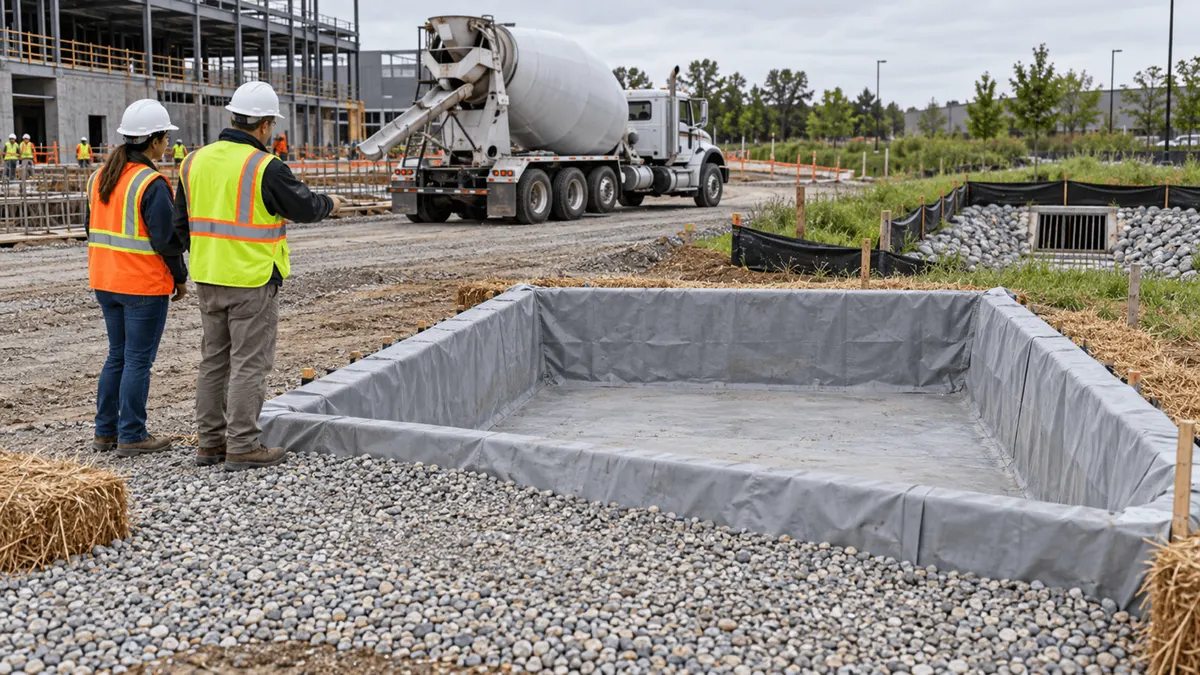
Concrete washout can become a stormwater problem fast, so its location, capacity, access, inspection, and disposal plan should be ready before a truck arrives. A lined box shown on a site map is only the beginning. The control must fit the expected concrete volume, truck movements, drainage pattern, weather, project phasing, and the local permit or reviewing authority's requirements.
Washwater contains fine particles and has a high pH. If it escapes, it can move across soil or pavement, reach an inlet or ditch, and leave hardened material in drainage infrastructure. A poorly placed facility may also cause trucks to track material, block access, back near an unprotected edge, or wash out at an unauthorized location because the approved area is too far from the pour.
The practical planning question is not simply whether the site has a washout. It is whether every concrete delivery can reach a functional containment area, use it without creating another hazard, and leave before the facility leaks, overfills, or conflicts with changing site work. Answering that question early supports compliance planning, clarifies responsibilities, and can reduce avoidable review or inspection delays.
Who This Affects
Concrete washout planning affects owners, developers, general contractors, concrete subcontractors, ready-mix suppliers, SWPPP preparers, qualified inspectors, civil engineers, site superintendents, and public agencies that review or inspect construction stormwater controls. On a small site, one superintendent may coordinate most of these functions. On a large project, responsibility may be split across several contracts and shifts.
The operator responsible for permit coverage needs to understand how concrete washout fits the pollution-prevention requirements and the project's stormwater plan. The concrete subcontractor needs a usable location and clear operating rules. Drivers need directions they can follow without guessing. Inspectors need criteria for evaluating capacity, damage, leakage, and maintenance. Waste haulers or recycling vendors need access before the facility becomes overfilled.
Municipal MS4 staff and plan reviewers may also encounter concrete washout through erosion and sediment control plans, construction inspections, or local ordinances. Their requirements may differ from EPA guidance or another jurisdiction's standard detail. Teams should confirm the applicable permit, local design criteria, and disposal requirements rather than treating a general BMP illustration as automatic approval.
The Stormwater Planning Issue
EPA identifies concrete washout as a good-housekeeping and materials-management BMP for construction sites. Federal construction stormwater requirements prohibit discharges of wastewater from concrete washout unless the wastewater is managed by an appropriate control. State, tribal, territorial, or local permits may add more specific expectations for siting, lining, capacity, inspection, recordkeeping, or disposal.
Concrete operations create more than one waste stream. Chute washwater, pump washout, tool cleaning, residual concrete, and saw-cutting slurry may have different volumes and handling needs. A facility sized only for occasional truck chutes may not be suitable for pump cleanout. The SWPPP or site plan should identify which activities are allowed at each location and how prohibited materials will be handled.
Siting must reflect drainage. A low spot may look convenient but can collect stormwater and reduce available capacity. A location next to an inlet may simplify traffic but increase the consequence of a leak. EPA's concrete washout BMP discusses separation from storm drains, open ditches, and waterbodies, stable approaches, and signage when the facility is not visible from the pour. The applicable permit or local rule should control the final setback and detail.
Capacity planning should use the construction schedule and expected activity, not a generic box size. The team should estimate how many trucks, pumps, tools, and crews will use the facility between service events. Rainfall, water added by drivers, hardened solids, and damaged liners reduce usable volume. A freeboard or service threshold provides time to stop use and arrange removal before an overflow occurs.
Project phasing changes the answer. A washout that works during mass grading may become inaccessible after paving, curb work, building enclosure, or utility installation. New inlets may connect to the drainage system before the team relocates the control. Pour locations can shift across the site. The plan should include relocation triggers and a method for updating maps, signs, subcontractors, and inspectors.
The facility also needs an end-of-life plan. Liquid should be managed according to permit and local requirements, while hardened material may be removed and recycled or disposed of through an appropriate route. Tearing out a liner with residual liquid or abandoning hardened concrete in place can create a new source of debris and contaminated runoff. Closeout should restore the area and update the site's records.
What to Review Before Moving Forward
Review the governing documents first. Identify the NPDES construction stormwater permit, local erosion and sediment control requirements, approved SWPPP, civil plans, specifications, and contractor responsibilities. Note any required detail for washout type, setback, signage, inspection frequency, maintenance, or waste disposal. When documents conflict, resolve the issue with the responsible designer or authority before installation.
Define the expected washout activities. List ready-mix chute rinsing, concrete pump cleanout, wheelbarrow and tool cleaning, stucco or masonry work, and saw-cutting slurry where relevant. Decide which activities the proposed facility can accept. Do not assume one control can safely contain every cementitious waste stream.
Walk the proposed location with the superintendent and concrete subcontractor. Check the drainage direction, nearby inlets and ditches, groundwater or ponding potential, slopes, utility conflicts, future excavation, overhead restrictions, pedestrian routes, and vehicle turning needs. A driver should be able to enter, position the chute, wash out, and leave without backing over controls or blocking emergency access.
Estimate volume and service timing. Use the pour schedule, expected truck count, pump operations, and vendor information to establish capacity. Include rainfall and the space occupied by solids. Set a visible action level for service before the facility is full. EPA guidance discusses inspection and attention before capacity is exhausted; the site's threshold should provide a realistic response window.
Choose a containment type suited to the work. Options may include prefabricated watertight containers, lined excavated pits, or constructed above-grade facilities where allowed. The liner and structure should withstand expected use. Sidewalls, entry points, and connections need enough strength to resist damage from chutes, tools, equipment, and traffic. If a vendor system is used, follow its installation and operating information.
Plan the approach. Gravel or another stable surface can help keep vehicles from rutting the area and carrying mud or concrete residue away. Delineators or barriers can protect the facility without preventing access. Signage and a site orientation should direct drivers to the correct location. If multiple pour areas are far apart, several facilities may be more effective than one remote control.
Identify inspection points. Inspectors should look for tears, punctures, collapsed walls, leakage, inadequate freeboard, stormwater accumulation, unauthorized waste, blocked access, missing signs, tracked material, and evidence that drivers are washing elsewhere. Inspections after heavy rain and during high-use periods may reveal conditions that a routine weekly visit misses. The schedule should meet the permit and actual site risk.
Assign maintenance and response responsibilities. Name who can close the facility, install a replacement, pump liquid, remove solids, repair the liner, clean escaped material, and notify the stormwater lead. Post contact information where the superintendent and crews can find it. A control without a service route is likely to remain in use after it should have been closed.
Document changes. Keep the SWPPP map, inspection reports, corrective-action records, subcontractor communication, and disposal or recycling records aligned with the field condition. Documentation should show what the team observed and did. It does not replace a functioning control, but it helps demonstrate coordination and supports future planning.
Planning, Permitting, or Compliance Support That Fits
A SWPPP preparer can incorporate washout locations, operating notes, inspection criteria, and responsible parties into the pollution-prevention plan. A civil engineer can help review grading, drainage, access, utility conflicts, and the relationship to temporary and permanent stormwater features. The contractor and concrete supplier contribute the production schedule, truck movements, and realistic waste volumes needed for the plan.
For municipal or third-party review, a clear detail can reduce questions. Show the containment type, dimensions or capacity basis, liner or container specification, stable approach, drainage relationship, nearby inlets, access route, signs, and service plan. If the washout will move with project phases, include the sequence or trigger rather than presenting one location as permanent.
Inspection support should match the site's permit and activity. A qualified inspector can add concrete operations to the field checklist, verify conditions during pours, and track corrective actions. Digital photos can document facility condition and relocation, but photos should be tied to a date, location, observation, and action. A picture alone may not explain whether the facility had enough capacity for the next pour.
Compliance support should use careful expectations. A well-developed plan supports compliance planning, helps prepare documentation, can reduce review delays, and clarifies responsibilities. It cannot guarantee permit coverage, approval, a successful inspection, or a compliance outcome. The operator remains responsible for meeting the applicable permit and correcting field conditions.
Common Mistakes to Avoid
Installing the facility after trucks arrive is a common failure. Drivers then use an unapproved low spot, soil area, or storm drain because the planned control is not ready. Installation, signage, and crew orientation should occur before the first pour.
Another mistake is choosing the lowest point on the site. Run-on can fill the facility with stormwater, and leakage can move directly toward the drainage system. Siting should consider both operational access and runoff pathways.
Teams also underestimate volume. Several small pours, a pump cleanout, or a rain event can consume capacity quickly. The plan should include a service threshold and backup location, not depend on last-minute hauling.
Some sites accept every liquid or construction waste in the same container. Paint, solvents, oils, trash, and sanitary waste may require different controls and disposal methods. Clearly state what the washout accepts and train crews to keep incompatible materials out.
An intact liner at installation can become a damaged liner after repeated use. Chutes, rebar, equipment buckets, and traffic can tear or collapse containment. Inspect the actual wear points and repair or replace the control promptly.
Finally, plans often fail to move with construction. A new curb, inlet, building entrance, or utility trench can make the original route unsafe or ineffective. Phase reviews should update location, signs, maps, and subcontractor instructions together.
Next Step
Before the next concrete pour, compare the pour schedule with the current SWPPP map and walk the truck route. Confirm the washout is installed, labeled, accessible, stable, undamaged, and sized for the planned activity. Verify the service vendor or responsible crew can respond before the action level is reached.
Use the walk-through to close three gaps: who directs drivers, who inspects during and after the pour, and who stops use if the control is damaged or nearly full. Record any relocation or maintenance in the site's stormwater documents. This simple coordination step can prevent a convenient containment drawing from becoming an unusable field control.
Sources
EPA, Stormwater Discharges from Construction Activities - https://www.epa.gov/npdes/stormwater-discharges-construction-activities
EPA, National Menu of Best Management Practices for Stormwater Construction - https://www.epa.gov/npdes/national-menu-best-management-practices-bmps-stormwater-construction
EPA, Stormwater Best Management Practice: Concrete Washout - https://www.epa.gov/sites/default/files/2015-11/documents/concretewashout_0.pdf
EPA, Developing Your Stormwater Pollution Prevention Plan - https://www.epa.gov/sites/default/files/2015-10/documents/sw_swppp_guide.pdf