
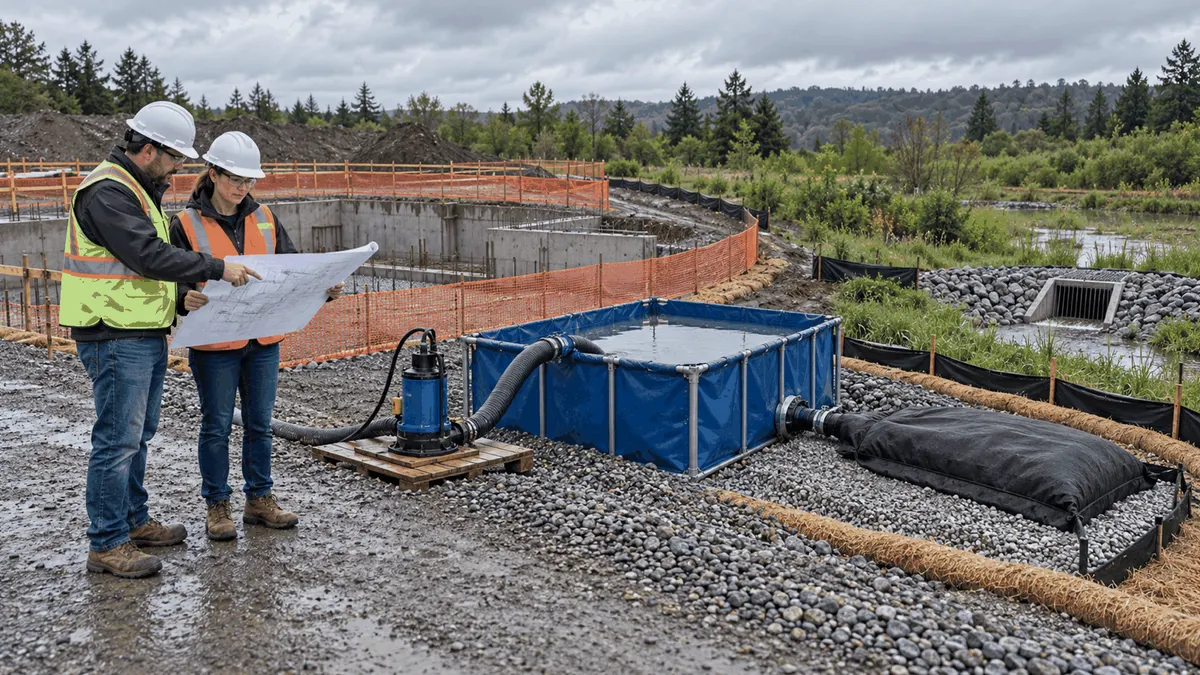
Dewatering can turn a contained excavation into a discharge point, so teams should map the water, treatment, route, and responsibilities before pumping starts. Water collected in a foundation, utility trench, vault, or sediment basin may carry soil particles, concrete residues, fuel, metals, or other pollutants. Moving that water without a documented plan can bypass site controls, overload a storm drain, erode a slope, or send turbid water toward a receiving water.
Construction dewatering is not governed by one universal field checklist. Requirements depend on the permitting authority, permit coverage, discharge location, water source and quality, receiving system, project approvals, and local ordinances. EPA's Construction and Development Effluent Guidelines require covered construction sites to manage dewatering activities, while specific permits may add treatment, inspection, monitoring, reporting, or prohibited-discharge conditions. Many states administer the NPDES program, and municipalities may impose additional MS4 or development requirements.
This article provides a planning framework rather than a permit determination. It supports compliance planning, helps prepare documentation, can reduce review delays, and clarifies responsibilities, but it does not guarantee permit coverage, agency acceptance, or a compliance outcome. Project teams should confirm current federal, state, tribal, and local requirements for the actual site before a discharge occurs.
Who This Affects
Owners and developers are affected because dewatering can change project risk, schedule, budget, and permit obligations. A geotechnical report may predict groundwater, but the construction documents still need a practical path for managing it. Owners should know who decides whether water can remain onsite, enter a municipal system, discharge to surface water, or require a different authorization. Leaving that choice to the pump operator at the bottom of the schedule creates avoidable uncertainty.
Civil engineers and drainage designers are affected because the planned discharge route must fit the site grading, erosion controls, receiving infrastructure, and downstream constraints. They may need to identify drainage areas, stable conveyance, treatment locations, overflow paths, and discharge points. If temporary dewatering is not shown or described, contractors may select a route that conflicts with the SWPPP, approved plans, utility ownership, or adjacent property.
General contractors and site superintendents are affected because they coordinate excavation, pumps, hoses, tanks, filter bags, power, inspections, and subcontractors. They need clear operating limits and stop-work triggers. A pump can move a large volume of water quickly, so a control failure that would be minor under rainfall runoff can become a concentrated discharge problem within minutes.
SWPPP inspectors and qualified personnel are affected because dewatering controls may require routine inspections, additional dewatering inspections, monitoring, corrective action, and records under the applicable permit. They should know where to observe water before treatment, after treatment, along the discharge route, and at the final outlet. An inspection limited to the pump may miss erosion, bypass, backflow, or an overloaded receiving feature.
Municipal reviewers and MS4 staff may be affected when construction water is proposed to enter a storm drain, roadside system, or municipal outfall. They may need enough information to understand the source, expected flow, treatment, monitoring, and discharge location. Early coordination can clarify responsibilities between the construction operator and system owner without suggesting that access to the municipal system is automatically allowed.
Specialty dewatering contractors, excavators, concrete crews, utility crews, environmental consultants, and laboratories may each hold part of the information. The project should identify who selects treatment, who operates the pump, who collects samples when required, who checks the receiving point, and who has authority to stop the discharge. A vendor's equipment proposal is useful, but it does not replace the operator's review of permit and site conditions.
The Stormwater Planning Issue
The core planning issue is that accumulated water has a source, a quality, a flow rate, a route, and a destination. Each can change during construction. Rainfall runoff may mix with groundwater. Excavation water may contact disturbed soil, grout, concrete, stored materials, contaminated fill, or equipment leaks. A discharge that appears clear at startup may become turbid when the intake shifts or the excavation is disturbed.
EPA explains that construction stormwater requirements are generally implemented through NPDES permits and that covered construction operators must manage dewatering activities. EPA's current Construction General Permit applies only where EPA is the permitting authority, while authorized states may use their own permits. Teams should not copy a requirement or numeric value from an EPA permit into a state-managed project without confirming that it applies. The applicable permit and authorization documents should control the project plan.
Permit coverage for construction stormwater does not necessarily authorize every water source or pollutant. Water associated with contaminated sites, industrial processes, hydrostatic testing, well development, remediation, or other activities may require separate review. A project should characterize why water is present and what it contacted. If the source is uncertain, pumping should not begin merely because a sediment bag is available.
Discharge location matters. Water kept onsite for infiltration, reuse, dust control, or another approved purpose may face different constraints than water sent to a storm drain or surface water. Infiltration is not suitable everywhere, particularly where soils, contamination, groundwater separation, slope stability, or property boundaries create concerns. Discharge to a sanitary sewer is also not a default option and generally requires coordination with the sewer authority.
Treatment must match the expected pollutants and flow. Sediment tanks, weir tanks, filter bags, sand filters, sediment basins, traps, and other controls can reduce suspended solids when properly selected and maintained. They do not remove every dissolved or chemical pollutant. Treatment chemicals introduce additional design, dosing, safety, residual, and permit considerations. A team should not assume that visible clarity proves that all applicable discharge conditions are met.
The discharge route can create its own impacts. A hose outlet directed onto bare soil may cause scour. A filter bag placed on a slope may fail or release concentrated flow. A tank overflow may bypass controls. A storm drain may lead directly to a sensitive outfall. The plan should trace the entire route from collection point through treatment and conveyance to the final receiving feature, including overflow and failure paths.
What to Review Before Moving Forward
Begin with jurisdiction and authorization. Identify the NPDES permitting authority, construction stormwater permit, local grading or erosion-control approval, MS4 requirements, easements, and any separate dewatering authorization that may apply. Confirm the permit version and effective dates. Record the agencies or system owners contacted, questions asked, and responses received. This review helps prepare documentation without treating informal guidance as a permit.
Next, define the water source. Estimate whether the water is groundwater, rainfall runoff, seepage, utility leakage, process water, or a mixture. Review prior site use, environmental reports, soil and groundwater information, and the construction activities that may contact the water. Note visible sheen, odor, color, foam, solids, pH concerns, or other indicators that call for additional evaluation. Field appearance alone should not be used to rule out pollutants.
Estimate flow and duration. A short pump-down after a storm has different operating needs than continuous well-point dewatering. The plan should identify anticipated peak flow, average flow, total volume, pumping schedule, storage capacity, treatment residence time, and backup capacity. Include assumptions and a method for checking them in the field. Undersized controls encourage bypasses, while oversized flows can overwhelm downstream conveyance.
Map the proposed discharge route. Show the collection point, pump, suction intake, hoses, tanks, filters, secondary containment where needed, stabilized outlet, property line, storm drains, ditches, outfalls, wetlands, and receiving waters. Note elevation changes and places where a hose could disconnect or water could escape. A simple plan view paired with site photographs can help reviewers and field crews understand the same route.
Select treatment based on water characteristics and permit conditions. Include equipment capacities, manufacturer operating instructions, maintenance needs, solids removal procedures, and the sequence of controls. Plan how sediment and spent media will be managed. If treatment chemicals are contemplated, obtain qualified design input and confirm applicable authorization, product selection, dosing, mixing, residual control, and documentation requirements before use.
Identify inspection and monitoring requirements. Some permits require dewatering inspections, turbidity monitoring, benchmark evaluation, pH checks, or other observations. Define sampling points after treatment and before discharge where the applicable permit requires that location. Specify equipment, calibration checks, frequency, laboratory needs, reporting, and record retention. Do not borrow EPA's 2022 CGP benchmark or frequency unless the project is subject to those provisions or the relevant authority requires them.
Set operating controls. Protect the intake from drawing sediment, secure hoses and connections, provide energy and fuel controls, keep equipment accessible, and direct discharge to a stable location. Mark acceptable tank levels and filter loading. Provide backup power or storage when an interruption could flood the excavation or force an uncontrolled release. Coordinate pump operation with excavation safety, traffic, electrical, noise, and public-access controls.
Define stop-work and corrective-action triggers. Examples can include visible sediment release, sheen, unexpected odor, foam, failed treatment, damaged hose, bypass, erosion, rising turbidity where monitored, discharge outside the approved route, or a receiving system that cannot accept flow. The responsible person should have authority to stop pumping, contain water, notify required parties, and revise controls before restarting.
Update the SWPPP and related plans when the applicable permit requires modification. Show the dewatering activity, controls, inspection points, responsible parties, and corrective actions. Keep field records consistent with the plan. A drawing that shows one outlet while crews use another undermines review and makes it difficult to connect observations to the authorized discharge.
Planning, Permitting, or Compliance Support That Fits
Early planning support fits projects that expect groundwater, deep excavations, seasonal wet conditions, or significant stored water. A planner or civil engineer can help compare onsite management, treatment, conveyance, and discharge options before bid or mobilization. This work is most useful when it connects geotechnical assumptions, civil plans, SWPPP controls, construction sequencing, and downstream capacity.
Permit screening support fits projects with uncertain water sources, multiple jurisdictions, sensitive receiving waters, municipal system connections, or non-stormwater components. The objective is to identify the responsible permitting authority and the questions that need documented answers. Screening can help teams avoid preparing a detailed plan around a discharge route that the relevant authority does not allow.
SWPPP support fits projects where dewatering is an authorized construction activity but the controls, inspection procedures, and records need to be integrated into the pollution prevention plan. The update should be site-specific. It can describe the water source, treatment train, outlet, inspection and monitoring tasks, corrective-action process, and responsible roles. A generic dewatering paragraph rarely gives field teams enough direction.
GIS and drainage mapping support fits large or complex sites with several excavations, inlets, outfalls, phases, or operators. Mapping can connect each pump location to its treatment and receiving point, identify sensitive areas, and preserve a record as work moves. Good mapping clarifies responsibilities and can reduce review delays when it is paired with accurate field verification.
Field inspection support fits active pumping operations. An inspector can verify that the installed route matches the plan, controls are functioning, records are complete, and changes are addressed. Inspection does not guarantee compliance, and it should not become a substitute for operator attention between visits. The operating crew needs daily ownership of the system.
Corrective-action support fits recurring turbidity, erosion, clogging, insufficient capacity, or monitoring concerns. The review should examine the entire system rather than repeatedly replacing one filter bag. Intake location, flow equalization, residence time, treatment sequence, maintenance, discharge stabilization, and upstream soil disturbance may all contribute to performance.
Common Mistakes to Avoid
Do not wait until water fills the excavation to choose a discharge point. Emergency conditions encourage shortcuts and can make coordination slower.
Do not assume a construction stormwater permit authorizes all pumped water. Confirm the water source, pollutants, and applicable permit provisions.
Do not route water to the nearest inlet without tracing where that inlet discharges and obtaining any required permission from the system owner.
Do not size treatment only for the pump's nominal capacity. Account for actual flow, solids loading, storage, maintenance downtime, and overflow.
Do not place filter bags on bare soil, steep slopes, sidewalks, or other locations where concentrated flow, sediment escape, or public hazards can occur. Use a stable, protected setup consistent with the design and permit.
Do not treat clear appearance as proof of acceptable quality. Visual observations are useful, but required monitoring and pollutant-specific evaluation still matter.
Do not add polymers or flocculants without qualified planning and permit review. Product chemistry, soil conditions, dose, mixing, residuals, and downstream controls all affect safe use.
Do not let the field route drift away from the SWPPP. Update plans and records when conditions or controls change, according to applicable requirements.
Do not overlook the receiving point. Inspect for scour, sediment deposits, discoloration, backwater, and system capacity, not just conditions at the pump.
Next Step
Before pumping begins, hold a short dewatering readiness review with the owner, superintendent, SWPPP lead, pump operator, civil or environmental support, and affected system owner when appropriate. Walk the entire route. Confirm the water source, authorization, treatment, flow capacity, outlet stabilization, monitoring, records, stop-work triggers, backup measures, and named decision makers.
Then place the current plan where operators and inspectors can use it. Record initial conditions, verify the installed system against the plan, and complete required inspections or monitoring. If water quality, flow, destination, or field conditions differ from the assumptions, pause and reassess before continuing. That discipline supports defensible planning and clearer coordination without promising a permit or compliance result.
Sources
United States Environmental Protection Agency, Construction and Development Effluent Guidelines: https://www.epa.gov/eg/construction-and-development-effluent-guidelines
United States Environmental Protection Agency, NPDES Stormwater Program: https://www.epa.gov/npdes/npdes-stormwater-program
United States Environmental Protection Agency, Construction General Permit Resources, Tools, and Templates: https://www.epa.gov/npdes/construction-general-permit-resources-tools-and-templates
United States Environmental Protection Agency, Turbidity Benchmark Monitoring for Dewatering under the Construction General Permit: https://www.epa.gov/npdes/turbidity-benchmark-monitoring-dewatering-under-construction-general-permit
United States Environmental Protection Agency, National Menu of Best Management Practices for Stormwater Construction: https://www.epa.gov/npdes/national-menu-best-management-practices-bmps-stormwater-construction