
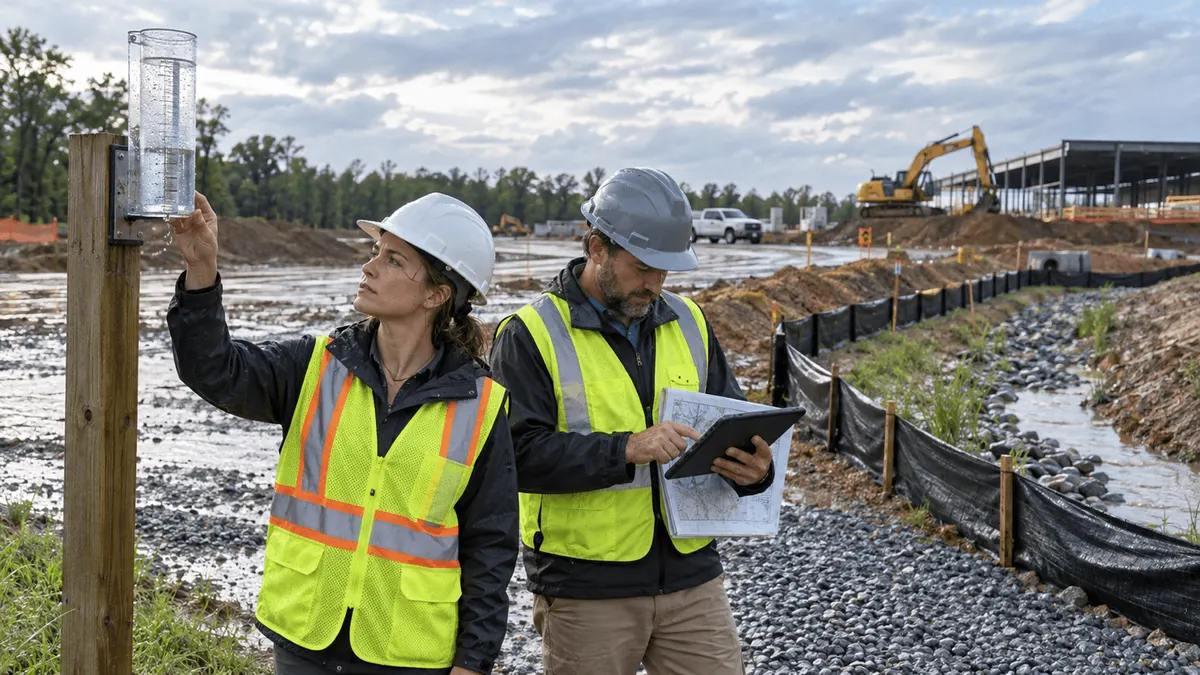
Construction rainfall records are useful only when teams connect each measured storm to the inspection schedule, field findings, and follow-up work.
A number in a rain log does not explain whether an inspection was triggered, which controls were affected, what maintenance was completed, or why a team used a particular schedule. Useful records connect the weather observation to the Stormwater Pollution Prevention Plan, site conditions, inspection report, corrective-action process, stabilization status, and the permit requirements that apply to the project.
EPA's 2022 Construction General Permit applies only in areas where EPA is the permitting authority, and states or other agencies may use different thresholds, schedules, forms, or definitions. Project teams should follow the permit and authorization that govern their discharge. The planning practices below support compliance planning and documentation, but they do not guarantee permit coverage, approval, or compliance outcomes.
Who This Affects
Construction operators, developers, general contractors, stormwater team members, qualified inspectors, civil engineers, environmental consultants, superintendents, subcontractors, and records administrators may all create part of the rainfall record. Owners and public agencies may also review the information during plan review, audits, complaint response, or project closeout.
The issue becomes more complicated when several parties use different systems. A superintendent may read an onsite gauge, an inspector may use a weather service, a consultant may prepare the report, and a corporate office may store the SWPPP. If time zones, observation periods, locations, or storm totals differ, the file may not show which value controlled the inspection decision.
Projects with changing acreage and stabilization need special care. A storm may occur while one phase is active, another temporarily stabilized, and a third not yet disturbed. The rainfall record should connect to a dated site plan or inspection map so reviewers can understand the conditions and controls in place when the storm occurred.
The Stormwater Planning Issue
Inspection schedules under construction stormwater permits can depend on time, rainfall, season, discharge conditions, or a combination of factors. EPA's 2022 CGP includes schedule options and requires specific information in the SWPPP, including the inspection schedule and, for certain rainfall-based schedules, the location of the rain gauge or address of the weather station used to obtain rainfall data. Other permits may handle rainfall differently.
Rainfall data should answer basic questions. Where was the measurement taken? What period does the total cover? When did the event begin and end? Was snow or mixed precipitation involved? Was the gauge accessible and functioning? Which schedule and threshold applied? Did the measurement trigger an inspection, or was the next inspection due for another reason?
The rain log must also connect to action. An inspection may identify a damaged perimeter control, sediment leaving a work area, an unstable stockpile, a blocked inlet, or a need to update the SWPPP. The corrective-action record should show the issue, decision, responsible party, required timing, completion, and verification under the applicable permit. A separate spreadsheet that stops at rainfall totals leaves that chain incomplete.
Permit language matters more than habit. Teams sometimes repeat a threshold from a past project even though the current permit uses a different schedule or definition. They may also reduce inspection frequency based on stabilization, drought, seasonal aridity, or frozen conditions without documenting how the project met the applicable conditions. The SWPPP and authorization should be the starting point for the current site.
What to Review Before Moving Forward
Confirm the governing permit and schedule
Identify the permitting authority, permit number, coverage dates, operator, site, and inspection schedule. Copy the schedule into the SWPPP accurately and note any selected option. If the schedule changes, document the effective date, reason, applicable criteria, and person approving the change. Do not blend two options in a way the permit does not allow.
Review the permit's definition of a storm event, inspection deadline, rainfall threshold, reduced-frequency provisions, and record-retention requirements. Confirm whether the site must measure total precipitation, rainfall only, or another value. Determine how weekends, holidays, extended storms, snowmelt, inaccessible areas, and unsafe conditions are addressed.
Establish the measurement source
For an onsite gauge, record its stable identifier, location, installation date, reading method, observation time, and maintenance responsibility. Place it where buildings, equipment, trees, splash, irrigation, or runoff will not distort the reading. Use a mounting and scale that allow consistent observation, and document replacement or relocation.
For a weather station, record the station name, address or coordinates, data source, distance and direction from the site, observation interval, and time zone. Explain why the station reasonably represents site conditions. A station across a watershed or elevation change may not reflect a localized event. Preserve the actual data used rather than relying on a link that may later change.
If the team uses both an onsite gauge and a weather station, define which source controls the inspection decision and how conflicts will be handled. A backup source is useful only when the procedure is clear. Do not choose the lower total after the fact without a documented reason tied to the plan.
Standardize the event log
Use a consistent event record with start and end date and time, total measurement, source, reader or importer, gauge condition, selected inspection schedule, trigger decision, and related report number. Include notes for resets, overflow, missing observations, snow, irrigation, instrument damage, or data corrections.
Separate raw observations from calculations. If a storm crosses midnight or several daily observations are combined, preserve each reading and show the method used to calculate the event total. If the permit defines a separation period between events, apply it consistently and cite the relevant provision in the project procedure.
Link rainfall to the site condition
Connect the event to the active disturbance map, stabilization status, and control inventory. An inspection report should identify the areas examined, discharges observed, controls maintained, deficiencies found, and photographs or map references used under the applicable permit. Include weather and rainfall data in the report or link to a controlled record with a stable identifier.
Inspectors should distinguish between a rainfall-triggered inspection and a routine inspection that happened after rain. That distinction helps show why the inspection occurred and which deadline applied. It also prevents the same inspection from being counted twice without explanation.
Connect findings to maintenance and corrective action
Not every maintenance need is necessarily a corrective action under every permit, but the distinction should be made using the governing requirements and documented procedure. The inspection report should route each finding to the correct process, responsible person, and due date. The work order or corrective-action log should point back to the inspection and rainfall event.
Completion should include what was done, when, by whom, and how the result was verified. If a control could not be repaired within the expected period, document the reason, interim measures, and revised plan as required. A photograph of finished work is more useful when it includes location, date, and the related finding.
Planning, Permitting, or Compliance Support That Fits
A rainfall-to-action register can clarify responsibilities. Use one row per event with fields for source, amount, event times, schedule, trigger decision, inspection identifier, findings, maintenance or corrective-action identifiers, completion dates, and verification. Keep the register concise and link to detailed records instead of repeating entire reports.
Build validation into digital forms. Require a gauge or station identifier, prevent a trigger decision without an amount, flag missing inspection links, and show open actions from prior reports. Use controlled dropdown values for schedule options and statuses, but allow notes when unusual conditions need explanation. Preserve edits and avoid silently overwriting original observations.
Create a simple responsibility matrix. Assign gauge reading, data import, trigger review, inspection scheduling, field inspection, report completion, corrective-action assignment, work verification, SWPPP updates, and archive management. Include backup roles for weekends and absences. Clarifying these handoffs can reduce review delays caused by missing records.
Use periodic reconciliation. Compare the rain log against inspection reports, work orders, corrective-action records, weather data, and site diaries for the same period. Look for storms with no decision, inspections with no weather record, duplicate event totals, open actions, and changes in gauge or schedule that were not reflected in the SWPPP.
For plan review or audit preparation, provide an index that explains the system. Identify the permit, schedule, measurement source, storage location, naming convention, and links among events, inspections, and actions. This helps a reviewer follow the record without implying that the index itself proves compliance.
Common Mistakes to Avoid
Do not copy the rainfall threshold from another project. Permits and authorizations vary by jurisdiction and date. Confirm the current site's requirements and selected schedule.
Do not record only a daily total when the event definition depends on start, end, or separation. Preserve enough timing data to explain how the event was grouped and when the inspection deadline began.
Do not change between an onsite gauge and several weather apps without a documented hierarchy. Inconsistent sources can produce different totals and make trigger decisions difficult to defend.
Do not leave gauge maintenance undocumented. A clogged, tilted, overflowing, relocated, or inaccessible gauge can create unreliable data. Record checks and corrections, and identify the backup procedure.
Do not treat every post-rain inspection as proof that the selected rainfall schedule was followed. Show the event, trigger, required timing, actual inspection time, and any applicable exception.
Do not close a finding when a work order is created. The record should follow the issue through completion and verification, and it should identify any SWPPP or control-plan update that resulted.
Do not promise that clean records will secure permit approval or eliminate enforcement risk. Accurate records support compliance planning, clarify responsibilities, and help prepare documentation, but outcomes depend on the applicable permit and actual site performance.
Next Step
Choose the last four weeks of rainfall and trace every event through the project file. Confirm the measurement source, event timing, applicable schedule, trigger decision, inspection report, findings, maintenance or corrective-action records, completion, and verification. List every broken link and assign an owner and due date.
Then update the SWPPP and team procedure if the audit reveals an outdated gauge location, unclear source hierarchy, changed schedule, missing backup, or inconsistent event definition. Brief the superintendent, inspector, and records staff together so the next storm produces one connected record from rainfall through field action.
Sources
- United States Environmental Protection Agency, 2022 Construction General Permit
- United States Environmental Protection Agency, 2022 Construction General Permit Fact Sheet
- United States Environmental Protection Agency, Construction General Permit Resources, Tools, and Templates
- United States Environmental Protection Agency, Construction General Permit Frequent Questions