
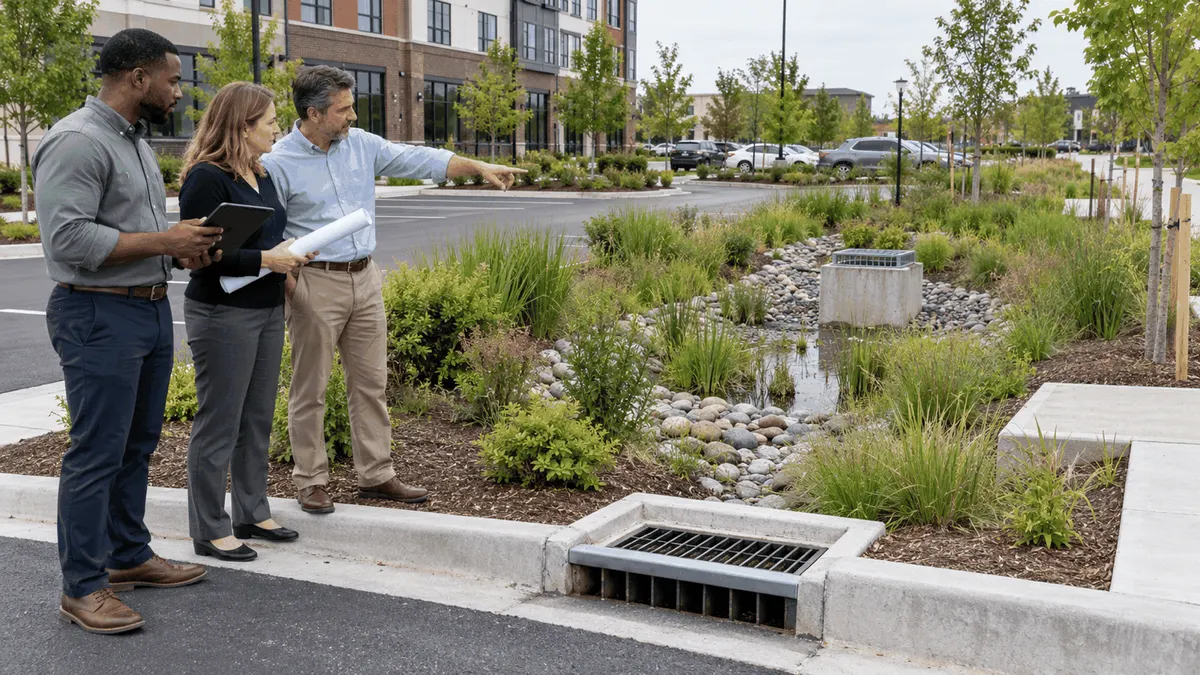
A stormwater BMP handoff works best when ownership, maintenance duties, records, and access are settled before the responsible party changes.
Post-construction controls can remain in service for decades while parcels are sold, associations take control, developers leave, and maintenance vendors change. A detention basin, bioretention area, underground system, green roof, or proprietary device may stay in the same location, but responsibility for inspection, maintenance, reporting, and repair can become unclear during a transfer.
Municipal separate storm sewer system programs and local review processes often depend on long-term operation and maintenance. A structured ownership-transfer record helps municipal staff, property owners, associations, and facility teams understand who must act and what information travels with the asset. It supports compliance planning and documentation, but it does not guarantee permit approval or any compliance outcome.
Who This Affects
Municipal stormwater staff, public works departments, plan reviewers, inspectors, developers, property managers, homeowners associations, commercial owners, and special districts may all touch a BMP transfer. Legal, finance, permitting, GIS, and records teams can also hold pieces of the information needed to identify the current responsible party.
The issue is especially important when a developer's temporary control ends, a subdivision association assumes common-area duties, a commercial site changes ownership, a parcel is divided, or a public entity accepts selected infrastructure while private controls remain on the property. Each event can separate physical ownership from maintenance responsibility if documents are not reconciled.
Consultants and maintenance contractors are affected too. Their inspection history, cleaning records, repair notes, and equipment specifications may be essential to the next owner. A new vendor should not have to reconstruct the design or discover access constraints during the first overdue inspection.
The Stormwater Planning Issue
EPA guidance for post-construction plan review emphasizes protocols for long-term operation and maintenance of stormwater controls. Depending on the local program, maintenance may be performed by the MS4 permittee, a property owner, an association, or a special district. The exact arrangement comes from applicable permits, ordinances, recorded instruments, approvals, and site-specific agreements.
A transfer creates several questions. Who owns the land under the BMP? Who owns the device? Who must inspect it? Who pays for sediment removal or replacement? Who reports results? Who may enter the property? What happens when the responsible entity dissolves or fails to act? A deed alone may not answer all of them.
Records can be split across departments. Approved plans may sit in a permitting system, agreements in a clerk or recorder file, inspection reports in stormwater software, asset locations in GIS, and enforcement correspondence in a separate case system. If those records use different site names or identifiers, a transfer may not update every system.
Physical conditions can also differ from the approved plan. The basin may have been modified, an access path obstructed, an underground unit replaced, or landscaping changed. Ownership transfer is a useful point to compare records with field conditions, but it should not become an informal promise that the municipality accepts undocumented changes.
Clear wording matters. A municipal acknowledgment of contact information is not necessarily acceptance of an asset, approval of a transfer, or release of prior duties. Staff should use language that matches their authority and route legal questions to appropriate counsel rather than improvising interpretations.
What to Review Before Moving Forward
Start with the governing documents. Assemble the approved stormwater plan, as-built drawings, operation and maintenance plan, maintenance agreement, recorded easement or covenant, permit conditions, inspection history, and any notices or corrective-action records. Confirm which documents are final and which were draft or superseded.
Identify the asset precisely. Use a stable BMP or facility identifier, parcel number, coordinates, drainage area, type, design capacity where relevant, installation date, and links to plans. A street address alone may change or cover several controls. The same identifier should appear in GIS, inspection records, correspondence, and the transfer checklist.
Verify the current and proposed responsible parties. Record legal names, mailing addresses, operational contacts, emergency contacts, and effective dates. For an association or special district, confirm that the organization exists and that the contact has authority to receive the information. For a sale, distinguish the closing date from the date maintenance responsibility actually changes under the governing documents.
Review access. Confirm how inspectors and maintenance equipment reach the BMP, whether gates or codes are involved, and whether recorded rights match the field route. Note seasonal or weight limitations, underground vault entry needs, traffic control, and confined space concerns. An easement shown on a plan is only useful if its location remains accessible.
Examine maintenance status. Compare the most recent inspection with open work orders, sediment measurements, vegetation needs, structural defects, outlet conditions, and manufacturer service intervals. Identify incomplete work without implying that a transfer erases responsibility. Where local rules require correction before transfer or acceptance, follow the applicable process.
Check financial and administrative mechanisms. Some programs use escrow, bonds, fees, reserve studies, maintenance contracts, or certification forms. Confirm current requirements rather than assuming an arrangement used on another site applies. Do not promise that a particular document will secure approval or satisfy all obligations.
Conduct a records-to-field reconciliation when appropriate. Verify that the asset exists at the mapped location, the type matches the record, key components are visible or documented, and the access route is workable. Photograph observations according to municipal policy. If conditions differ from approved plans, document the discrepancy and route it through the established review process.
Planning, Permitting, or Compliance Support That Fits
A transfer packet can clarify responsibilities. It may include a cover sheet with the asset identifier, parties and effective date; a responsibility matrix; approved as-built plans; the operation and maintenance plan; recorded instruments; inspection and maintenance history; open issues; manufacturer information; access instructions; and municipal contacts.
Use a responsibility matrix for recurring tasks. List inspection frequency, routine maintenance, major repair, documentation, reporting, access management, vegetation care, sediment or waste disposal, and emergency response. Assign a named role or entity to each item and cite the controlling document. Avoid vague entries such as owner handles BMP.
Add a municipal review checklist. Staff can verify identifiers, contacts, document versions, GIS attributes, open cases, access, field observations, and database updates. The checklist helps prepare documentation and can reduce review delays caused by missing information, but it should not be described as guaranteeing acceptance or compliance.
Update connected systems together. When the transfer becomes effective, revise the asset owner and maintenance contact in GIS, inspection scheduling, correspondence, billing where applicable, and records management. Preserve the prior responsible party and dates in the history rather than overwriting the past.
For development closeout, coordinate transfer timing with stabilization, as-built review, punch-list completion, and any required maintenance period. If a public entity will accept some conveyance assets but not private BMPs, state the boundary clearly on the plan and in the handoff documents.
For existing properties, a voluntary orientation can help the new owner understand inspection points, access, maintenance triggers, and reporting channels. The orientation should stay within the municipality's role and should not substitute for professional design, legal review, or contractor qualifications.
Common Mistakes to Avoid
Do not rely only on the deed or sale notice. Property ownership may change while a recorded agreement, association, district, lessee, or other entity retains specific duties. Review the full set of applicable documents.
Do not overwrite the former owner's information without an effective date. Historical responsibility may matter for missed inspections, prior notices, or unresolved maintenance. Preserve a time-based record showing who was responsible and when.
Do not transfer a generic maintenance manual without the site-specific plan. The next owner needs locations, frequencies, access details, design features, and known conditions. Manufacturer literature can supplement but not replace site records.
Do not assume all BMPs on a parcel have the same responsible party. Public pipes, private detention, shared access, and association landscaping may overlap. Map each asset and duty separately.
Do not close open defects because a sale occurred. Carry forward inspection findings, due dates, correspondence, and corrective actions according to the applicable program. Make the status visible to staff handling the transfer.
Do not describe a staff checklist as a legal determination or compliance guarantee. Requirements vary by jurisdiction, permit, ordinance, and recorded agreement. Use careful language, document the review performed, and obtain legal or technical support when questions exceed staff authority.
Do not forget digital access. The incoming owner may receive paper plans but lack portal credentials, inspection forms, or the correct reporting contact. Include practical steps for future submissions and record retention.
Next Step
Select a recent BMP ownership change and trace it through every municipal system. Compare the recorded documents, GIS owner, inspection contact, maintenance schedule, open work orders, and field access. Any mismatch shows where the transfer workflow needs a shared identifier or required update.
Then build a standard packet and checklist around local requirements. Define who starts the transfer, who validates documents, who updates each system, what field review is appropriate, and how open issues carry forward. A consistent handoff clarifies responsibilities and helps preserve long-term stormwater control performance as people and properties change.
Sources
United States Environmental Protection Agency, NPDES Stormwater Best Management Practice: Post-Construction Plan Review | https://www.epa.gov/system/files/documents/2021-11/bmp-post-construction-plan-review.pdf
United States Environmental Protection Agency, Urban Runoff: Post-Construction Performance Standards | https://www.epa.gov/npdes/urban-runoff-post-construction-performance-standards
United States Environmental Protection Agency, National Menu of Best Management Practices for Stormwater | https://www.epa.gov/npdes/national-menu-best-management-practices-bmps-stormwater