
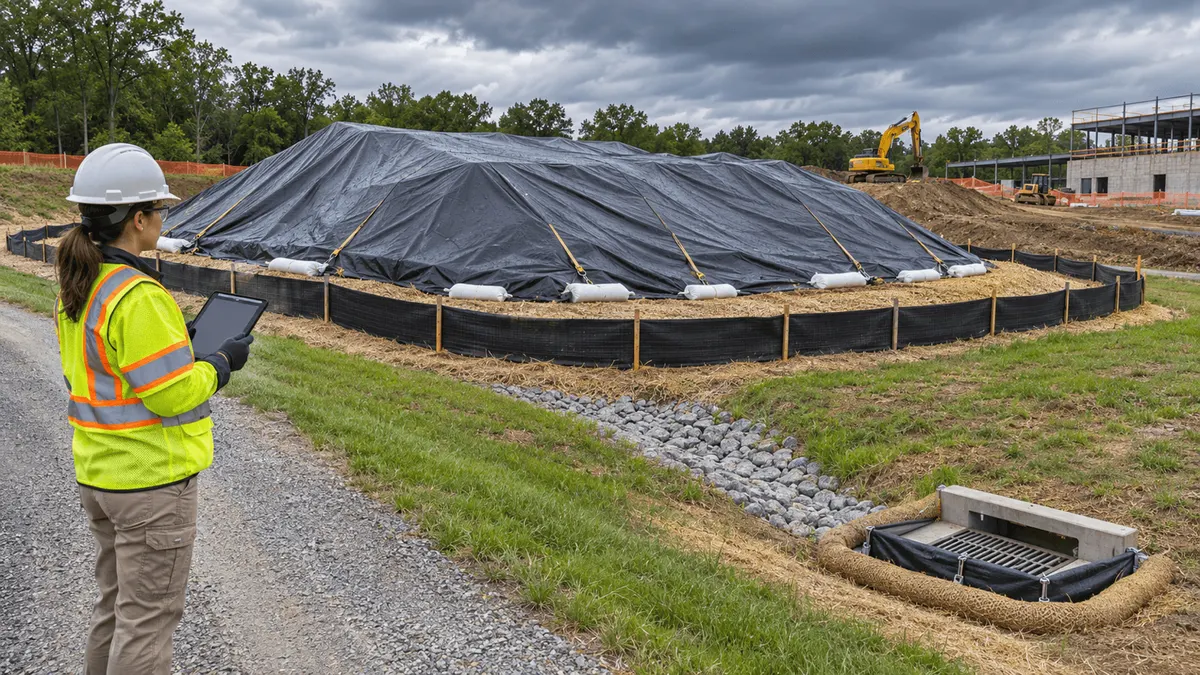
An uncovered construction stockpile can change a routine rain into a sediment response, especially when its location and controls are missing from the SWPPP.
Soil, aggregate, rubble, paving material, and other construction stockpiles are temporary, but their stormwater consequences can persist. Rainfall can detach fine material, carry sediment toward inlets or surface waters, erode the pile, undermine perimeter controls, and spread material into traffic areas. A stockpile placed for convenience can also block drainage, redirect flow, or occupy space reserved for another best management practice.
Effective planning connects the field location to the Stormwater Pollution Prevention Plan, permit conditions, site map, inspection process, and corrective actions. It does not assume that every pile needs the same control. The type of material, activity status, slope, duration, weather, flow path, and receiving feature all shape the appropriate approach. Teams should use the applicable permit and approved plan rather than treating a generic checklist as a universal rule.
Who This Affects
This issue affects owners and operators, SWPPP preparers, construction superintendents, erosion and sediment control inspectors, civil contractors, grading crews, utility contractors, material suppliers, and municipal reviewers. It also affects whoever has authority to move a pile or direct additional controls before a forecast storm.
Large sites may have several stockpile owners. The grading contractor manages soil, the utility contractor stores trench spoils, and a paving subcontractor stages aggregate. Without assigned responsibility, each crew may assume another party is inspecting the pile. The SWPPP and site procedures should identify who installs, maintains, and removes controls and who updates the map as locations change.
Small projects need the same clarity at a different scale. A compact site may place a pile close to an inlet, sidewalk, property line, or excavation because staging space is limited. The practical constraints are real, but they make deliberate location review more important. A covered pile with damaged edges or unanchored sheeting may still release sediment or create a new hazard.
The Stormwater Planning Issue
EPA explains that construction stormwater can wash over loose soil and outdoor materials, carrying pollutants from the site. Federal construction and development effluent guidelines require permits to address effective erosion and sediment controls, pollution prevention, and stabilization. The exact permit obligations vary by permitting authority and project, so teams must review the permit that covers their discharge.
The SWPPP should describe the controls selected for site conditions and show relevant features on the site map. EPA's construction SWPPP guidance identifies stockpiles as a feature to map and emphasizes that plans should reflect changing site conditions. When a pile moves but the map and inspection route do not, the written plan stops matching the field.
Stockpile runoff involves both erosion and flow management. Covering or stabilizing the pile can reduce direct rainfall contact and particle detachment. Perimeter controls can intercept sediment leaving the pile. Run-on controls can keep concentrated flow from crossing the material. Safe location and grading can preserve drainage patterns. These measures serve different functions and may need to work together.
Material type matters. Exposed soil is not managed exactly like aggregate, rubble, contaminated material, or bagged products. Some materials may require additional pollution-prevention, handling, or disposal measures. The SWPPP team should coordinate with project specifications, safety information, environmental requirements, and the applicable permit when the pile contains more than ordinary clean soil.
Activity status matters as well. A pile that crews add to every hour has different cover and access needs than one that will remain inactive for several weeks. Teams should define what "active" means for their project, what control applies while material is being handled, and when stabilization or full cover is triggered. Those decisions should follow permit language and the approved plan, not an improvised rule at the end of the day.
What to Review Before Moving Forward
First, confirm the location. Review slope, drainage direction, nearby inlets, channels, wetlands, surface waters, property boundaries, roads, and sensitive areas. Avoid placing a pile where it blocks an established flow path or where concentrated run-on can cut through it. Preserve access for inspection and maintenance without sending equipment through protected areas.
Second, document material and dimensions. Identify what the pile contains, who controls it, when placement began, expected duration, and whether material will remain active. Estimate its footprint and height so the control can be sized and installed around the actual feature. A perimeter barrier pressed against the toe may leave no room for sediment storage or maintenance.
Third, review surface protection. Depending on the plan and permit, options may include cover, temporary stabilization, compaction, or other approved practices. Covers need anchoring, overlap, and edge control that can withstand forecast conditions. Inspect for tears, ponded water, displaced weights, exposed faces, and runoff escaping below the material.
Fourth, review perimeter and run-on controls. Check continuity, end treatment, contact with the ground, capacity, and signs of bypass. A barrier that ends on the downhill side of the pile can route water around its edge. An upslope diversion may need a stable outlet. Controls should not create a new concentrated discharge or direct water toward neighboring property.
Fifth, connect the pile to the inspection route and site map. Give it a clear identifier that appears in photographs, reports, and corrective actions. Record both overall views and close details of defects. If the pile moves, update the identifier and map so later records do not appear to describe the wrong location.
Finally, check the weather response process. Define who reviews forecasts, who may direct work, what materials and labor are available, and when controls must be completed. A forecast is not a permit deadline, but it is useful operational information. Teams should leave enough time to install measures correctly instead of attempting a rushed cover after rainfall starts.
Review how stockpile removal will affect the site. Loading can damage perimeter controls, track sediment, expose unstabilized ground, and leave a depression that collects runoff. The closeout plan should assign cleanup, inspection, map revision, and stabilization tasks so a temporary material pile does not leave an undocumented drainage problem after it is gone.
Planning, Permitting, or Compliance Support That Fits
Planning support can develop a stockpile decision matrix tied to material, duration, location, and activity status. The matrix should reference the applicable permit and project SWPPP, clarify responsibilities, and show escalation points. It can help supervisors select a planned response without promising that one control fits every condition.
Permitting support can compare project practices with the current authorization and local requirements. EPA administers the Construction General Permit only in jurisdictions where EPA is the permitting authority; many states and authorized programs use their own permits. Confirm the correct authority, effective permit, stabilization provisions, inspection schedule, and documentation rules for the project.
Field support can reconcile maps with actual conditions, identify stockpiles missing from inspection forms, and check whether controls are installed and maintained as described. This work supports compliance planning and can reduce review delays by making records easier to follow. It does not guarantee a permit, approval, inspection result, or compliance outcome.
Data support can connect stockpile identifiers, photographs, rainfall information, inspections, and corrective actions. A simple mobile form or GIS layer can help if it remains usable for field staff. Technology should clarify responsibilities rather than create a parallel record that never reaches the official SWPPP files.
Common Mistakes to Avoid
Do not place stockpiles solely according to hauling convenience. The shortest loader route may direct runoff toward an inlet or occupy a stabilized buffer. Review drainage and protected features before material arrives.
Do not rely on cover without inspecting the full assembly. Wind can lift edges, runoff can enter through tears, and water can pond in low areas. Anchors and seams need routine attention, especially after handling or weather.
Do not install a perimeter control that cannot be maintained. Leave working room, stable access, and a defined removal method. Sediment accumulation, undermining, or damaged sections should lead to timely corrective action under the project process.
Do not let moving piles disappear from the documentation. Update the site map, inspection route, and responsible-party list when conditions change. Close the old location only after residual material is removed and the disturbed area receives the required treatment.
Do not copy federal language without checking the controlling permit. EPA's resources are useful references, but the project may be covered by a state, tribal, territorial, or local program with different details. The permittee should verify the requirements that apply at the site.
Next Step
Walk the site before the next forecast rain with the current SWPPP map in hand. Number every stockpile, identify its material and owner, trace the drainage path, and compare installed controls with the approved plan. Record defects as specific actions with responsible people and due times.
After the walk, revise the map and inspection form so the field and plan match. Confirm that crews have the materials, authority, and training needed to maintain controls. This focused review supports compliance planning, improves documentation, and helps the project respond to change without making promises about regulatory outcomes.
Sources
United States Environmental Protection Agency, Stormwater Discharges from Construction Activities: https://www.epa.gov/npdes/stormwater-discharges-construction-activities
United States Environmental Protection Agency, Developing Your Stormwater Pollution Prevention Plan: https://www.epa.gov/sites/production/files/2015-10/documents/sw_swppp_guide.pdf
United States Environmental Protection Agency, Construction and Development Effluent Guidelines: https://www.epa.gov/eg/construction-and-development-effluent-guidelines
United States Environmental Protection Agency, Stormwater Pollution Prevention for Small Residential Construction Sites: https://www.epa.gov/system/files/documents/2022-01/cgp_small_lot_swppp_brochure.pdf