A detention pond outlet can look intact while debris, corrosion, joint movement, or erosion quietly changes how the basin stores and releases runoff. Because the outlet controls normal drawdown and often interacts with an emergency spillway, small defects can affect pond performance, downstream channels, maintenance access, and public safety. A useful inspection program connects the field observation to design records, ownership, work priorities, and documented closure.
Who This Affects
This issue affects municipalities, drainage districts, campuses, transportation agencies, commercial owners, homeowners associations, industrial facilities, developers, and other parties responsible for dry or wet detention ponds. Public works staff, stormwater program managers, civil engineers, GIS teams, inspectors, landscape contractors, maintenance crews, and emergency-management staff may all hold part of the information needed to make a sound decision.
The planning need is especially important where ownership has changed, as-built records are incomplete, ponds were constructed in phases, or inspection findings are stored separately from work orders. The outlet may be on private property while the downstream pipe is public. A municipal permit program may require documentation while a property manager controls access. Clarifying those relationships supports compliance planning and helps prevent a known defect from remaining between departments.
The Stormwater Planning Issue
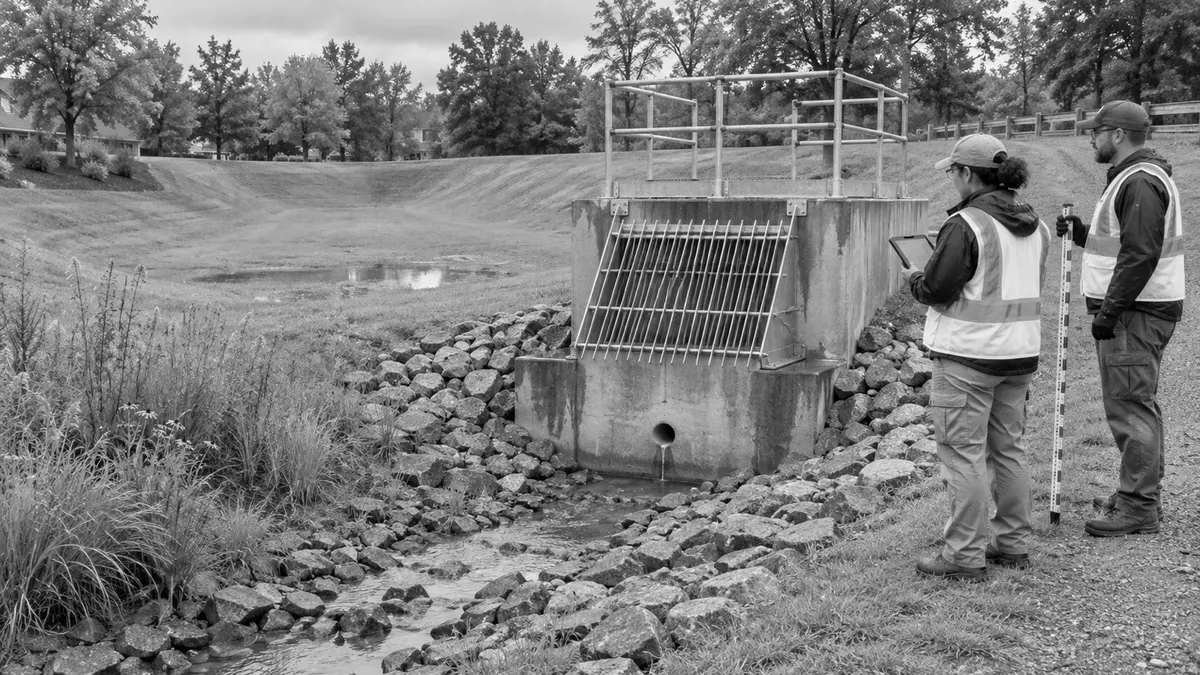
An outlet is more than the visible pipe at the downstream end. The system may include a riser, low-flow orifice, weir, trash rack, anti-vortex device, valve, barrel, joints, headwall, apron, underdrain, emergency overflow, and downstream channel. Each component has a function and a failure mode. Debris can clog an opening. Corrosion can reduce metal thickness. Separated joints can leak into an embankment. Settlement can shift an elevation. Erosion can undermine concrete or expose pipe.
Inspection planning should begin with the intended function. Design plans and as-built information may show the pond's storage elevations, outlet sizes, control points, emergency spillway, drainage time, and access route. Field staff should know which features regulate low flows and which convey larger events. Without that context, an inspector may photograph a condition without recognizing whether it is cosmetic, operational, structural, or urgent.
Observed water levels can provide clues. A dry pond that remains wet longer than expected may have a clogged low-flow opening, a blocked downstream system, groundwater influence, or a changed basin floor. A wet pond with an unexpected elevation may have an obstructed outlet or leakage. A pond that drains too quickly may have a damaged control, bypass, eroded opening, or inaccurate design record. These observations support investigation but should not be treated as a diagnosis without review.
Outlet defects can also affect the embankment and receiving channel. Seepage along a pipe, soil loss near joints, animal burrows, cracking, settlement, or vegetation changes may indicate a condition that needs engineering evaluation. Downstream scour can migrate toward the outlet. Debris removal can restore flow but also reveal damaged material. Inspection procedures should include a safe escalation path and should never ask unqualified staff to enter structures, disturb unstable slopes, or work in flowing water.
What to Review Before Moving Forward
Assemble the available plans, calculations, easements, maintenance agreements, prior inspection reports, complaint records, rainfall history, work orders, and photographs. Confirm the asset identifier and map location. Identify the owner, responsible maintenance party, access rights, downstream connection, and any permit or local ordinance requirements. When records conflict, note the conflict rather than silently selecting one version.
Build an inspection form around the asset's components. Record inlet condition, sediment, vegetation, side slopes, embankment, emergency spillway, access, public exposure, water level, outlet openings, trash racks, concrete, metal, joints, valves, pipe alignment, riprap, and downstream erosion. Include fields for weather, recent rainfall, photos, measurements, observed urgency, and recommended follow-up. Consistent terms help staff compare inspections over time.
Plan both routine and event-based reviews. Routine frequency should reflect permit obligations, design documents, ownership agreements, risk, and local experience. Additional inspections may be appropriate after major storms, flooding, construction nearby, reported ponding, vandalism, or maintenance work. The program should define who can adjust frequency and how the decision is documented.
Establish safe access before sending a crew. Review traffic exposure, steep or wet slopes, deep water, unstable banks, insects, vegetation, confined spaces, and electrical or mechanical features. Inspectors should remain outside structures unless a separate, qualified entry plan applies. Remote cameras, poles, survey equipment, or contractors may be appropriate when a direct view cannot be obtained safely.
Set the evidence standard before field work. Inspectors should know which dimensions, elevations, drainage times, or defect sizes need measurement and which conditions require only a documented observation. Where a design comparison is necessary, identify the reference datum and acceptable tolerance. This preparation prevents teams from returning to the site simply because the first inspection lacked a scale, orientation, or component identifier.
Planning, Permitting, or Compliance Support That Fits
A basic outlet inventory can connect each pond to a unique asset record, coordinates, ownership, design documents, component types, condition rating, inspection date, and maintenance responsibility. GIS can help display upstream drainage areas, downstream receiving channels, complaints, flood locations, and nearby capital projects. The map should support field decisions, not become a substitute for field verification.
Condition ratings should distinguish severity, consequence, and confidence. A small amount of surface rust is different from perforation. Leaves on a trash rack are different from a blocked control orifice. Minor downstream vegetation loss is different from active headcutting toward the structure. A rating system should guide follow-up while allowing inspectors to flag uncertainty and request engineering review.
Work orders should preserve the link to the inspection. The maintenance request should identify the exact asset, defect, location, access need, expected work, environmental controls, and completion evidence. When crews finish, the record should capture what was found, what was removed or repaired, photos, quantities when useful, and whether the condition requires monitoring. Closing a work order without verification can hide a recurring problem.
Some findings need design or permitting support rather than routine maintenance. Altering an orifice, weir, pipe, spillway, embankment, or discharge point can change hydraulic performance and may require engineering analysis, owner authorization, and agency review. Planning support can clarify responsibilities, help prepare documentation, and reduce review delays, but it should not promise a permit, approval, grant, or compliance outcome.
Capital planning should use repeated evidence. If several inspections show joint movement, persistent clogging, inaccessible controls, downstream scour, or costly emergency response, the owner can compare repair, retrofit, and replacement options. Connecting field data to cost and risk creates a stronger project record than relying on a single complaint or a general statement that the pond is old.
Program managers should also define record retention and quality checks. A reviewer can sample inspection files for complete locations, usable photographs, consistent ratings, assigned follow-up, and closure evidence. Periodic review helps identify whether different inspectors rate the same condition differently or whether certain asset types generate repeated incomplete records. Updating the field guide and training from those findings can improve the next inspection cycle.
Common Mistakes to Avoid
One mistake is inspecting only the visible outlet face. Problems may occur at the upstream side of the riser, inside a pipe, along an embankment penetration, at a submerged opening, or downstream of the headwall. The inspection scope should follow the flow path and the known components while respecting access and safety limits.
Another mistake is removing debris without documenting why it accumulated. Routine trash may require housekeeping, while repeated woody jams, sediment, displaced riprap, or upstream erosion may point to a larger source. Crews should restore function when authorized and safe, then record conditions so planners can decide whether a recurring cause needs attention.
Teams should avoid vague photographs and duplicate asset names. A close-up without orientation can be difficult to interpret months later. Include a context view, component view, defect view, direction, and scale when practical. Use the same asset identifier in the GIS record, inspection, work order, and project file.
Do not change outlet geometry during maintenance simply because a larger opening seems easier to keep clear. The control was designed to regulate discharge, and unauthorized modification can change pond routing and downstream effects. Route structural, hydraulic, or recurring performance concerns to qualified engineering review.
Finally, do not treat a completed inspection as a completed response. The process needs ownership for review, prioritization, work assignment, verification, and record retention. If no one receives the finding, the form only documents that a problem was seen.
Next Step
Select one representative detention pond and trace its records from design through the latest inspection and work order. Confirm that the asset location, outlet components, owner, maintenance party, access route, condition, and follow-up can be understood without relying on one employee's memory. Use the gaps to improve the inspection template and data structure before expanding the program.
Then schedule a coordinated field review with inspection, maintenance, and engineering representatives. Compare the outlet to the record, test the handoff from observation to work order, and define the evidence needed for closure. A small pilot can clarify responsibilities and produce a repeatable process that supports maintenance planning across the larger pond inventory.
Sources
U.S. Environmental Protection Agency, NPDES Stormwater Best Management Practice, Dry Detention Ponds: https://www.epa.gov/system/files/documents/2021-11/bmp-dry-detention-ponds.pdf
U.S. Environmental Protection Agency, Stormwater Wet Pond and Wetland Management Guidebook: https://www.epa.gov/sites/default/files/2015-11/documents/pondmgmtguide.pdf
U.S. Environmental Protection Agency, MS4 Permit Improvement Guide: https://nepis.epa.gov/Exe/ZyPURL.cgi?Dockey=P100A9N3.TXT