
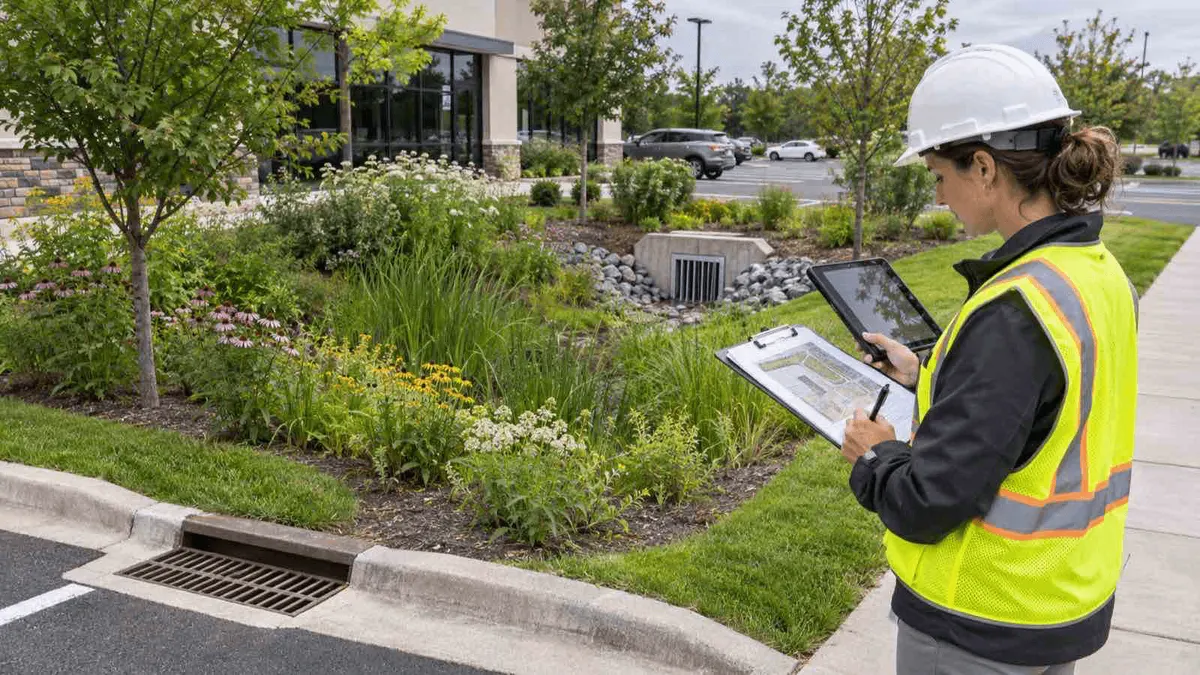
Post-construction BMP inspection notices work best when each due date, owner response, field finding, maintenance action, and closure decision stays connected. A mailing log alone cannot show whether a privately maintained pond, bioretention area, underground system, filter, or other control was inspected and kept functional.
Municipal programs often depend on property owners or operators to inspect and maintain post-construction stormwater controls under local requirements, permit conditions, recorded agreements, or other mechanisms. The exact duties vary by jurisdiction and permit. A practical tracking process helps staff see which assets are due, which submissions are complete, which deficiencies remain open, and when field verification or escalation may be appropriate.
This is an administrative topic with direct field consequences. When ownership changes, contacts go stale, reports arrive in different formats, or corrective actions are recorded separately, a municipality can lose the history needed to plan follow-up. Connecting the notice cycle to the asset inventory and maintenance record supports compliance planning and clarifies responsibilities without promising a particular permit or enforcement outcome.
Who This Affects
MS4 program managers are responsible for organizing program requirements, schedules, records, and follow-up. They need a view that distinguishes notices sent, reports received, reports reviewed, deficiencies identified, maintenance completed, and closure verified. A single status labeled complete can hide whether the owner merely submitted a form or actually addressed a field condition.
Public works and engineering staff may maintain the asset inventory, review designs, inspect controls, or advise on corrective work. They need access to approved plans, as-built information, maintenance agreements, prior findings, and site contacts. If those records remain in separate project folders, a reviewer may not know that a report describes the wrong BMP type or omits a critical component.
Planning, building, and development-review staff affect the system at project closeout and ownership transfer. Accurate parcel, owner, contact, and control information should enter the long-term program before construction files are archived. A clean handoff can prevent years of notices going to a developer after the property has been sold.
Property owners, homeowners associations, facility managers, and third-party inspectors need clear instructions. They should know which controls are covered, what inspection period applies, what form or qualifications are required locally, how to document maintenance, and where to send questions. Vague notices create inconsistent submissions and unnecessary back-and-forth.
Legal, code, or enforcement staff may become involved when required records or maintenance remain unresolved. They need a reliable chronology showing the applicable requirement, contacts, notices, responses, field evidence, deadlines, and actions. The tracker should support the jurisdiction's adopted process, not invent one.
The Stormwater Planning Issue
EPA guidance for post-construction programs emphasizes long-term operation and maintenance of stormwater controls. Program approaches may include municipal inspections, owner inspections under maintenance agreements, required documentation, and mechanisms to obtain necessary maintenance. The specific approach depends on the MS4 permit and local legal authority.
The planning problem begins with inventory quality. A notice cannot be reliable if the municipality does not know the control's location, type, responsible party, inspection frequency, or governing record. Duplicate asset identifiers, missing parcel links, retired controls, and outdated ownership data can produce missed or misdirected notices.
Timing can also become fragmented. One system may calculate due dates, another may store incoming reports, and email may hold the only record of an extension or correction. Staff then spend review time reconstructing what happened. A connected workflow should preserve the original due date, notice date, response date, review result, corrective deadline, verification date, and closure status.
Submission quality matters as much as receipt. A report may lack photographs, omit the outlet structure, use an outdated checklist, or list no maintenance even though the narrative describes sediment, erosion, blocked flow, dead vegetation, damaged components, or unauthorized modifications. The review process should test completeness and consistency before marking the obligation resolved.
Deficiencies need a separate lifecycle. Some can be corrected through routine maintenance, while others may require design review, access coordination, specialized inspection, or capital work. The tracker should identify the issue, responsible party, temporary controls if applicable, required evidence, target date, and verification method. This structure can reduce review delays by making the next step explicit.
Ownership changes are a predictable point of failure. A new owner may not know that a stormwater control exists or that a recorded maintenance responsibility follows the property. The municipality should connect its notice process with available ownership updates and keep a method for confirming the responsible contact. The program should also preserve the prior history so the new contact receives context without losing accountability for open items.
Records should reflect the distinction between program support and guaranteed outcomes. A well-designed tracker can help prepare documentation, support permit reporting, and clarify responsibilities. It cannot guarantee compliance, approval, or the performance of a BMP. Field conditions, owner actions, design limitations, and permit requirements still need professional review.
What to Review Before Moving Forward
Begin with the controlling requirements. Identify what the current MS4 permit, local code, maintenance agreement, recorded covenant, approved plan, or program procedure requires. Note inspection frequency, submission content, responsible party, deadlines, qualifications, retention, municipal verification, and escalation steps. Avoid building software rules around a practice that is not supported by the adopted program.
Review the asset inventory. Each control should have a stable identifier, site address, mapped location, parcel or project link, BMP type, construction or acceptance date, design reference, owner, operator, primary contact, and applicable inspection schedule. Record whether the asset is public or private and who is expected to maintain it.
Check data sources for ownership and contact updates. Determine how frequently parcel data, business contacts, association managers, or facility personnel change. Establish a process for returned mail, bounced email, undeliverable notices, and disputed responsibility. Keep the evidence used to change a contact or status.
Review the notice itself from the recipient's perspective. It should identify the site and control, explain the applicable due date, list required materials, describe the submission method, and provide a contact for questions. Use careful language that matches the jurisdiction's authority. Do not make broad legal conclusions in a routine reminder.
Define the report-review checklist. Reviewers may need the inspection date, inspector identity, weather or operating context, component observations, photographs, measurements, maintenance performed, deficiencies, recommended actions, and certification required locally. The checklist should reflect the BMP type because a wet pond, infiltration practice, proprietary unit, and vegetated swale do not have identical components.
Establish status definitions. Useful stages may include upcoming, notice prepared, notice sent, due, overdue, submission received, under review, incomplete, deficiency open, maintenance reported, verification pending, closed, and escalated. Define which event moves an item between stages and which role has authority to make that change.
Review how exceptions are handled. A control may have been removed under an approved plan, converted to public ownership, replaced, found on a different parcel, or assigned a revised schedule. Extensions, appeals, access problems, and active construction may also affect timing. Exceptions should be documented rather than hidden by changing the original due date.
Plan quality control before a large notice batch. Sample records across BMP types, neighborhoods, construction years, and ownership types. Compare the tracker with maps, plans, prior reports, and field knowledge. Correct systematic errors before hundreds of notices reproduce them.
Planning, Permitting, or Compliance Support That Fits
A spreadsheet can support a small inventory when fields, validation rules, ownership, and backups are well managed. It should use stable identifiers and controlled status values. Separate columns for due date, response, review, deficiency, verification, and closure are more useful than a single notes field.
A relational database or asset-management system fits larger programs with many controls, inspections, contacts, attachments, and recurring schedules. Link each notice and report to the asset rather than storing duplicated location text. Role-based access and an audit trail can show who changed a deadline or closed a finding.
GIS support helps staff confirm locations, parcels, drainage connections, watersheds, and inspection routes. A map can reveal duplicate assets, missing areas, clustered overdue controls, or sites near sensitive drainage features. GIS should connect to authoritative records and should not become a separate inventory with different identifiers.
Document templates can standardize notices, incomplete-submission letters, deficiency follow-ups, and closure communications. Templates should pull verified fields from the tracker and allow reviewers to explain site-specific issues. Periodic legal and program review can keep the language aligned with current authority and permit conditions.
An owner portal may reduce manual entry when it supports secure submission, required fields, attachments, and confirmation receipts. The portal should not force every BMP into one generic form. Provide a path for accessibility needs, technical problems, changed ownership, and records that cannot be submitted through the standard channel.
Field verification support may include mobile forms, photographs, measurements, maintenance records, and map access. Inspectors should be able to compare current conditions with prior deficiencies and approved plans. A field visit is especially valuable when a report is inconsistent, repeated deficiencies persist, or the program requires municipal inspection.
Program dashboards can summarize notices due, response rates, incomplete reports, open deficiencies, aging, verification workload, and recurring maintenance issues. Use dashboards to guide staffing and outreach, not to substitute for record review. A high submission rate can coexist with poor maintenance or incomplete evidence.
Consulting or engineering support can help clean inventories, develop BMP-specific checklists, review complex reports, inspect controls, and scope corrective work. This support should be tied to clear deliverables and local decision roles. It can help prepare documentation and reduce review delays, but it does not guarantee permit or compliance outcomes.
Common Mistakes to Avoid
One mistake is treating a sent notice as a completed inspection. The notice begins the workflow. Completion depends on the applicable program and may require a reviewed report, maintenance evidence, municipal verification, or another documented action.
Another mistake is overwriting dates. If staff replace the original due date with an extension, the history becomes unclear. Preserve original and revised dates with the reason, authority, and approval.
Programs also lose information when reports are saved only by property name. Names and owners change. Use a stable asset identifier in filenames, forms, maps, and database links so the record remains connected through ownership transfers.
A generic checklist can miss important components. A reviewer should know which structures, pretreatment features, vegetation, storage zones, inlets, outlets, emergency spillways, or access areas belong to the control. Tailor the inspection record to the approved design and BMP type.
Closing a deficiency when maintenance is merely scheduled is another common error. Distinguish promised, completed, documented, and verified work. Record the evidence needed for closure and who accepted it.
Finally, avoid using automated messages without quality control. Incorrect owner names, asset descriptions, deadlines, or legal language can undermine confidence and create additional work. Test templates, sample merged data, and review unusual cases before release.
Next Step
Select a small group of private post-construction controls with different BMP types and trace each one from approved plan to current owner, last inspection, most recent notice, open deficiency, maintenance evidence, and closure. Record where information breaks or duplicates.
Use the pilot to define required fields, status meanings, review roles, exception handling, and quality checks. Then build the next notice batch from the corrected inventory and monitor it through verified closure. A connected process can support compliance planning, clarify responsibilities, and give municipal teams a more reliable picture of long-term BMP maintenance.
Sources
United States Environmental Protection Agency, National Menu of Best Management Practices for Stormwater Post-Construction - https://www.epa.gov/npdes/national-menu-best-management-practices-bmps-stormwater-post-construction
United States Environmental Protection Agency, MS4 Program Evaluation Guidance - https://www.epa.gov/sites/default/files/2015-11/documents/municipal_separate_storm_sewer_system_ms4_program_evaluation_guidance.pdf
United States Environmental Protection Agency, Post-Construction Plan Review BMP - https://www.epa.gov/system/files/documents/2021-11/bmp-post-construction-plan-review.pdf
United States Environmental Protection Agency, Stormwater Discharges from Municipal Sources - https://www.epa.gov/npdes/stormwater-discharges-municipal-sources